
Battery Thermal Derating in Electric Loaders at Subzero Sites: What Operators Underestimate
Battery thermal derating shrinks the usable capacity of electric loaders at subzero sites, and most fleet plans do not account for it. The decline is predictable rather than gradual: once cell temperature drops below the manufacturer’s operating threshold, capacity falls along a measurable curve, and that curve decides how much work a machine can finish in a winter shift.
Most planning models still assume nameplate capacity.
A charged loader is counted as a fully productive loader, whatever the weather. A machine rated for a full shift can deliver noticeably less when it is well below freezing, and the shortfall multiplies across an entire cold-weather fleet working outdoors.
The gap between rated capacity and winter output is among the biggest hidden costs in an electric loader budget.
The useful exercise is to quantify the loss at your own temperatures and put it into the fleet numbers before the season starts.
How Thermal Derating Works
Lithium-ion cells make power by moving lithium ions between the anode and the cathode. When the temperature drops, the electrolyte inside each cell thickens and the reactions that drive that transfer slow down. The ions move more slowly, internal resistance rises, and the cell’s ability to deliver current falls. The battery management system detects the shift and caps the maximum charge and discharge current to prevent lithium plating and permanent cell damage. That cap is thermal derating. It happens automatically, whether or not the operator notices, and the result is less power and shorter runtime even when the battery still reports a healthy state of charge. On a loader, that shows up as slower lift and travel, weaker breakout force, and more trips back to the charger during a shift.
- Falling ambient temperature chills the cells and thickens the electrolyte
- Slower ion movement raises internal resistance and reduces deliverable current
- The battery management system caps charge and discharge rates to protect the pack
- Reduced current lowers both peak power and usable runtime, so the loader works slower and covers fewer cycles per shift
Cold-weather equipment gives more predictable results when derating is planned for rather than discovered, the same way efficient snow removal technologies are scheduled around conditions.
A simplified left-to-right view of how the derating chain unfolds, from cold air to lost output.
What Published Subzero Battery Data Actually Shows
Battery laboratories, national research programs, and cell manufacturers all report the same trend: capacity retention in lithium-ion packs slides as soon as temperatures dip below freezing.
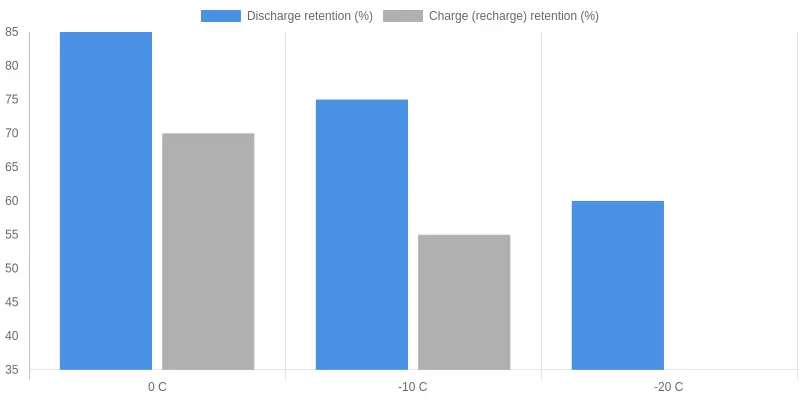
At 0 C, many cells still deliver roughly 85 to 90 percent of rated discharge capacity. At -10 C, that figure typically sits near 70 to 80 percent, and at -20 C it often narrows to about 50 to 65 percent. These are planning approximations taken from published ranges, not guarantees.
Charge And Discharge Behave Differently
Discharge is the gentler case. Charging is where subzero operation gets sharp: reported charge acceptance can fall to roughly 60 to 70 percent at -10 C and below 50 percent at -20 C. That is why cold packs are frequently restricted, conditioned, or heated before charging begins.
Those values vary widely by cell chemistry, electrolyte formulation, cathode blend, and pack design, including heater and thermal-management choices. An electric loader on a winter yard therefore loses range and duty cycle before any load is applied.
One caveat: most published numbers come from single cells in climate chambers. A sealed pack adds BMS cut-offs, contactor losses, and accessory draw that can widen the shortfall. Treat these figures as planning ranges and check them against your own telemetry, the way fleet managers already do when they plan for severe winter conditions.
Sources: peer-reviewed cold-climate battery studies, national laboratory reports, and cell-maker datasheets.
Battery Capacity Retention vs Ambient Temperature
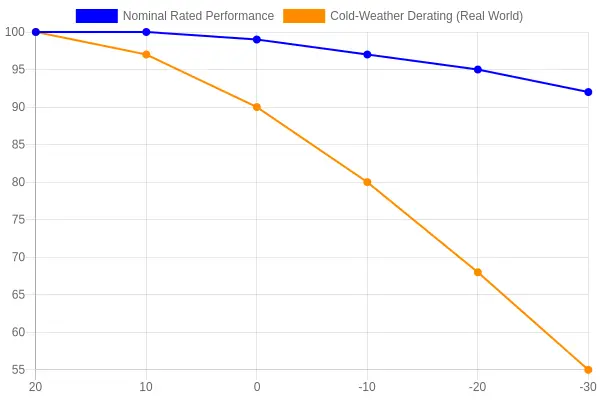
The chart below plots usable battery capacity retention (y-axis, percent) against ambient temperature (x-axis, from +20°C down to -30°C) for a representative electric loader battery pack. Two lines contrast the factory “nominal rated” figures most spec sheets quote against the real-world cold-weather derating operators actually see on a subzero site.
Reading the chart
At mild temperatures the two lines sit almost on top of each other, which is exactly why cold-weather shortfalls catch crews off guard. The gap only becomes obvious once the thermometer drops below freezing:
| Ambient Temp | Nominal Rated | Cold-Weather Derating |
|---|---|---|
| +20 C | 100% | 100% |
| +10 C | 100% | 97% |
| 0 C | 99% | 90% |
| -10 C | 97% | 80% |
| -20 C | 95% | 68% |
| -30 C | 92% | 55% |
Chart configuration
- Chart type: line
- X-axis title: Ambient Temperature (C) – labels: 20, 10, 0, -10, -20, -30
- Y-axis title: Usable Capacity Retention (%) – range 40 to 100
- Dataset 1 – “Nominal Rated Performance”: 100, 100, 99, 97, 95, 92
- Dataset 2 – “Cold-Weather Derating (Real World)”: [100, 97, 90, 80, 68, 55] (dark orange)
The takeaway for fleet planning: a pack rated at 100% loses about a third of its usable capacity by -20°C and nearly half by -30°C. That lost capacity translates directly into shorter shifts, more mid-day charging stops, and reduced push force when you need it most. Budgeting run time off the nominal number is one of the most common – and costly – cold-weather planning mistakes. Operators weighing diesel versus electric options can also review broader municipal fleet truck guidance to align equipment choices with seasonal duty cycles.
What Operators Underestimate
Fleets usually build their expectations from mild-weather operation, and a subzero site behaves differently. Most of the surprises sit in the gap between lab numbers and real shifts.
- Charging slows down. Below freezing, derating limits how fast a pack accepts energy. A loader that recharges briskly indoors can take far longer at an unheated staging area.
- Charge sessions run long. Even with chargers free, longer sessions and more dwell time squeeze the window available for opportunity charging between tasks.
- Power fades under heavy lifts. Lifting dense loads repeatedly draws high current, and sustained demand can trigger further thermal limits that quietly trim torque just when operators need full hydraulic response.
- Range estimates stop holding. Predictions built on warm-weather testing no longer apply, so managers cannot say how many working hours an electric loader will deliver before a top-up is required.
- The losses compound. Each factor looks minor on its own, but reduced acceptance, longer sessions, faded power, and shrinking range stack up over eight hours and cut effective runtime by more than any single number suggests.
For teams focused on maximizing fleet efficiency, the point is to plan for cumulative, cold-condition behavior rather than best-case figures.
Fleet Planning and Operational Impacts
Derating reshapes the math behind every fleet decision. Less usable capacity means less work per charge, so duty-cycle budgeting has to move from nameplate runtime to realistic cold-weather output. Planners should model achievable amp-hours at the lowest expected ambient temperature and set daily task targets against that figure, not mild-weather benchmarks. Spare-unit ratios need the same revision: if one electric loader does roughly 20-30% less work per shift, matching existing coverage usually means adding a unit or holding a dedicated backup for peak periods. Coordinating these purchases through fleet procurement planning keeps costs predictable.
Shift scheduling and charging-infrastructure design absorb the same pressure. Longer charge windows and shorter run windows compress productive hours, pushing many subzero sites toward staggered shifts or battery-swap routines. Charging bays should be sized for slower cold-charge acceptance, and heated or insulated enclosures cut wasted downtime while protecting pack health. Treat charging uptime as a first-class planning constraint, not an afterthought.
- Actionable takeaway: budget duty cycles on cold-weather output, add roughly one spare electric loader per working group, stagger shifts around longer charge windows, and design heated charging bays so subzero sites stay productive.
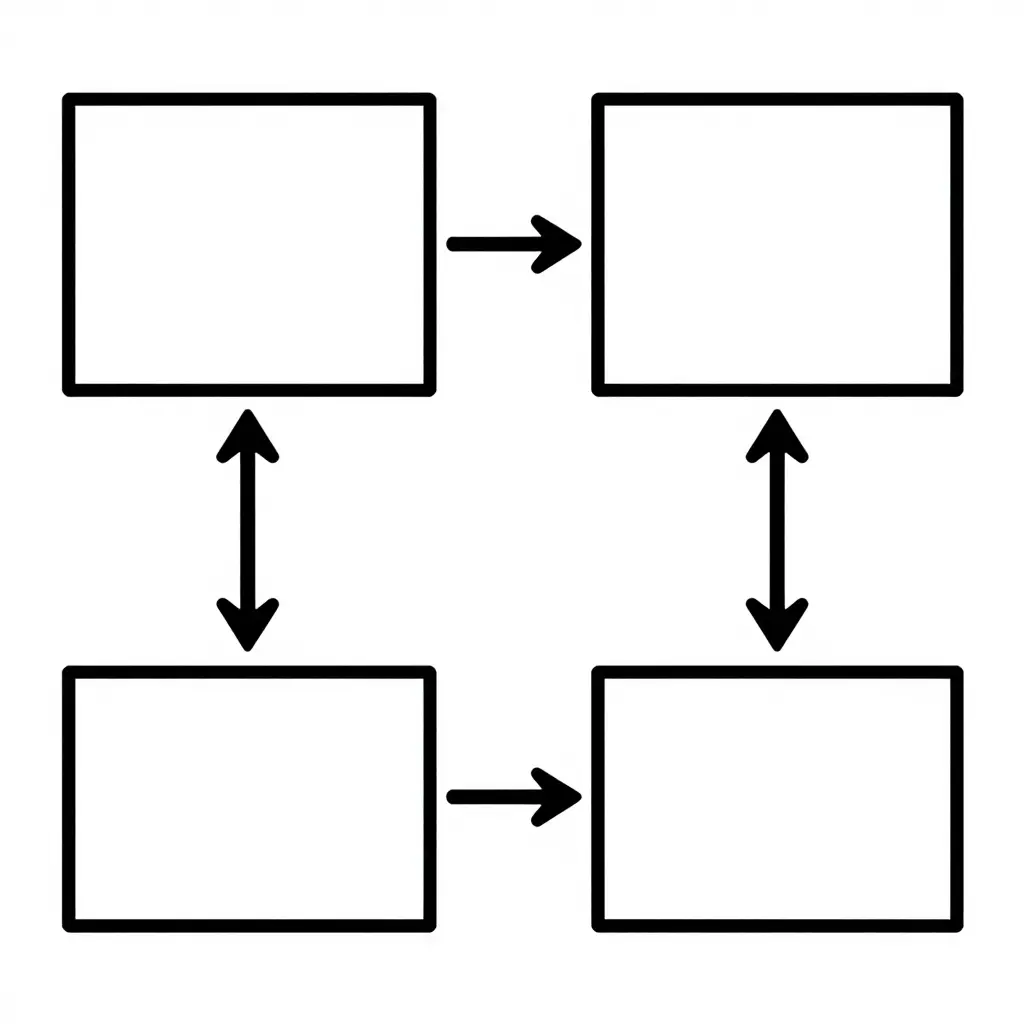
A simple four-step flow: precondition/preheat pack -> charge at limited current -> allow equalization -> return to duty. Follow the arrows left to right to keep the pack warm and balanced before pushing the loader back into service.
FAQ
Winter raises practical questions about range, charging, and pack health. These are the ones operators and logistics managers raise most often.
Why does an electric loader lose runtime in the cold?
Cold temperatures slow the chemical reactions inside lithium-ion cells, reducing usable capacity and raising internal resistance. This effect, known as battery thermal derating, can trim runtime on electric loaders by 20 to 40 percent at subzero ambient temperatures. The pack is not empty; the battery management system simply limits discharge to protect the cells.
Does preheating really help?
Yes. Warming the pack into its optimal operating window before a shift restores much of the lost capacity and reduces strain on the cells. Preheating is most effective while the loader is plugged in, because grid power rather than stored energy drives the heater. Skipping this step is one of the most common cold-weather oversights.
Which chemistry tolerates subzero best?
Lithium titanate oxide (LTO) cells handle cold conditions best, keeping usable charge acceptance and high-current output at temperatures where other chemistries have already derated. Nickel-based cells such as NMC sit in the middle. Lithium iron phosphate (LFP) is often the cheaper choice, but it loses usable capacity earlier in the cold and in most packs cannot be charged below freezing without heating first.
How should a fleet adjust for winter?
Shorter, staggered duty cycles and indoor or heated parking reduce daily derating losses. Fleets can also schedule charging around the warmest part of the day and monitor state of charge more closely. Reviewing fleet efficiency strategies further protects winter productivity.
Can fast charging be used at subzero temperatures?
Fast charging is possible below freezing, but only after the pack has been warmed to a safe range. Charging a cold battery at high current causes lithium plating, which permanently reduces capacity and can damage cells. Most systems therefore taper charge rates automatically at subzero temperatures.
Conclusion: Battery Thermal Derating Is a Variable You Can Manage
Battery thermal derating in electric loaders is not a surprise waiting on the first cold morning. It is a predictable, measurable variable that responds to planning. Operators who treat it as a known constraint keep their fleets moving through subzero shifts. Addressed early, derating becomes a line item in the operating plan rather than a mid-shift failure.
Three things matter most:
- Measure performance. Track real capacity and runtime loss at your site’s actual temperatures instead of relying on mild-weather specs.
- Choose the right thermal strategy. Match pack heating, insulation, and charging routines to how your electric loaders are used each day.
- Plan the fleet for winter. Build derated range and charging time into schedules, and lock in winter fleet readiness planning before the season starts.
As battery thermal management continues to advance, electrified equipment fleets will likely close much of the remaining cold-weather performance gap.