
What a Mislabeled Vacuum Pump Actually Means
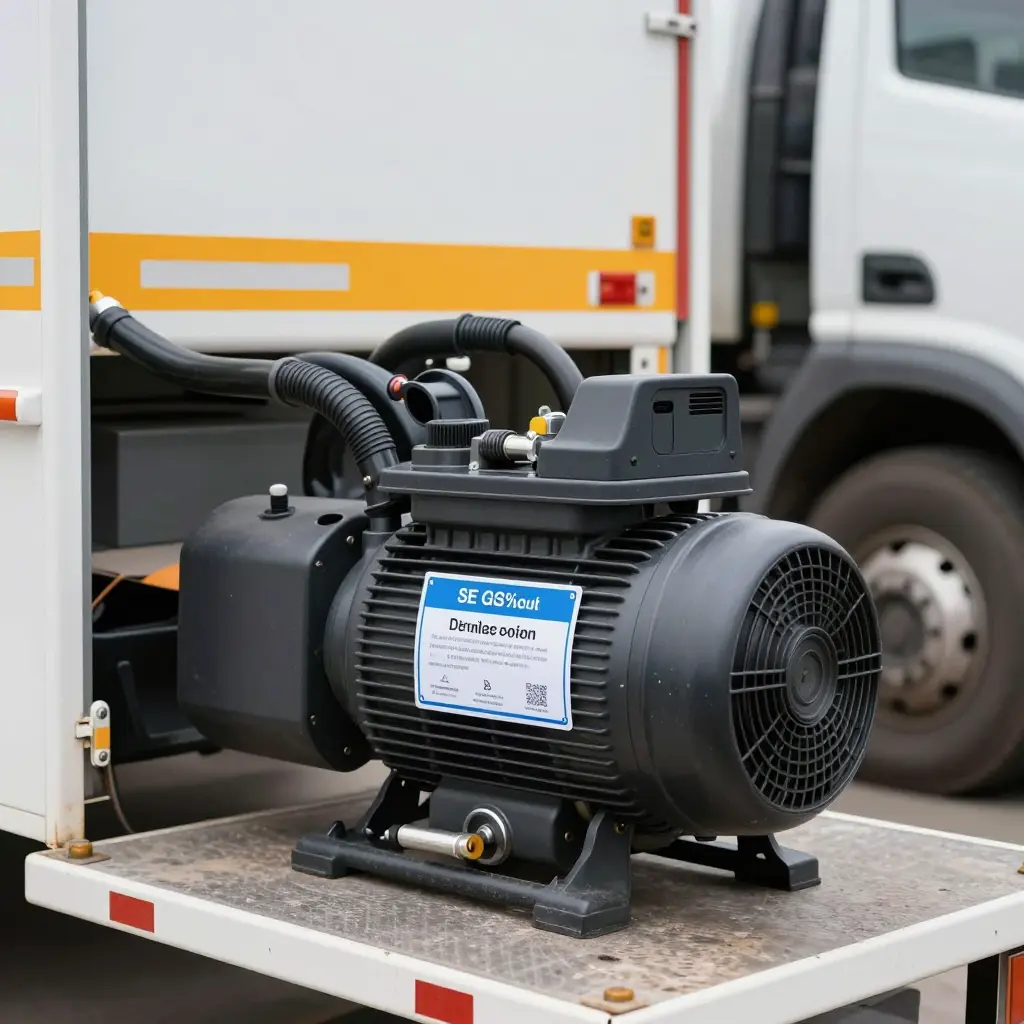
A mislabeled vacuum pump on a sewer cleaner truck is a nameplate figure, whether it is stated as airflow in CFM or m³/min or as vacuum level in inHg or mbar, that the installed hardware cannot support. Three physical facts decide whether that number is real: how much air the pump displaces per revolution, what drive ratio sits between the chassis engine or PTO and the pump shaft, and what the assembled machine delivers when someone runs it against a gauge. Overstate any one of the three and the label describes a pump the buyer will never receive. The gap usually stays invisible on a spec sheet, because the claimed figure and the pump model number are printed side by side in the same font.
The buyers exposed to this are easy to name. Municipal wastewater fleet managers specifying jetting and vacuum capacity for a ten-year service life; septic and sewer cleaning contractors whose crews are paid by the completed job; dealers and distributors who absorb the warranty and resale risk; procurement teams sourcing from Chinese sewer cleaner truck manufacturers on documentation alone. Each group pays for the number on the plate and then lives with the machine bolted behind it. That is why qualifying sewer cleaner truck suppliers on evidence rather than brochures changes the risk profile of a purchase.
For all four, the pre-shipment factory test is where the risk gets settled, because it turns paper claims into measured data before payment and before shipping. A witnessed flow test at the jetting nozzle, a vacuum hold test on a sealed tank, and a pump-speed calculation checked against the PTO ratio give the advertised performance of a sewer jetting truck a baseline you can defend. What the pump is labeled to do matters far less than what the flow meter, the vacuum gauge, and the stopwatch record while the buyer or an independent inspector is standing there.
Pump Architectures and What Each Nameplate Value Should Mean
A vacuum pump is one of the easiest components to overstate on paper, because most buyers never see it running at working vacuum before the truck ships. Arguing about the number on the plate goes better once you know which architecture you are looking at, since the physics of each one sets a hard ceiling on what any nameplate can honestly claim.
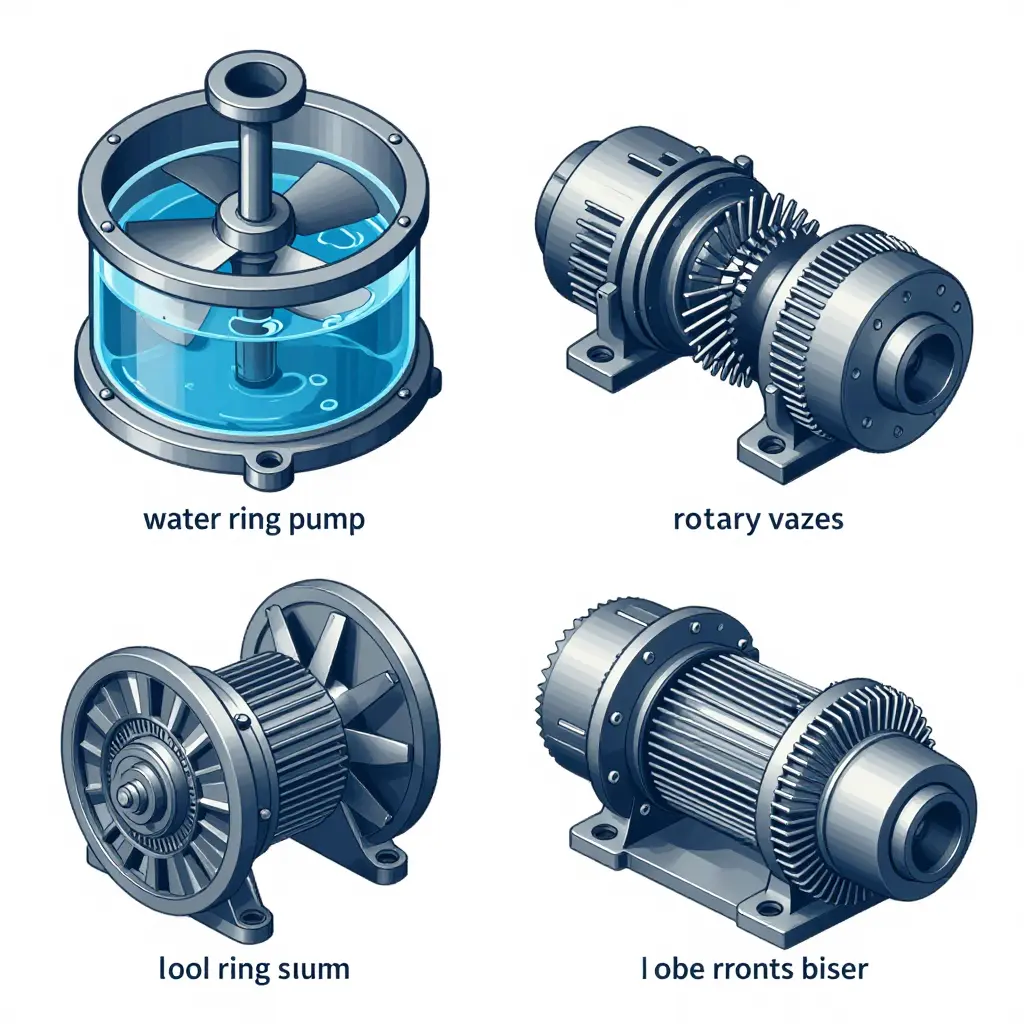
Liquid ring (water ring) pumps
An eccentric rotor with fixed, forward-curved blades turns inside a cylindrical casing that is partly filled with service water. Centrifugal force throws the water outward into a rotating ring, leaving a crescent-shaped void between the rotor hub and the ring. As the rotor turns, the crescent expands and draws air in through the inlet port, then contracts and pushes air and water vapor out the discharge. Displacement per revolution is the crescent volume; multiplied by rotor speed, it gives the flow the pump should move.
On the nameplate and datasheet, expect rated airflow (cubic feet per minute, CFM), ultimate vacuum (inches of mercury, inHg, with single-stage water-ring pumps realistically topping out near 25 inHg because the vapor pressure of warm seal water rises as the water heats), seal water flow rate, power draw (kilowatts, kW), drive speed (revolutions per minute, RPM), and inlet connection size (inches of nominal bore).
Rotary vane pumps
Sliding vanes sit in radial slots in an eccentric rotor and sweep a crescent chamber. Each revolution traps and displaces a fixed volume, so displacement per revolution (cubic feet per revolution, ft³/rev) is the honest measure of size. Ultimate vacuum is typically 26-29 inHg, which is why vane pumps are common on high-vacuum sewer work.
Nameplate items: displacement per revolution, rated airflow at a stated speed, ultimate vacuum, kW, RPM, inlet bore, and, critically, the PTO ratio (power take-off speed relative to engine speed) at which the rated RPM is reached.
Rotary lobe (Roots) blowers with a jetting pump
Two figure-eight lobes counter-rotate inside a casing with only running clearances, so there is no internal compression and airflow tracks speed almost directly. These usually pair with a high-pressure jetting pump, moving air for the tank or for air-assisted rodding. Because nothing compresses internally, single-stage units top out around 15-20 inHg.
Nameplate items: rated airflow at a defined speed, maximum vacuum and pressure, displacement per revolution (fixed by lobe geometry), kW, drive RPM, and inlet bore.
| Parameter | Unit | What it must mean |
|---|---|---|
| Rated airflow | CFM (or m³/h) | Must be tied to a stated vacuum, not free-air open flow |
| Ultimate vacuum | inHg (or mbar) | Blank-off maximum, achievable with the fitted seal arrangement |
| Power draw | kW | Absorbed shaft power at the rated duty point, not motor nameplate |
| Drive RPM | RPM | Pump shaft speed, matched to a real PTO and pulley ratio |
| PTO ratio | ratio (:1) | Gearbox output speed relative to engine speed |
| Displacement per revolution | ft³/rev (or L/rev) | Geometric swept volume per shaft turn |
| Inlet connection | in (or mm) | Nominal bore of the suction flange at the pump |
How a pump gets effectively mislabeled
An oversized nameplate on a smaller pump body. Plates are cheap; castings are not. Measure the pump body length and rotor chamber diameter and compare them against the displacement figure. A casting that cannot contain the stated swept volume is the giveaway.
Rated airflow quoted at open flow. Free-air figures are never reached at working vacuum. Sewer cleaning vacuum runs around 12-24 inHg, and at 20 inHg a vane pump loses a large share of its open-flow number.
RPM claims that require a drive ratio the truck does not have. Do the arithmetic yourself: engine speed x PTO ratio x pulley ratio = pump RPM. If the fitted PTO or pulleys cannot produce the quoted speed, the rated airflow is fiction.
A vane or lobe count that contradicts the stated displacement. Count the vanes through the inspection port, measure rotor diameter and width, and run the numbers. If they do not return the displacement on the plate, the plate belongs to a different pump.
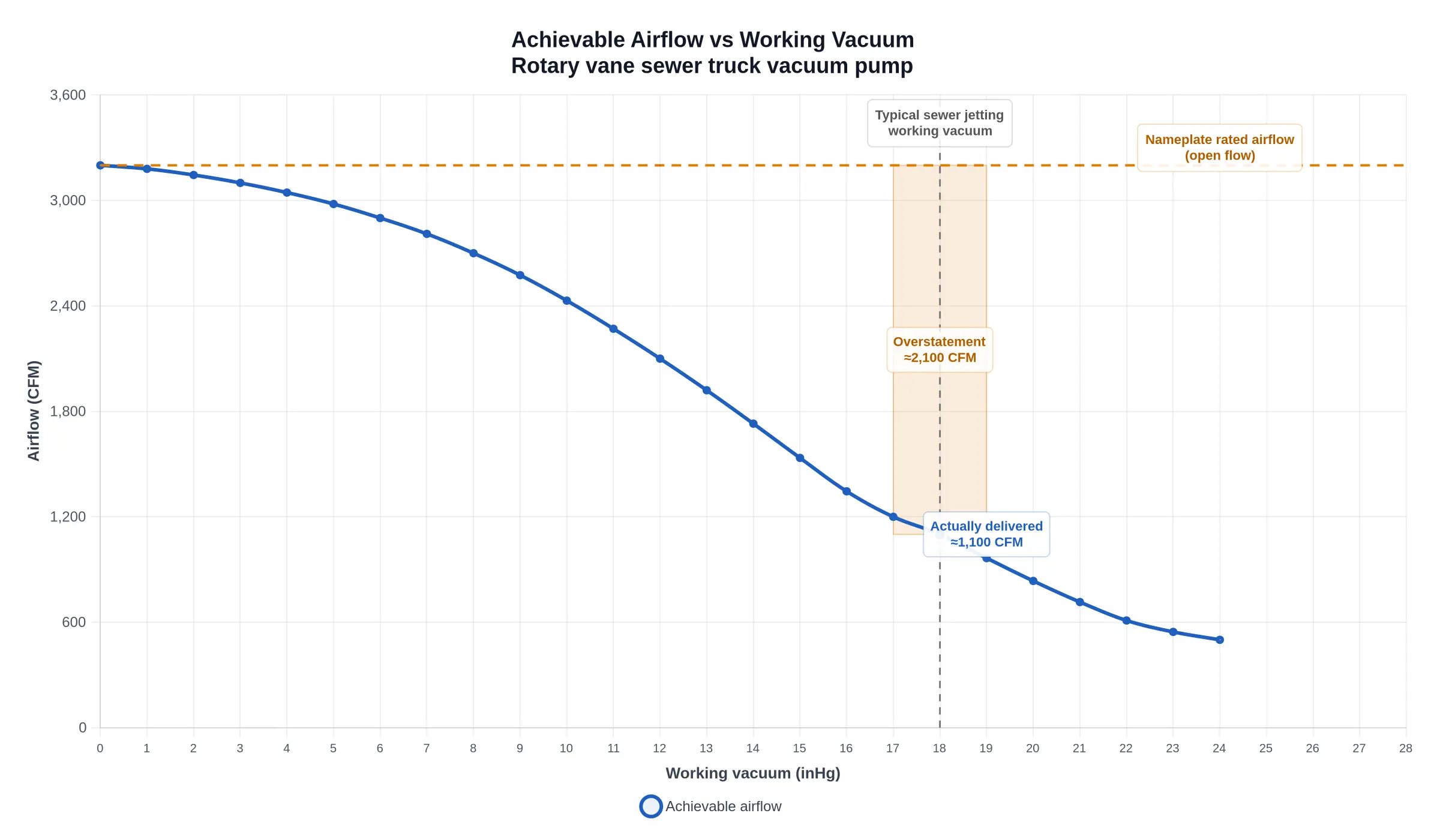
Ask for the full performance curve rather than a single point, then compare it with how qualified suppliers document sewer cleaner vacuum performance at the pre-shipment factory test. A sewer jetting truck vacuum pump that is honestly rated comes with a curve that falls off, and with a supplier willing to explain where and why it falls.
Pump Technology vs. Nameplate Claims: What You Can Actually Verify
Nameplate ratings are usually written by the seller and copied from a spec sheet, not measured on the dock by anyone independent. The table below pairs each pump architecture with the parameter you can measure on site, which is the difference between due diligence and brochure reading when you are vetting qualified suppliers of municipal sewer cleaner trucks.
| Pump technology | Typical nameplate claim | Field-verifiable parameter | Test instrument | Common mislabeling pattern |
|---|---|---|---|---|
| Liquid ring vacuum pump, PTO direct drive | “9,000 CFM at 25 inHg” | Airflow measured at rated working vacuum | Orifice plate plus calibrated manometer | CFM quoted at open inlet, not working vacuum |
| Liquid ring pump, hydraulic drive | “Hydraulic drive, 100% continuous duty” | Oil flow, system pressure, case drain temperature | Hydraulic flow meter and pressure gauge set | Intermittent-duty drive labeled as continuous duty |
| Rotary vane pump, belt driven | “1,500 CFM, 28 inHg ultimate” | Actual shaft RPM, belt slip, sheave ratio | Optical tachometer and belt tension gauge | Free-air displacement reported as delivered CFM |
| Rotary vane pump with VFD control | “Variable speed, constant vacuum” | Vacuum held during a stepped load change | Vacuum data logger and clamp meter | VFD badge from smaller pump frame reused |
| Rotary lobe blower (Roots), gear driven | “3,000 CFM at 15 psi” | Airflow at rated back pressure and blower RPM | Pitot tube, manometer, contact tachometer | Rating taken at zero back pressure, slip ignored |
| Rotary lobe blower, hydrostatic drive | “Hydrostatic drive, 2,000 CFM” | Motor displacement versus measured shaft speed | Hydraulic flow meter and proximity tachometer | Motor displacement overstated only on paper |
| Vacuum/pressure relief valve and control panel | “Automatic vacuum regulation and relief” | Relief cracking pressure and set-point response time | Manometer, vacuum gauge, stopwatch | Manual ball valve fitted behind an “automatic” panel |
Start with the field-verifiable parameter. A nameplate number with no matching instrument reading attached is an unverified claim, however authoritative it looks.
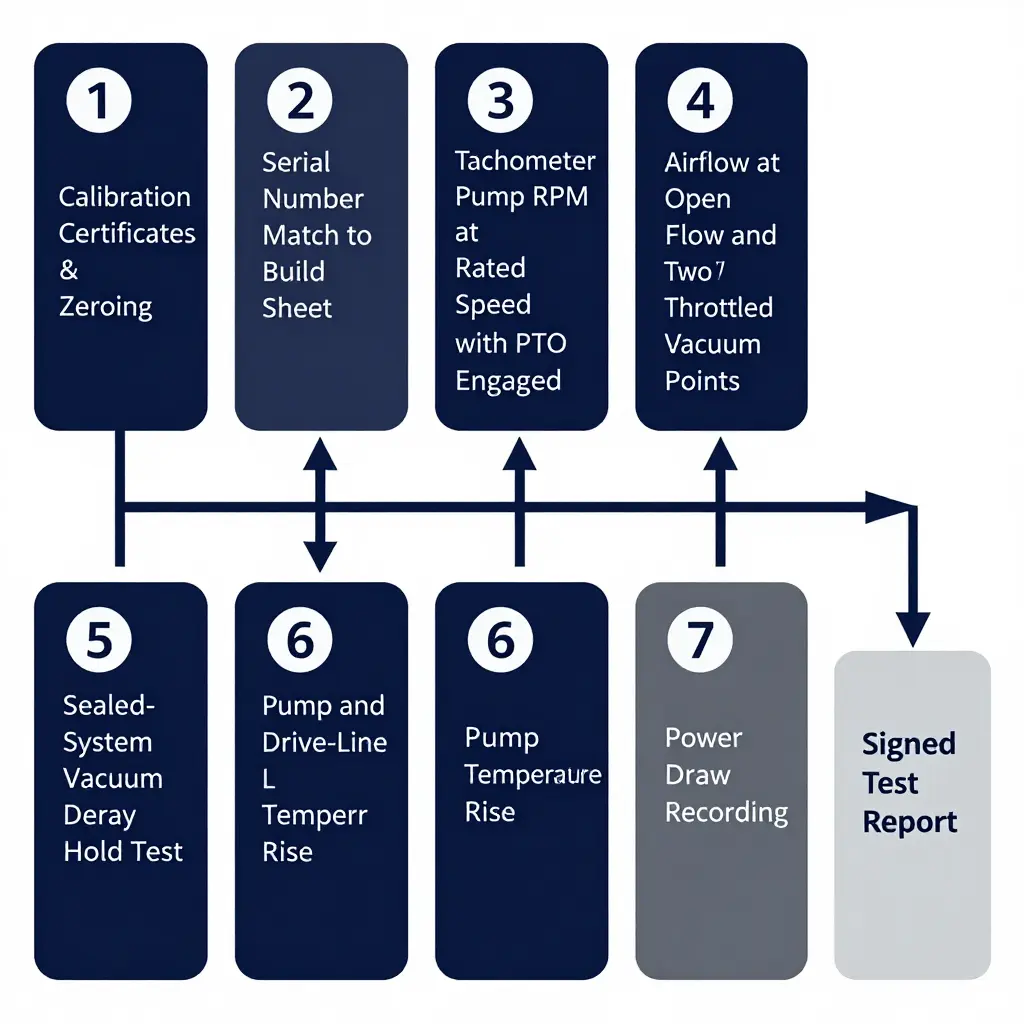
The pump on the build sheet and the pump on the chassis are not always the same unit. A structured factory acceptance test in the supplier’s bay, before the truck is loaded for export, is the cheapest place to catch the difference. A competent inspector works through the steps below in this order, with a pass or fail signal at each one.
1. Instrument Calibration Certificates and Zeroing
What the inspector checks
- Calibration certificates for the vacuum gauge, airflow meter (anemometer or pitot tube), tachometer, thermocouple or infrared thermometer, and clamp meter.
- Certificate dates inside the validity window and traceability to a national standard.
- Gauge zeroed with the pump stationary and the tank at atmospheric pressure.
Pass vs. discrepancy
Full current certificates plus a gauge reading zero with the inlet open is a pass. An expired certificate, a missing traceability chain, or a needle resting off zero before the run voids the whole test, not just one line of it.
2. Serial Numbers Against the Build Sheet
What the inspector checks
- Pump nameplate serial and model.
- Blower (roots-type exhauster) serial and model.
- PTO and drive-line component tags where fitted.
- Names, models, and displacements on the purchase order and approved build sheet.
Pass vs. discrepancy
The plate and the paperwork should match character for character, photographed before the test begins. A model number one tier below the contract, a re-stamped or missing plate, or a blower serial that traces to a different order counts as a discrepancy. Photograph the plate against a readable background; that image outlasts any verbal assurance.
3. Tachometer Pump RPM at Rated Engine Speed, PTO Engaged
What the inspector checks
Bring the engine to rated speed, engage the PTO, and measure shaft speed directly with an optical or contact tachometer. The dashboard gauge is not a measurement.
Pass vs. discrepancy
Measured pump RPM should sit within a stated tolerance, usually a few percent, of what the engine speed and PTO gearing predict. A pump turning slower than the ratio points to a smaller pump, a mismatched gearbox, or a slipping drive. One rated at 1,000 RPM that only reaches 850 cannot deliver its published airflow, however healthy the rest of the system is.
4. Airflow at Open Flow and Two Throttled Vacuum Points
What the inspector checks
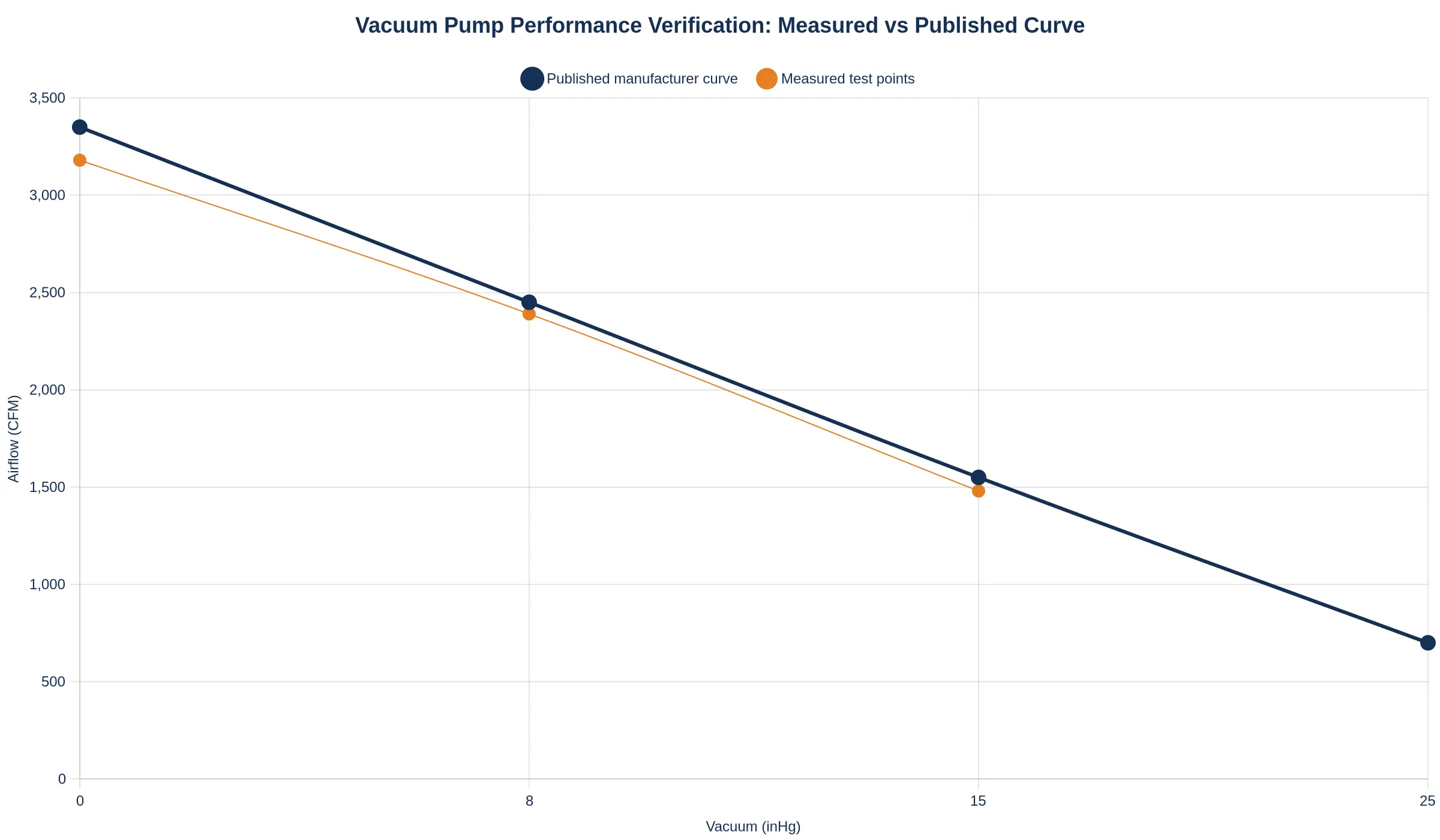
Airflow is measured with the inlet fully open, then at two throttled vacuum points, typically 8 inHg and 15 inHg, with readings taken at stable conditions and the tank inlet conditions recorded.
Pass vs. discrepancy
A pass is three plotted points that track the published curve within the agreed tolerance across the whole range, not just at the open-flow end. A discrepancy is a curve that sags increasingly at higher vacuum, or an open-flow figure that lands neatly on the rating of the next smaller model. Airflow matching the smaller unit while the nameplate reads larger is the classic signature of a mislabeled pump, and it is why vacuum pump performance verification has to be plotted rather than spot-checked.
5. Sealed-System Vacuum Decay (Hold) Test
What the inspector checks
The inlet is closed, the pump pulled to its specified hold vacuum, then shut down. The gauge is watched for a fixed interval, commonly five to ten minutes, and the decay rate logged in inHg per minute with the starting vacuum noted.
Pass vs. discrepancy
A steady gauge, or a decay rate inside the allowable limit, confirms that tank, piping, and pump seals hold. A fast drop can mean leaking tank gaskets, a cracked hose, or internal pump clearances that were never set. Log the decay curve, not just the final number; its shape separates a small seal leak from a large one.
6. Pump and Drive-Line Temperature Rise
What the inspector checks
Bearing housing, pump casing, gearbox, and drive-line temperatures are recorded at start, during the run, and at shutdown.
Pass vs. discrepancy
The rise should plateau below the manufacturer’s limit. A continuous climb with no plateau, or a drive line running noticeably hotter than the pump, suggests misalignment or a shaft undersized for the load.
7. Power Draw Recording
What the inspector checks
Current or hydraulic power draw under load, compared against the pump’s expected absorption at the tested speed and vacuum.
Pass vs. discrepancy
Draw consistent with the pump model and duty point is what you are looking for. Draw that matches a smaller pump, or a spike that hints at binding internals, is a discrepancy; cross-check it against Steps 3 and 4.
The Signed Test Report
Every reading belongs on one test report carrying instrument serial numbers, ambient conditions, and the signatures of the inspector and the supplier’s representative. A report without instrument serials cannot be defended six months later, and a supplier who resists signing one is telling you something. Buyers comparing candidates can review how to screen qualified suppliers of municipal sewer cleaner trucks for the documentation standards worth insisting on.
| Recorded item | Detail required |
|---|---|
| Certificate references | Document number, valid-until date, instrument serial |
| Nameplate data | Pump and blower model, serial, photograph reference |
| Pump speed | Engine RPM, PTO ratio, measured pump RPM |
| Airflow points | CFM at 0, 8, and 15 inHg with inlet conditions |
| Hold test | Start vacuum, interval, decay rate per minute |
| Temperatures | Start, peak, shutdown readings per component |
| Power draw | Amps or hydraulic kW at the tested duty point |
The record is the inspection. Get the signed report, the photographs, and the plotted curve before the balance payment clears.
Test result summary
A clean run shows matched serials, correct pump speed, three airflow points on the curve, a slow hold decay, stable temperatures, and power draw that fits the model. Anything else is a discrepancy to settle in the factory, not in your yard.
Nameplate CFM vs. Measured CFM: Where the Numbers Actually Land
Supplier conversations usually start with pump specs, and the specs are the right place to test them. A blower or vacuum pump nameplate reflects a design point measured under favorable lab conditions: a set inlet temperature, a clean filter, often the manufacturer’s own test stand. Once that pump sits behind a hose run, a silencer, a cyclone, a boom reel, and a partially loaded tank, the airflow reaching the nozzle is a different number. The chart below shows what our inspectors see when they clamp a calibrated flow meter onto the suction line and hold the system at working vacuum instead of free air.
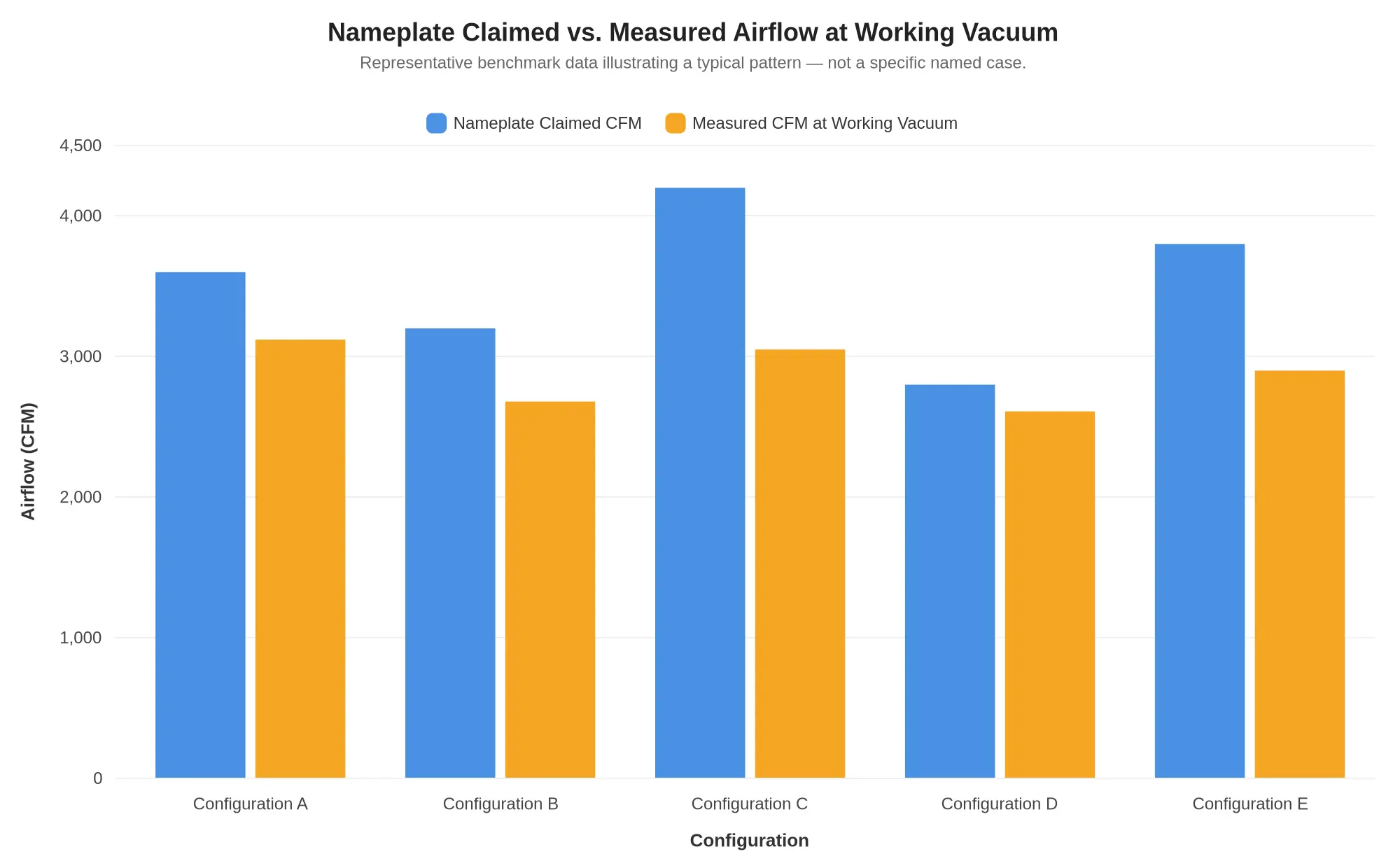
Every configuration in the chart measures below its claimed figure, with the shortfall running from about 7 percent on the best-sorted unit to more than 27 percent on the worst performer. That is the spread you want to identify before a single dollar moves. At the nozzle the gap shows up as slower lift velocity in the line, a lag when the operator opens the boom valve, and a truck that quietly takes longer on every manhole because the suction cannot move water and debris as fast as the paperwork promised.
Illustrative benchmark data representing a typical measured pattern across anonymized configurations, not a named product or specific case.
Because the label and the meter disagree this consistently, treat the claimed number as a hypothesis to verify rather than a specification to file. Buyers who want the full inspection sequence, free-air versus working-vacuum checks, gauge calibration, seal integrity, and the documentation to demand at a factory witness test, can review how to screen qualified suppliers for municipal sewer cleaner trucks before committing to a build slot.
Red Flags During the Pre-Shipment Factory Test
The factory test is where the paperwork finally meets the iron, and it is the last clean moment to walk away before the balance payment leaves your account. A supplier who genuinely built the pump on the datasheet will run a closed-loop test without drama and hand over the numbers. The ten items below are the practical shortlist of sewer cleaner truck supplier red flags, drawn from our vetting checklist for qualified municipal sewer cleaner truck suppliers.
-
Refusal to run a sealed-system hold test. You ask the supplier to close every valve, pull the system to maximum vacuum, shut the pump down and hold for ten to fifteen minutes. A refusal, a shortened hold, or a gauge that visibly bleeds while the inspector watches usually points to tank manway seals, valve seats or pump clearances that will not survive real service duty.
-
Pump curve supplied without serial-number traceability. A legitimate blower or vacuum pump curve carries a model, a serial number and a test date that match the unit bolted to the chassis. A generic photocopy with no serial, or a plate number the supplier cannot find in its own build file, means you were sold a brochure claim rather than a tested machine.
-
Resistance to independent instrument use. An inspector who brings a calibrated vacuum gauge and a handheld tachometer should be allowed to clamp or tee them in. Stalling, offering “factory gauges only”, or arguing that outside instruments void warranty is an attempt to control the measurement you paid to verify.
-
A rating quoted only at open flow. Open-flow CFM is measured with essentially nothing attached and flatters every pump. Ask for airflow and vacuum at realistic working points such as 15 inHg and 18 inHg, then compare those figures against the curve and the installed blower.
-
A drive ratio documented differently from the installed pulley set. Measure the PTO, jackshaft and blower pulley diameters and calculate the actual ratio. If the datasheet claims the blower turns at roughly 1,000 rpm but the pulleys installed on the chassis multiply it to 1,350, the performance you were quoted belongs to a different machine.
-
Test plumbing that bypasses the pump or the tank. Watch where the hoses actually run. A bench loop teed straight from the blower outlet to the gauge, with the tank and the sewer hose reel left out of the circuit, verifies the blower in isolation and tells you nothing about the assembled truck.
-
Mismatched or missing nameplates and casting numbers. Photograph the pump plate, blower housing and tank data tag and check them against the purchase order. Fresh paint over a plate, a plate riveted in the wrong place, or a casting number that does not match the quoted model suggests a substitution made after the contract was signed.
-
Vacuum and pressure read at the wrong port. Readings taken upstream of a clogged filter, on the wrong side of a closed valve, or from the supplier’s permanently plumbed dash gauge can read several inches high. Insist that the test point sits where the sewer hose connects.
-
Reluctance to demonstrate water-ring or priming behavior live. A vacuum pump that primes slowly, cavitates or will not recover after a slug of water is a maintenance problem disguised as a specification. Ask for a cold start, a full prime and a recovery run, back to back.
-
Refusal to let you record the run. Video is the only evidence that survives the trip home and the arrival inspection. A supplier who will not allow filming of the test, or who films only the dashboard, is managing perception rather than quality.
How to Escalate a Red Flag Before Shipment
Do not argue the point on the factory floor. Put it in writing the same day, hold the balance payment until it is resolved, and request a re-test with either your own witness on site or a scheduled live video call from the test bay. Be specific about the test you want: sealed hold duration, test points, instrument type, pulley diameters measured on camera. Require a signed test report carrying the pump serial number, the gauge readings and the date. If the supplier stalls again, escalate from the agent to factory management and bring in a third-party inspector. A supplier who cannot pass a documented re-test has told you everything you need to know before the container is loaded.
The Six-Step Verification Sequence at a Glance
Before a sewer cleaner truck leaves the factory floor, its vacuum pump should be proven on paper and on the test stand. The diagram folds the steps above into six gates in a single left-to-right flow: cross-check the nameplate and serial against the order, confirm instrument calibration, measure RPM and drive ratio, run the airflow and vacuum curve, hold a sealed-system vacuum decay test, and issue a signed test report.
Treat it as a gate sequence rather than a menu. Each step earns the next one, and a failure at any square stops the flow, which is how a mislabeled pump gets caught before it crosses an ocean.

Use the summary when briefing third-party inspectors, or attach it to a purchase-order specification. Buyers still narrowing down vendors can pair it with our guide to qualified suppliers of municipal sewer cleaner trucks as a screening checklist.
Documentation and Traceability: The Paper Trail Has to Match the Iron
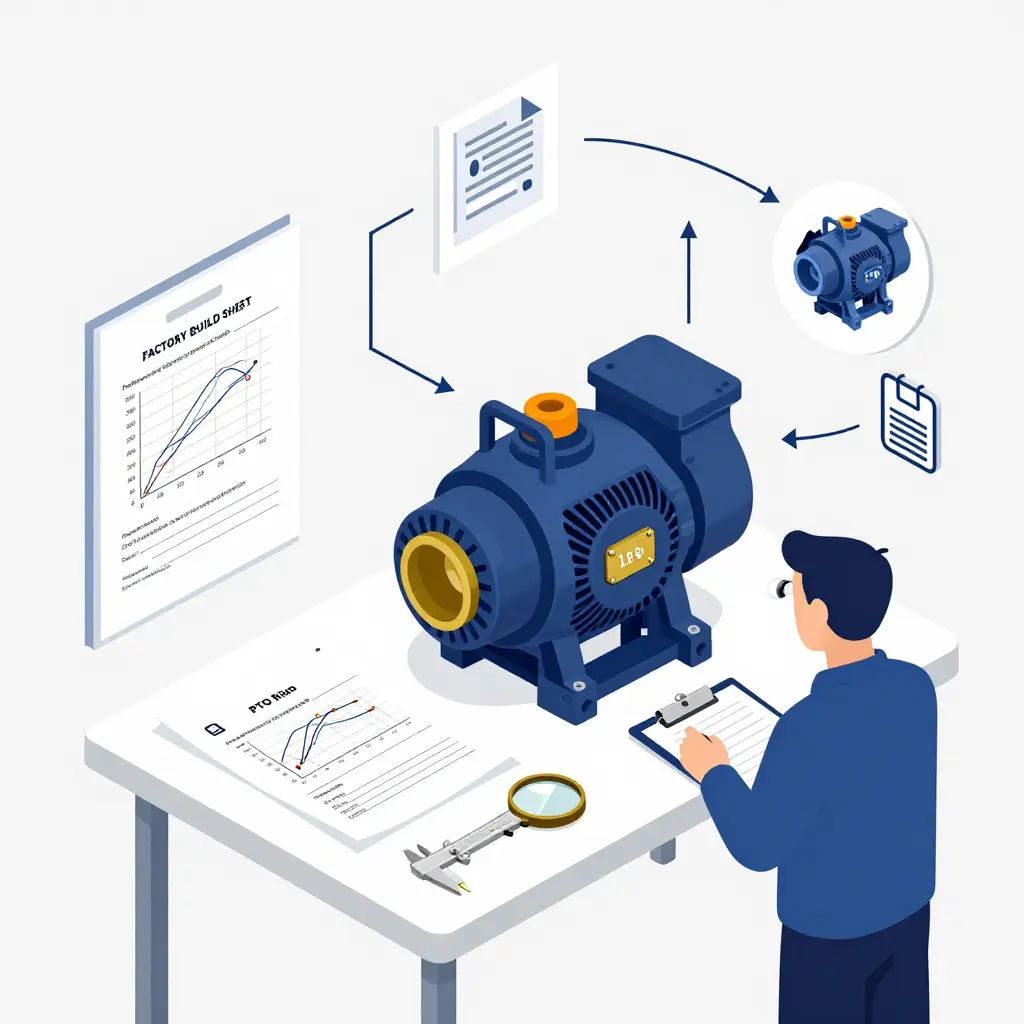
A vacuum pump that performs well for twenty minutes on a test pad tells you what the machine can do today. The paperwork tells you whether that machine is the one you bought. Strong sewer cleaner truck documentation is the only way to prove that the pump, blower and drive-line in the chassis are the components that generated the test numbers on the certificate in front of you, so check the packet before you trust the dials.
1. Pump and blower serial number traceability to the factory build sheet
Every Roots blower and liquid-ring vacuum pump leaves the factory with a serial number stamped or riveted on the housing. That number must appear on the manufacturer’s build sheet, which records the model, rotor size, gear ratio, materials, seal arrangement and the date of assembly. Ask for the build sheet and trace it in three places: the physical plate on the unit, the plate or nameplate photo taken at the supplier’s yard, and the supplier’s own invoice line item. Pump serial number traceability breaks the moment any of those three disagree, or when the plate looks freshly stamped next to old casting flash.
2. The manufacturer’s published performance curve, with the tested RPM stated
A curve without an RPM reference is decoration. Vacuum pumps are positive-displacement machines, so capacity scales with speed: a blower rated at 1,800 rpm will not deliver the same cfm at 1,250 rpm, and a jetting pump curve at half speed tells a very different story about pressure and flow. Demand the OEM curve that matches the exact model on the build sheet, plus a written statement of the rpm at which the factory test was run and the pulley or gear ratio that produced it. If the test rpm is missing, or if the numbers on the test sheet sit above the curve with no explanation, treat the data as unverified.
3. Calibration certificates for gauges and flow meter
Test instruments drift. A vacuum gauge reading 2 inHg low, or a flow meter reading 3 percent high, will make an average pump look excellent and an excellent pump look average. Require current calibration certificates, traceable to a national metrology institute, for the vacuum gauge, pressure gauge, tachometer and flow meter used during the run. Check that each certificate’s serial number matches the instrument on the test bench in the photos or video, and that the calibration date precedes the test date. An expired certificate does not automatically mean the pump is bad, but it does leave you unable to settle a warranty or performance dispute with the result.
4. Drive-line and PTO ratio documentation
Many field failures blamed on the pump originate in the power take-off. Ask for the PTO model, ratio, torque rating and the driveline slip-yoke and shaft specification, plus confirmation that the PTO was engaged for the full duration of the test. Compare the documented ratio against the rpm stated on the performance sheet; if the arithmetic does not close, the test was run at a speed the truck cannot reproduce on the street.
5. Incoming inspection and material certificates for the pump body and impeller
A reputable builder keeps incoming inspection records: dimensional checks on the housing, hardness or material grade certificates for the impeller and casing, and the results of any dye-penetrant or hydrostatic check. Material certificates (mill certificates or the equivalent) should name the grade, heat number and specification. Missing inbound records usually mean the pump was bought as a finished, unbranded unit from a trading company that never saw the inside of it.
6. Third-party inspection report, if one was commissioned
If you paid for an independent inspection, the pre-shipment inspection report should be in the packet, with the inspector’s name, the date, the scope of the check, the instruments used and pass/fail results per line item. A report that lists only “visual check: OK” is a receipt, not an inspection.
The document packet at a glance
| Document | What it proves | Cross-check against |
|---|---|---|
| Factory build sheet | Identity and configuration | Serial plate on pump and blower housing |
| OEM performance curve + tested rpm | Rated capacity at a known speed | Test sheet figures and PTO ratio math |
| Calibration certificates | Instrument accuracy at test date | Instrument serial numbers in test photos |
| PTO / driveline specification | The truck can reproduce the test speed | rpm stated on the performance sheet |
| Material and incoming inspection records | Casting and impeller quality | Heat numbers, hardness results |
| Third-party inspection report | Independent verification | Inspector signature and scope |
How to spot recycled or repurposed documentation
Look at page structure as much as content. Recycled packets usually show a different font or printer on the test sheet than on the letterhead, a build sheet whose model code does not match the curve, a serial number in a different hand or over correction fluid, and dates that run backwards: a calibration performed after the test, or an inspection report dated before the pump was assembled. Photocopies of photocopies, missing page numbers, and certificates that carry a company chop but no engineer’s signature are all familiar signals. Ask for the original scan of the serial plate next to a ruler or a dated tag; a supplier with nothing to hide produces one within the hour.
Why a serial number mismatch alone justifies a hold
You do not need to prove the pump is defective to stop a shipment. A mismatch between the serial number on the unit and the number on the build sheet or test certificate severs the chain of evidence: no document describes the hardware on the trailer. That is sufficient grounds for a hold, because a warranty claim, a performance guarantee and a spare-parts order all depend on knowing what the pump is. Hold the shipment, request an explanation in writing, and re-inspect at the supplier’s cost.
None of this is exotic. It is the same discipline used when qualifying sewer cleaner truck suppliers for any municipal tender: documents first, dials second, signatures last. The supplier who can hand you a complete, internally consistent packet before you ask twice is usually the one whose test results you can trust.
Supplier Capability Pre-Audit Checklist
A pre-shipment test only proves something if the factory behind it is capable in the first place. Run this sewer cleaning truck supplier audit as a desk exercise first, and treat every unanswered item as a red flag rather than a gap to fill later.
- Pump mounting performed in-house versus outsourced. Ask directly whether the vacuum pump subframe is cut, welded, and aligned on your supplier’s own floor or farmed out to a subcontractor. A satisfactory answer names the workshop, describes the alignment fixture used, and produces a runout or alignment record within the tolerance stated in the drawing.
- Test bench availability and its instrument inventory. Request the bench layout plus the make, model, and last calibration date of the flow meter, vacuum gauge, and tachometer. You want current calibration certificates, gauges rated above the pump’s maximum vacuum, and a bench that can run the pump at rated speed under load rather than spinning it dry.
- Engineering staff who can explain the drive ratio calculation. Ask the supplier’s engineer to show how pump RPM is derived from PTO or engine speed through the pulley or gear set, and what CFM that produces at your required vacuum level. A satisfactory reply arrives in writing, with numbers that reconcile against the published pump curve.
- Spare parts and pump seal availability. Request the stocked parts list, seal kit part numbers, and current lead times for wear plates and shaft seals. A strong answer shows seals on the shelf with a lead time measured in days, cross-referenced to the exact pump model on your build sheet.
- Warranty terms on the vacuum pump specifically, not the chassis. Insist on separate written warranty language covering the pump itself, stated in months and running hours. Satisfactory coverage names the pump model, defines seal and wear-part exclusions, and is signed by the supplier rather than buried in chassis boilerplate.
- Export and after-sales support structure. Ask who prepares export documentation, who fields technical calls, and whether a service partner or technician exists in your region. The right answer is a named contact, a documented escalation path, and English-language diagnostics support that does not route through a sales inbox.
- References from comparable fleet buyers. Request two or three buyers running similar tank sizes, jetting pressures, and climates. A useful reference is reachable by phone, confirms the pump model actually delivered, and can speak to duty cycle and seal life after real service hours.
- Willingness to accept a witnessed or remotely streamed test. Ask whether you or your third-party inspector may attend, or whether the full test can be streamed live. Acceptance with gauge close-ups, on-screen timestamps, and no scripted cuts is the baseline; hesitation here usually signals something in the build is not repeatable.
- Nameplate, datasheet, and order-form consistency. Ask for a photo of the pump nameplate beside the invoice line item before scheduling anything. Model number, displacement, and rated vacuum should match character for character, which is the fastest way to catch a substitution early. Our guide to qualified suppliers of municipal sewer cleaner trucks walks through the documentation trail in more detail.
Score each answer above against the weighted criteria in the scorecard below, and shortlist only suppliers that clear the threshold on the pump-specific items.
The Weighted Vetting Scorecard: From Inspection Notes to a Go/No-Go Call
Score each line only after the supporting evidence is physically in your hands: full weight for a clear pass, zero for a fail, and no partial credit for verbal assurances. Because the weights total 100 percent, the final figure tells you whether the truck ships or the deal goes back for rework. When you widen the shortlist, our guide to qualified suppliers of municipal sewer cleaner trucks is a useful companion.
| Vetting criterion | Evidence to request | Pass threshold | Weight |
|---|---|---|---|
| Pump displacement verification | Nameplate photo, pump curve, flow-meter reading at rated RPM | Measured displacement within 3 percent of nameplate | 15% |
| Witnessed performance test | Video of jetting pressure and vacuum hold at full load | Rated vacuum and jetting pressure sustained ten minutes | 20% |
| Vacuum decay result | Recorded decay log with timestamps and gauge values | Decay under 2 inHg per minute from working vacuum | 15% |
| Serial number traceability | Pump, blower, and tank serials cross-checked against bill of lading | All serials match factory records and shipping documents | 10% |
| Calibration certificates | Dated gauge and vacuum sensor calibration certificates | Calibration dated within twelve months of shipment | 10% |
| Drive ratio confirmation | PTO ratio calculation, pulley sizes, and driveline photos | Calculated ratio matches pump manufacturer specification | 10% |
| Seal and wear-part spares | Spare parts list, seal kit photos, and pricing sheet | Critical seals in stock with quoted lead times | 10% |
| After-sales response commitment | Written warranty terms and named regional service contact | Parts response within 48 hours, service within 72 | 10% |
A total between 70 and 84 percent is not an automatic rejection. Hold the deposit, issue a written punch list with a re-test date, and require photo evidence of every correction before shipment.
Contractual Acceptance Criteria and Remedies for a Mislabeled Vacuum Pump
A supplier’s datasheet is marketing. A contract clause is evidence. If the blower on your sewer cleaner arrives 20 percent short on airflow, what decides whether you hold a claim or start a negotiation is what the sewer cleaner truck purchase contract says about performance, testing, and payment. Write that section once, correctly, and the argument is over before it starts.
Turn performance into a test point, not an adjective
“High-performance vacuum pump” is unenforceable. “3,000 CFM at 15 inHg vacuum, measured at the tank inlet, with the pump turning 1,000 rpm” is enforceable. Anchor every number to an rpm, because blower output rises and falls with speed and a supplier can hit a headline CFM at a spin your truck will never see in service. Name the measuring location (tank inlet, upstream of the silencer), state the ambient conditions, and make clear the figure is a guaranteed point rather than a free-air maximum.
Tight acceptance test criteria look like this:
| Parameter | Guaranteed value | Fail threshold | Method |
|---|---|---|---|
| Blower airflow | 3,000 CFM at 15 inHg | below 3,000 CFM | pitot traverse per AMCA 210 / ISO 5801 |
| Vacuum level | 15 inHg at rated engine rpm | below 15 inHg | calibrated gauge at tank inlet |
| Pump speed | 1,000 rpm | outside plus or minus 2 percent | optical tachometer on shaft |
Name the standard and the instrument chain
Cite a published method so the dispute is about data rather than opinion: ISO 21360 for vacuum pump performance measurement, AMCA 210 or ISO 5801 for airflow by pitot traverse. Then require calibrated instruments with ISO/IEC 17025 or traceable certificates no older than twelve months, serial numbers recorded on the report, plus barometric pressure, temperature, and the correction calculations. The deliverable is a signed test report on company letterhead with the raw readings attached.
Make the report a shipping prerequisite and the gate on your money
Link payment to the test, not to the completion of production. A typical structure: 30 percent deposit, balance released only after a passed test and a signed report, and the bill of lading held until then. State plainly that shipment release is conditional, so the supplier’s shipping department and yours work from the same rule.
Secure witness rights or live video verification
The buyer should have the right to attend the test at no charge, with reasonable notice, or to receive live video verification: one continuous, time-stamped recording showing the pump serial plate, the gauge, the tachometer, and the flow readings in a single uncut shot. Edited clips and still photos of a display do not count.
Write tolerance bands so a marginal unit fails
This is where most contracts leak. Two-sided language such as “plus or minus 5 percent is acceptable” turns a weak pump into a bargaining chip. Write the band one-sided instead: the unit must not measure below the guaranteed value, and any shortfall within the measurement uncertainty of the method counts against the supplier, never in their favor. Round readings down, not up. Ban words like “approximately,” “typical,” and “up to.” A unit that lands at 99 percent is a fail, with the remedy set out below, not an invitation to renegotiate.
Set a remedy ladder, not a single option
- Replacement. A failed pump or blower is replaced at the supplier’s cost, including freight both ways, with a repeat test before shipment.
- Price re-rating. A shortfall inside an agreed grace band triggers a formula-based reduction, for example a fixed dollar amount per CFM below the guarantee.
- Cancellation. A shortfall beyond the grace band, or a second failed test, allows cancellation with a full refund of deposit and any letter of credit charges.
- Cure period. Give ten working days to cure, then escalate automatically.
Because these clauses settle specifications before the chassis is even built, they pair naturally with disciplined custom municipal truck specification work at the front end of the project.
Four clauses to insist on
- A guaranteed CFM and vacuum level at a named rpm, with the measuring point and ambient conditions defined.
- A named test standard, calibrated instruments, and a signed test report with raw data.
- Balance payment and shipment release tied to a passed test, plus witness or live video rights.
- A one-sided tolerance band and a written remedy ladder: replacement, price re-rating, or cancellation.
With those four in the document, a pump that misses its numbers becomes the supplier’s problem rather than yours.

Reading the diagram, left to right: drive unit and blower, drive connection, inlet piping, flow meter, throttle valve, vacuum gauge tap, sealed test tank, silencer and exhaust path. That is the order an inspector walks a bench during a pre-shipment pump test, which makes a missing gauge tap or a bypassed flow meter easy to spot. Buyers comparing offers can pair the layout with the checks outlined in vetting qualified suppliers of municipal sewer cleaner trucks.
Fleet Impact: What a Mislabeled Pump Actually Costs
A nameplate that overstates airflow rarely announces itself with a failure. It shows up as a shift that quietly finishes one manhole short, a tank that fills with water instead of solids, a hose replaced a season early. The cost is real, but it lands in operating budgets rather than capital ones, which is exactly why it survives procurement review. The way to expose it is a calculation model a fleet manager can populate from their own dispatch and utility data.
Start with the cost-per-completed-job equation
Everything downstream traces back to one relationship. Cost per completed job equals the sum of labor, water, disposal, and allocated truck costs, divided by the jobs actually completed to specification. A vacuum pump shortfall of 10 to 20 percent hits numerator and denominator at once: the inputs per attempt rise while the number of attempts that qualify as complete falls. Build the baseline on completed and verified jobs, not dispatched jobs, or the shortfall simply hides in the gap between the two.
The variables to plug in
| Variable | What to measure | Why it moves the answer |
|---|---|---|
| Jobs per day | Average completed manholes per shift, per crew | Sets the multiplier for every per-job loss |
| Cycle time per manhole | Setup, jet, vacuum, dump, reset, in minutes | The primary surface where reduced lift rate appears |
| Water cost | Cost per gallon or cubic meter, delivered | Rises with re-flushing and re-pass work |
| Labor rate | Fully burdened hourly crew cost | Amplifies every extra minute of cycle time |
| Disposal cost | Per-gallon tipping or treatment fee | Water-heavy loads carry solids cost without solids |
| Downtime cost | Lost billable hours plus standby or subcontract cost | Converts unplanned failures into currency |
| Season length | Working days in the peak window | Determines how far the per-day gap compounds |
Run the model twice, once at rated airflow and once at the airflow measured during acceptance testing. The difference between the two outputs, multiplied by season length, is the annual exposure of accepting the truck as delivered.
Where the shortfall compounds
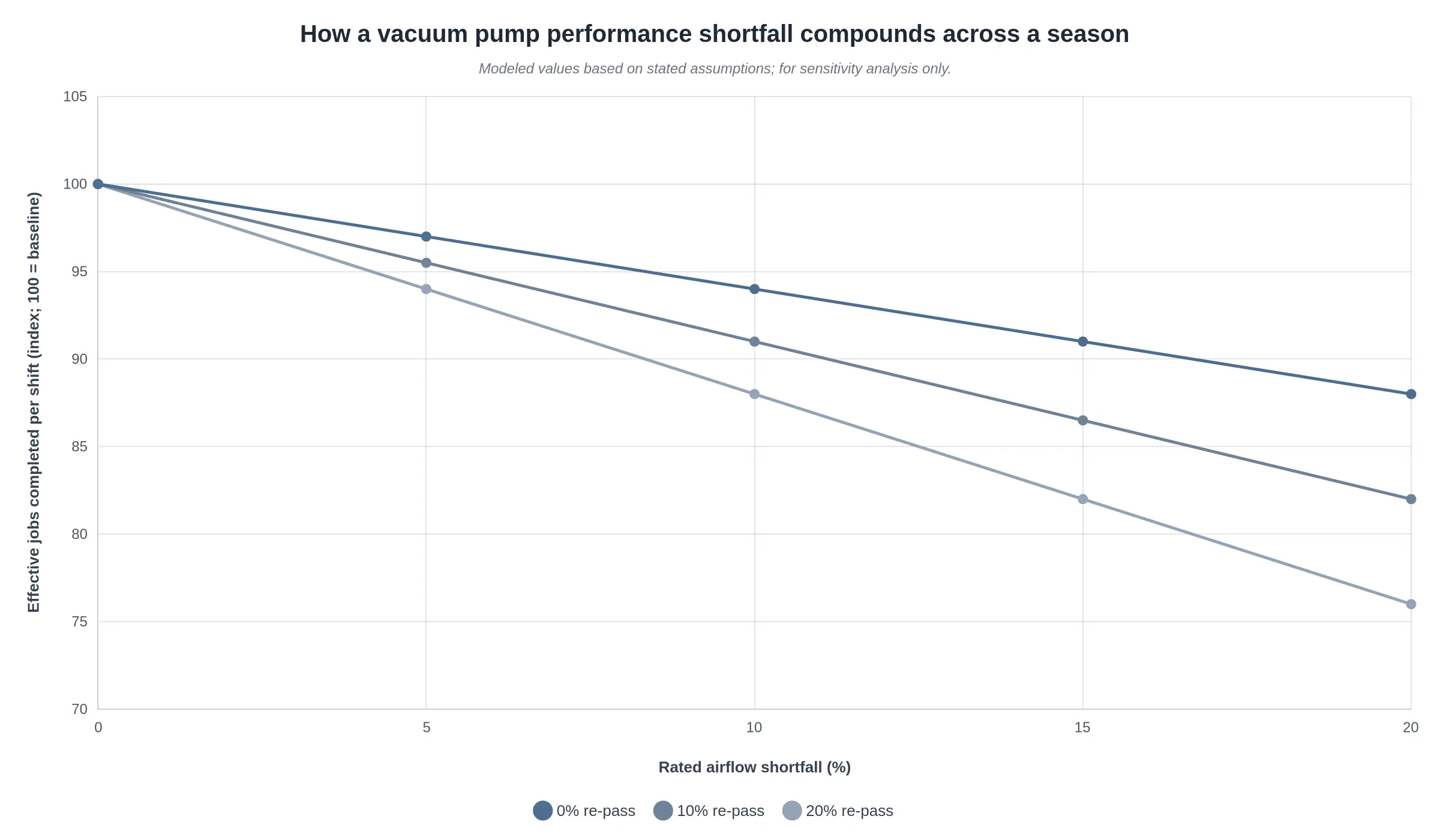
Reduced liftable debris per load is the first-order effect. A pump moving less air per unit time picks up less material per vacuum cycle, so the tank fills with a lighter, wetter slurry and needs dumping more often for the same mass removed. That single change lengthens cycle time per manhole, because the crew spends proportionally more of the shift on the dump-and-return leg and less on productive jetting. Longer cycle time then cuts jobs per day, which reduces revenue per shift for a contractor and extends the completion window for a municipal program.
Water consumption rises in parallel, and not only from longer jetting passes. Poor vacuum performance forces crews to re-flush and re-pass manholes they have already worked, so water is spent twice on the same linear footage. Per completed job, that re-pass factor is the least reported line in the cost model, and it is where a 10 to 20 percent airflow gap compounds fastest, since each marginal shortfall raises the probability of a second attempt rather than merely slowing the first.
Strain, downtime, and premature wear
Mechanically, a pump asked to do rated work with less than rated airflow runs longer at higher vacuum to compensate, raising heat load on the drive line and accelerating wear on bearings, seals, and lobe or vane clearances. Nozzles and hoses absorb the same penalty: crews compensate for weak pickup by running higher jetting pressure and dragging hose through partially cleared lines, which shortens hose life and increases nozzle replacement frequency. None of these costs appear at delivery, but all of them appear in the maintenance schedule within the first full season.
The largest single line item is usually unplanned downtime during peak season, when the fleet has no slack, standby units are already committed, and subcontracting or emergency rental rates are at their highest. A truck that fails in the shoulder months costs a repair. The same truck failing mid-season costs the repair plus the work it could not complete plus whatever premium was paid to cover it. Quantify this as expected downtime hours multiplied by the difference between in-house cost per job and replacement cost per job, weighted toward the months when demand is highest.
Make the model part of the purchase decision
Present the output as a range anchored to the measured airflow shortfall, not a point estimate. A fleet manager who runs the sensitivity twice, at 10 and 20 percent, and multiplies by the season’s working days will usually find that the modeled annual exposure exceeds the cost of a pre-shipment factory test by an order of magnitude. That comparison is the argument for vetting qualified suppliers of municipal sewer cleaner trucks before payment, and for treating measured airflow as a contractual acceptance criterion rather than a brochure specification. Protect sewer jetting truck productivity where it is measured, and the compounding never starts.
Where Mislabeling Actually Surfaces
A vacuum pump that arrives with the wrong nameplate is rarely exposed by a visual walkaround. Data exposes it, and in a predictable order. Inspectors who work sewer cleaner trucks systematically tend to find the deception in the same five places: the airflow measured at the pump’s actual working vacuum, the vacuum decay rate of a sealed system, the relationship between engine RPM and blower drive ratio, the amperage and power draw under load, and finally the paperwork trail that is supposed to prove all of the above.
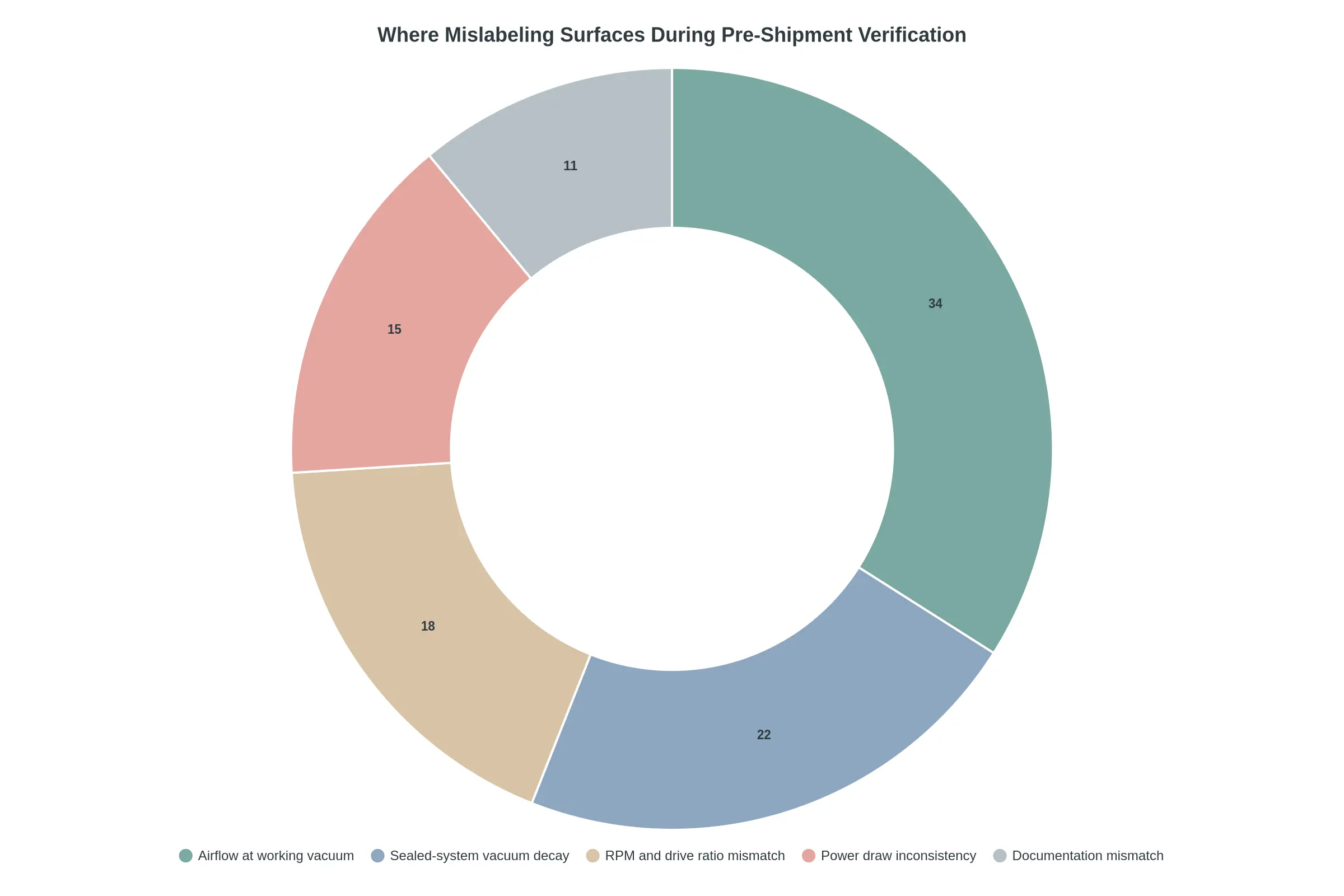
Illustrative distribution data showing where a vacuum pump mislabeling is most likely to surface during pre-shipment verification (percentages are a representative inspection profile, not a field-wide statistic).
Airflow at working vacuum typically reveals the largest gap, because a raised engine speed or a favorable test condition cannot hide a shortfall once the system is held at working vacuum. That check belongs at the top of the verification list.
Reading the Chart in the Field
| Detection Point | What the Test Exposes |
|---|---|
| Airflow at working vacuum | Real free-air delivery (CFM) at the pressure the truck will actually operate at, versus the catalog figure |
| Sealed-system vacuum decay | Leaks in tank, piping, and valve seals that mask a pump’s true capacity |
| RPM and drive ratio mismatch | A blower spinning outside its intended speed envelope through pulley or PTO substitution |
| Power draw inconsistency | A pump absorbing less (or more) power than its claimed displacement should require |
| Documentation mismatch | Serial numbers, nameplates, and test certificates that do not agree with the delivered assembly |
The pattern matters for procurement strategy. Buyers who only inspect the pump visually, or who accept a factory test certificate at face value, are checking the segment least likely to catch anything. Buyers who insist on witnessing a timed airflow test at working vacuum, followed by a sealed-system decay hold, close most of the exposure in a single afternoon. If your team is still assembling the shortlist itself, review how qualified suppliers of municipal sewer cleaner trucks are screened before the factory visit is scheduled, so the inspection is spent confirming a pump rather than discovering a vendor.
A Practical Verification Order
- Airflow at working vacuum – timed test with a calibrated flow meter or orifice plate, at the vacuum level the truck will run in service.
- Sealed-system decay – isolate the tank and piping, pull to target vacuum, and record the hold over a fixed interval.
- RPM and drive ratio – verify blower shaft speed against the claimed ratio at rated PTO output.
- Power draw – compare measured input power against the pump’s expected absorption curve.
- Documentation – match nameplate, serial, and certificate to the pump physically on the chassis.
Each step is cheap to run and expensive to skip. The chart above is illustrative; the sequence it implies is not. Verify the number the pump has to deliver in service first, then work outward toward the paperwork.
Sewer Cleaner Truck Vacuum Pump FAQ: Buyer Questions Answered
What does a pre-shipment factory test of the vacuum pump actually include?
A pre-shipment factory test runs the vacuum pump at the exact engine or PTO speed the truck will see in service and records airflow, vacuum level, discharge temperature, oil carryover, and shaft seal condition on calibrated instruments. It also covers mechanical checks: rotor-to-rotor and rotor-to-case clearances, relief valve lift point, drive coupling alignment, silencer restriction, and a vacuum-hold leak test on the tank and piping. This is the test that decides whether a nameplate number is real, and it is the one most often skipped in practice. The output should be a signed report with raw readings, calibration traceability, ambient conditions, and the pump serial number photographed next to the nameplate.
Can a pre-shipment factory test be witnessed remotely instead of in person?
Yes. A live, unedited video call with time-stamped gauge close-ups is now the standard workaround when travel is impractical, and most reputable plants will schedule a walkthrough on request. Insist on seeing the serial number plate on camera before the run starts, the flow meter display during the run, and the test sheet being filled in by hand rather than a pre-printed report. Edited highlight clips and emailed gauge photos taken at unknown times should be treated as marketing material, not evidence. For high-value orders, an independent inspector from SGS, TUV, or Bureau Veritas attending in person remains the strongest option.
How can nameplate CFM be wrong without the pump itself failing?
CFM is a conditional number, not a fixed property: it depends on rotor speed, inlet air density, temperature, and the restriction upstream and downstream of the pump. A supplier can quote a figure measured on a bench at 1,100 rpm with a wide-open inlet on a cool day, while the truck’s PTO only spins the blower at 950 rpm through a longer, more restrictive silencer and cyclone. The pump will sound normal, build vacuum, and still deliver 12 to 18 percent less air than the plate claims. Rating airflow as free air delivery instead of at the truck’s real operating point is the single most common source of honest-looking overstatement.
Can a low airflow reading come from the jetting pump, plumbing, or tank instead of the vacuum pump?
On a combination sewer cleaner the air path shares space with water and debris handling, so a poor reading rarely proves the blower is at fault. A blocked or saturated inlet filter, a leaking diverter valve, water carryover into the silencer, a collapsed hose liner, an undersized inlet pipe, or a baffle gasket leak will all pull airflow down while the pump performs exactly as designed. Good test practice isolates the pump by measuring at a straight, calibrated test port near the inlet and again at the hose end, which makes plumbing pressure drop visible. If inlet vacuum at the pump is normal but hose-end airflow is low, the restriction is in the truck, not the blower.
What tolerance band should a buyer accept on rated airflow and vacuum?
Plus or minus 5 percent on rated CFM at the contract-specified speed and inlet condition is a band most suppliers will accept for a new rotary-lobe or liquid-ring blower, while a 10 percent shortfall should trigger a re-test and a conversation rather than instant rejection. Vacuum level, relief valve setting, and temperature rise usually get a similar band, depending on pump type and how the reading is taken. Whatever band you choose, write it into the purchase order together with the test standard, the measurement location, and the correction method for altitude and ambient temperature, and write it one-sided as the contract section argues, so a reading below the guarantee is a fail rather than a bargaining position. A number with no conditions attached is not enforceable. Learn how to screen suppliers before the test stage in this guide to qualified suppliers of municipal sewer cleaner trucks.
| Parameter | Typical acceptance band | How it is verified |
|---|---|---|
| Airflow (CFM) at contract RPM | +/-5% of rated; +/-10% triggers re-test | Calibrated flow meter or orifice at defined test port |
| Vacuum at rated speed | +/-5% of rated | Calibrated gauge, corrected for altitude |
| Relief valve lift point | +/-5% of setpoint | Bench-set and photographed with tag |
| Vacuum-hold leak test | No decay beyond contract limit over 5 minutes | Isolated tank and piping, valves closed |
| Discharge temperature rise | Within OEM curve (+/-10%) | Thermocouple at outlet, ambient recorded |
| Oil carryover | Per OEM specification | Filter patch or OEM-approved method |
Which documents should arrive with the truck alongside the pump?
At minimum you need a signed factory test report with raw data and instrument calibration traceability, the pump performance curve, and photos of the serial number plate that match the paperwork. Add material certificates, the relief valve setting record, the tank vacuum or hydrostatic test certificate, hydraulic system pressure data, and CE, EPA, or local emissions documents where they apply. Commercial paperwork – bill of lading, invoice, packing list, warranty terms, O&M manual, and spare parts list – should be complete before final payment, not after the vessel arrives. Missing calibration certificates are the classic tell that a test report was written instead of performed.
What recourse exists after shipment if the pump underperforms?
Recourse lives or dies in the contract, so the practical move is to keep a payment holdback or performance bond tied to an independent re-test at destination. Once a shortfall is documented – measured CFM against nameplate, with corrected conditions and a calibrated meter – most suppliers will ship a replacement blower, a pulley or drive-ratio change, or a credit rather than argue. Escalate through the warranty clause, then through the named arbitration venue or a letter-of-credit discrepancy claim if the response stalls. The inspection report from the pre-shipment factory test is your most persuasive evidence, because it establishes exactly what the pump did before it left the plant.
Should the airflow test be run on the truck or on a bench?
Do both, in that order. A bench test confirms the bare pump against its own curve, while an on-truck test at operating PTO speed confirms the installed system including silencer, cyclone, valving, and hose. A supplier who only offers a bench test is quietly telling you that the plumbing was never measured as a system. Ask for both sets of readings side by side, because the gap between them is where most delivered-airflow disappointments are born.
The Five-Point Release Checklist
Before a sewer cleaner truck is released for shipment, a buyer should be able to produce five items. If any one of them is absent, the unit is not verified, however clean the walkaround looked.
| # | Item to confirm | What the document must show |
|---|---|---|
| 1 | Signed performance test at rated RPM | Airflow, vacuum and jetting pressure readings taken at governed engine RPM and at the pump’s rated blower speed, with engine RPM, pump RPM, tank vacuum and test duration recorded, then signed and dated by the factory tester and the buyer’s representative |
| 2 | Documented vacuum decay result | Tank sealed, pulled to a stated starting vacuum, with the interval and the exact loss recorded in inches of mercury or mbar |
| 3 | Matched serial numbers | Pump, blower, tank, PTO and chassis VIN on one sheet, matched to nameplate photographs taken during the test |
| 4 | Calibration certificates | Current, traceable certificates for every gauge used, dated inside their validity window |
| 5 | Contract language tying release to the test outcome | A clause stating that shipment release and final payment depend on the unit meeting the stated performance thresholds, with retest and remedy rights if it does not |
When any item is missing
Do not release the truck. Withhold the balance payment and instruct the supplier in writing that the unit remains unaccepted until the missing document is produced. A performance test without a gauge calibration certificate is an opinion, not a measurement. A vacuum decay figure without a stated starting vacuum and interval cannot be compared to a specification or to another unit. Request a retest filmed with the gauge face and the pump nameplate in the same frame, and require the serial number sheet to be signed at the same time. If the supplier resists clause five, treat that resistance as a finding in itself.
Buyers comparing factories often begin with a wider look at how civic trucks are specified and sourced, and teams assembling a mixed fleet frequently weigh new units against the used municipal truck market. Civictrucks.com is a B2B civic trucks dealer working with multiple Chinese factories on civic trucks, custom builds, and after-sales support for global buyers.
A sewer cleaner truck should be released on evidence, not on assurances. The evidence is concrete and checkable: a signature on a rated RPM test, a vacuum decay curve with numbers on it, a serial number matched to a nameplate photo, a calibration date, and a contract clause that makes the test result the condition of shipment. Confirm all five, and the specification on the invoice will match the machine on the chassis.