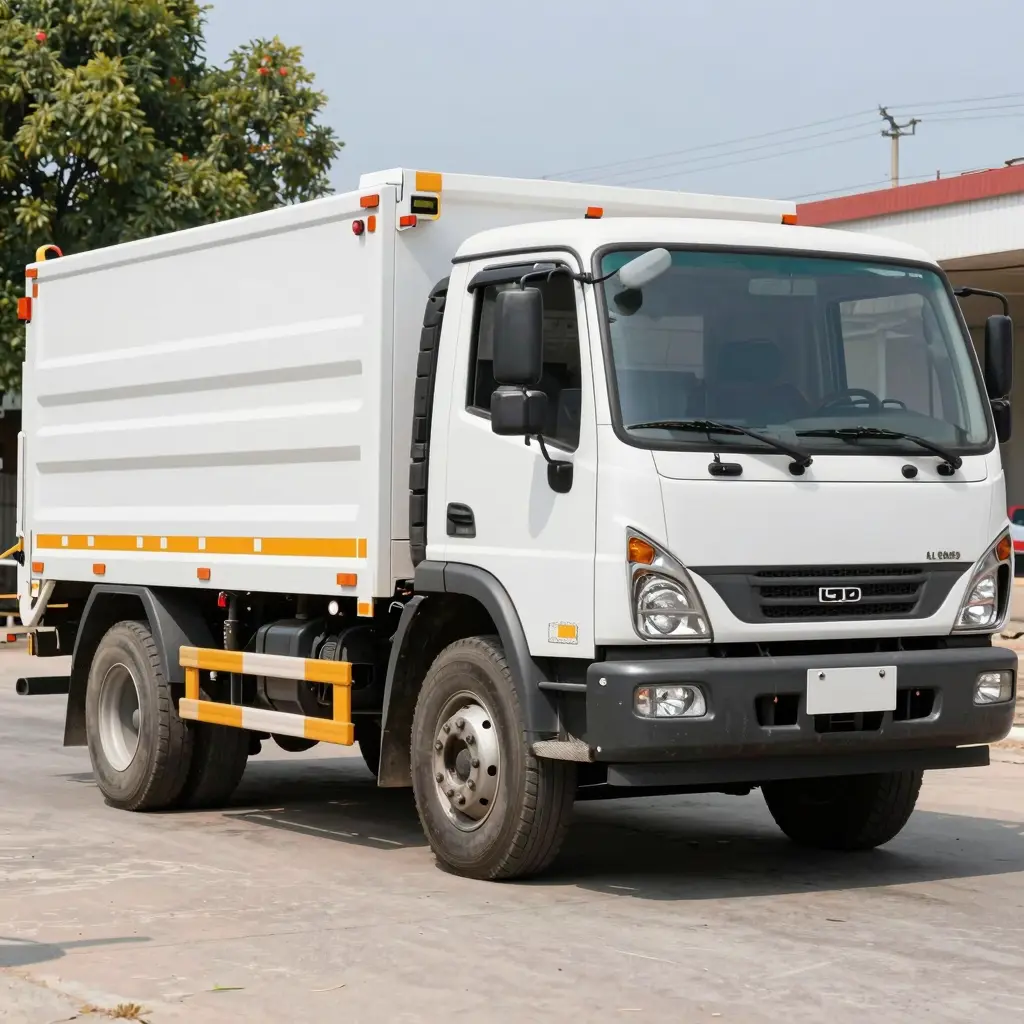

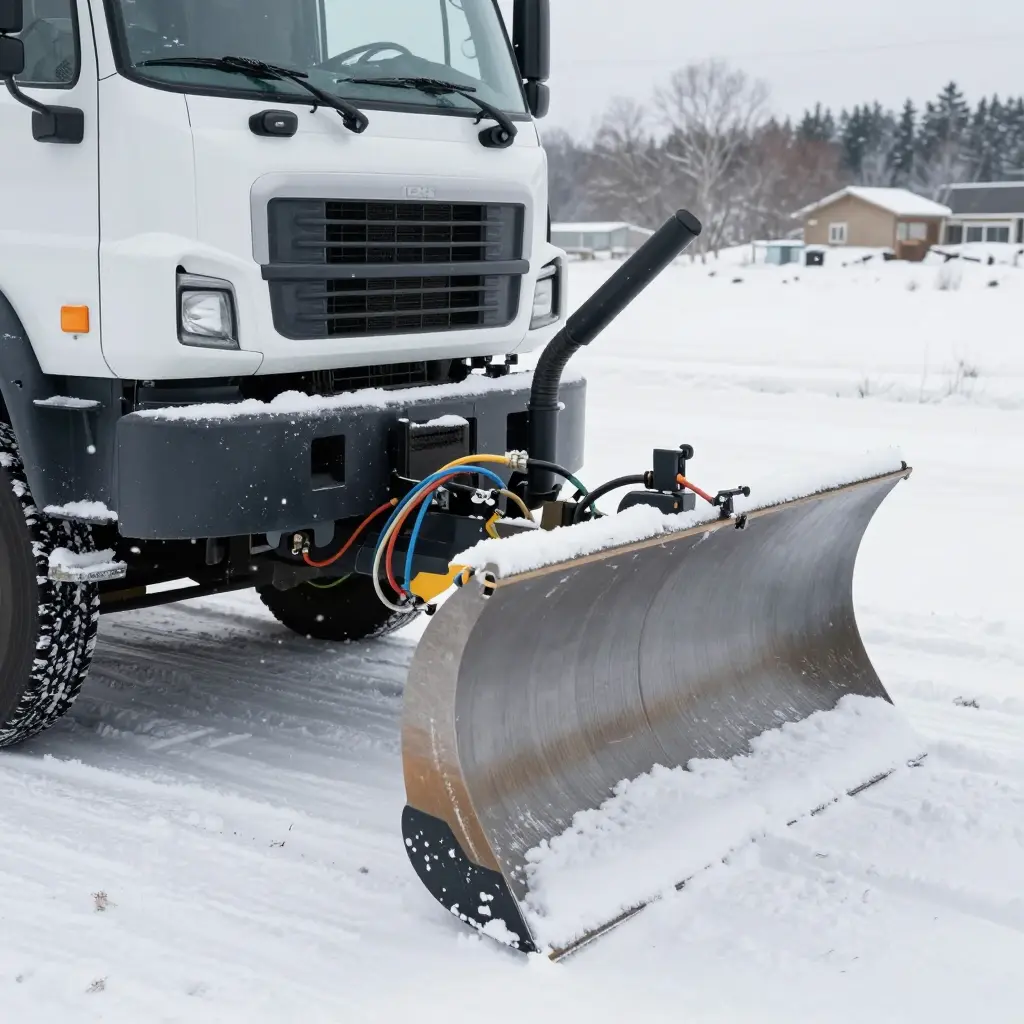
Ram Municipal Trucks for Sale: Wiring Gaps Hidden Inside the Snow Plow Prep Package
Fleets that order Ram municipal trucks with the factory snow plow prep package keep hitting the same problem: the truck that arrives does not match the wiring assumed on the spec sheet. Buyers expect a finished snow plow prep wiring interface. Many units show up instead with a partial harness run, missing relay circuits, empty fuse cavities, and pigtails that end in blunt-cut wire. Fitting the plow then takes the custom labor the package was supposed to eliminate. Nobody notices until the first storm.
The causes range from mismatched option codes to control-module differences to electrical loads the OEM never assumed. Where the gaps start, how they differ by chassis, trim, and model year, and what to check before signing all come down to the same thing: what did the factory actually build? The sections below cover factory and upfitter provisions, connector and control-module differences, and how to audit a unit at delivery, write the requirement into the bid, and budget the labor these gaps create. For broader context on outfitting practices, see this overview of efficient snow removal technologies for municipal plow truck fleets.
Ram OEM Snow Plow Prep Package: Advertised Contents vs. Delivered Configuration
Ram markets the snow plow prep package to municipal buyers as a turnkey electrical foundation. Its standard content is narrower than most procurement specs assume, and knowing what actually ships is what keeps the upfit from turning into rework.
What the factory package usually includes:
- A dedicated snow plow prep wiring harness with fused pigtails terminating near the front frame rail
- Provision for upfitter switches, usually four auxiliary positions, integrated into the instrument panel
- A body builder interface connection point intended for aftermarket control modules
- Rated electrical take-off points with documented amperage limits for plow pump and lighting loads
Municipal buyers usually expect more than that baseline. They assume the package includes a populated body builder interface module with live CAN bus integration, ignition-run circuits ready to carry load, and connectors pre-terminated for a specific plow brand. Many configurations ship harness pigtails only; the dealer or upfitter has to source the interface module and build the ignition-run circuits by hand.
In a municipal shop there is no margin for a mid-season retrofit. On the order sheet, “prep” usually means provisioned, not finished.
Before delivery, check amperage ratings, harness termination points, and module availability against the build sheet itself rather than the package description in the brochure. Treat the prep package as a starting point to validate.
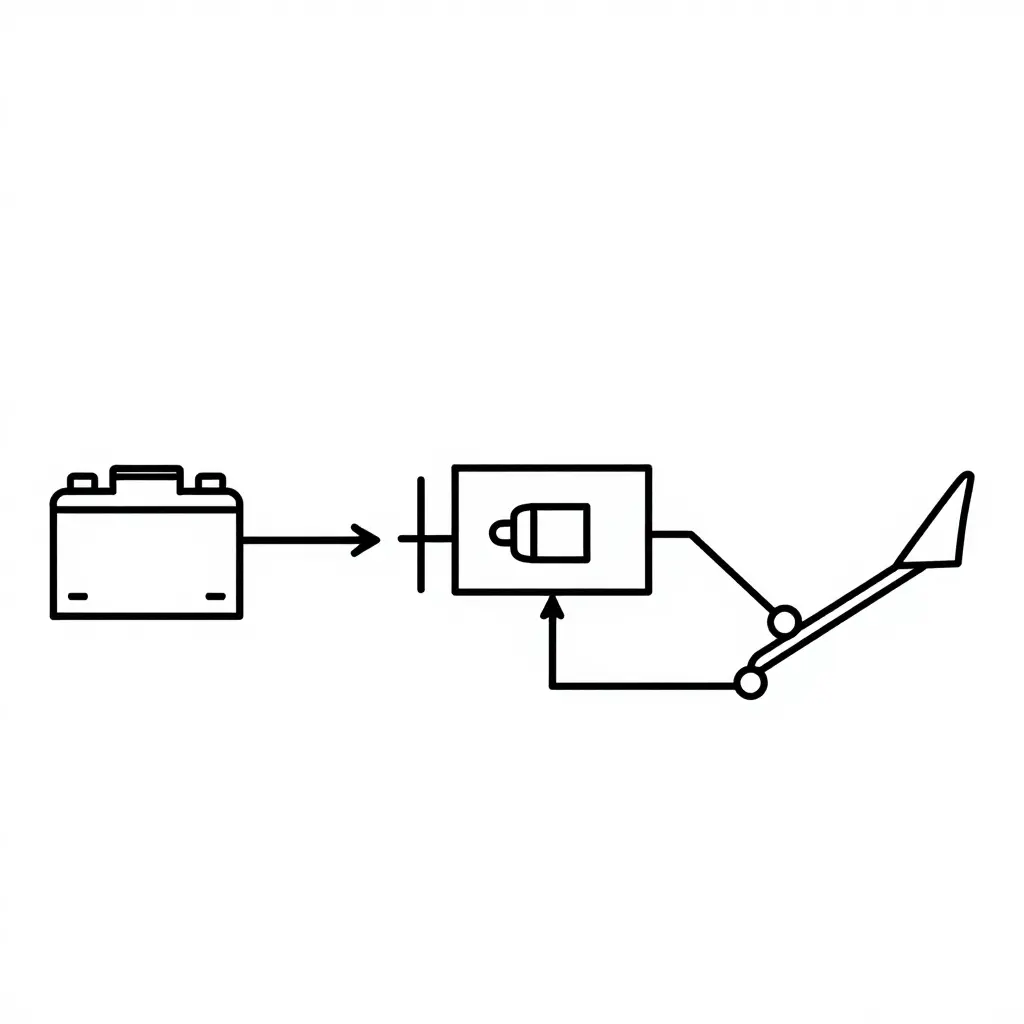
Figure: Snow plow prep wiring flow. Power runs from the vehicle battery through the charging system into the upfitter interface, then onward to the plow control module and blade. The diagram also shows where each connection point lands and where the ground returns.
Keep this diagram handy when you audit a delivered Ram municipal truck. The upfitter interface is where most wiring gaps appear, because the routing here is only as good as the taps and grounds the factory actually installed. For how these circuits support seasonal operations, see our guidance on efficient snow removal technologies for municipal plow trucks.
Common Snow Plow Prep Wiring Gaps Fleets Find After Delivery
The delivered configuration often does not match the plow system a fleet intends to install. These snow plow prep wiring gaps turn up again and again in post-delivery inspections and acceptance audits.
Missing or Unterminated Front Harness Pigtails
Many trucks arrive with a plow-prep harness that stops behind the cab or ends in a blunt-cut connector. Upfitters have to splice and run ignition, battery, and control circuits forward to the bumper themselves. This is the most common fault.
Absent Relay and Fuse Provisions
Prep packages often route the wiring path but omit the dedicated relay bank and high-current fuse block. Without relay isolation, plow pump startup can brown out the body control module and set fault codes in systems that have nothing to do with the plow.
Unlabeled or Misconnected Auxiliary Switch Circuits
Upfitter switch banks arrive with generic labels or none at all. When an operator works the lighting and hydraulics at the same time, a misidentified circuit can throw an intermittent fault that is hard to trace in the middle of a storm.
Insufficient Gauge for Plow Hydraulic Loads
A 12-gauge feed will carry lighting. It will not carry the 100-plus-amp inrush of a hydraulic pump. Undersized conductors cause voltage drop, hot terminals, and connectors that fail after a winter of steady use.
Missing Ground Provisions to the Frame
High-draw plows need a clean chassis ground. Many prep builds tie into the body ground only, so technicians end up adding frame-bonded grounds after delivery. A properly specified municipal dump truck with plow package should arrive with those grounds in place and tested.
Write down every gap before you accept the truck. It protects warranty coverage, shortens upfit time, and keeps breakdowns out of the plowing season.
Snow Plow Prep Wiring Provisions: Advertised vs Delivered vs Required
| Wiring Element | Advertised Spec (Snow Plow Prep Package) | Typical As-Delivered Condition | Fleet-Required Standard |
|---|---|---|---|
| Front harness pigtail | Plow-ready front accessory pigtail with sealed connector | Capped blunt-cut leads; no mating connector present | Weatherpack/Deutsch sealed pigtail, 10-12 AWG, labeled and loomed |
| Relay block | Pre-wired relay center provisioned for plow controls | Empty cavities; relays and jumpers not installed | Populated 40A relays, labeled circuits, spare slots retained |
| Fuse rating | Upgraded snow plow prep fuse provision | Base 10-15A fuse fitted; no plow-rated fuse or breaker | 30-40A fuse/breaker sized to snow removal equipment draw |
| Auxiliary switch wiring | Auxiliary switch wiring routed to cab | Flying leads, unterminated; no switch bank supplied | Terminated switch bank, independently fused, labeled at panel |
| Frame ground point | Dedicated frame ground provision for plow load | Painted frame surface; no stud or dielectric applied | Bare-metal stud, star washer, corrosion inhibitor, torque spec |
| Upfitter interface module | Upfitter interface module (UIM) ready | Module absent or unconfigured; blank CAN input map | UIM provisioned, inputs mapped, firmware updated and documented |
Electrical Load, Alternator, and Battery Implications of Snow Plow Prep Wiring
Wiring gaps show up the first time a fully outfitted truck runs in subzero weather. Factory prep circuits assume a light plow load; a real winter deployment stacks much more on top. The charging system then runs a deficit it was never specified to cover.
The draw adds up fast. Hydraulic plow systems pull 120-180 A during lift and angle cycles. Control lighting, strobes, and cab accessories add 25-40 A continuously. A hopper spreader with auger and spinner motors takes another 60-100 A. Combined demand can spike past 300 A – more than a 220 A alternator delivers at idle. Once output falls short, the batteries absorb the difference, and reserve capacity drains quickly.
Undersized conductors make it worse. Hold total voltage drop under 3% (roughly 0.36 V on a 12 V system) and match cable gauge to run length and load current – 2/0 AWG for runs exceeding 15 feet at 200+ A. Size fuses and breakers to conductor ampacity rather than plow motor inrush peaks. Fuses sized to the inrush will nuisance-trip and strand trucks mid-route.
For fleet managers writing the spec, treat snow plow prep wiring as part of the charging-system equation, not an accessory. Validate alternator output and battery reserve against worst-case winter loads before delivery, not after.
The Numbers Behind the Complaints
Five wiring gap categories show up repeatedly in post-delivery inspections of Ram municipal trucks ordered with snow plow prep packages. The chart below ranks them from most to least common.
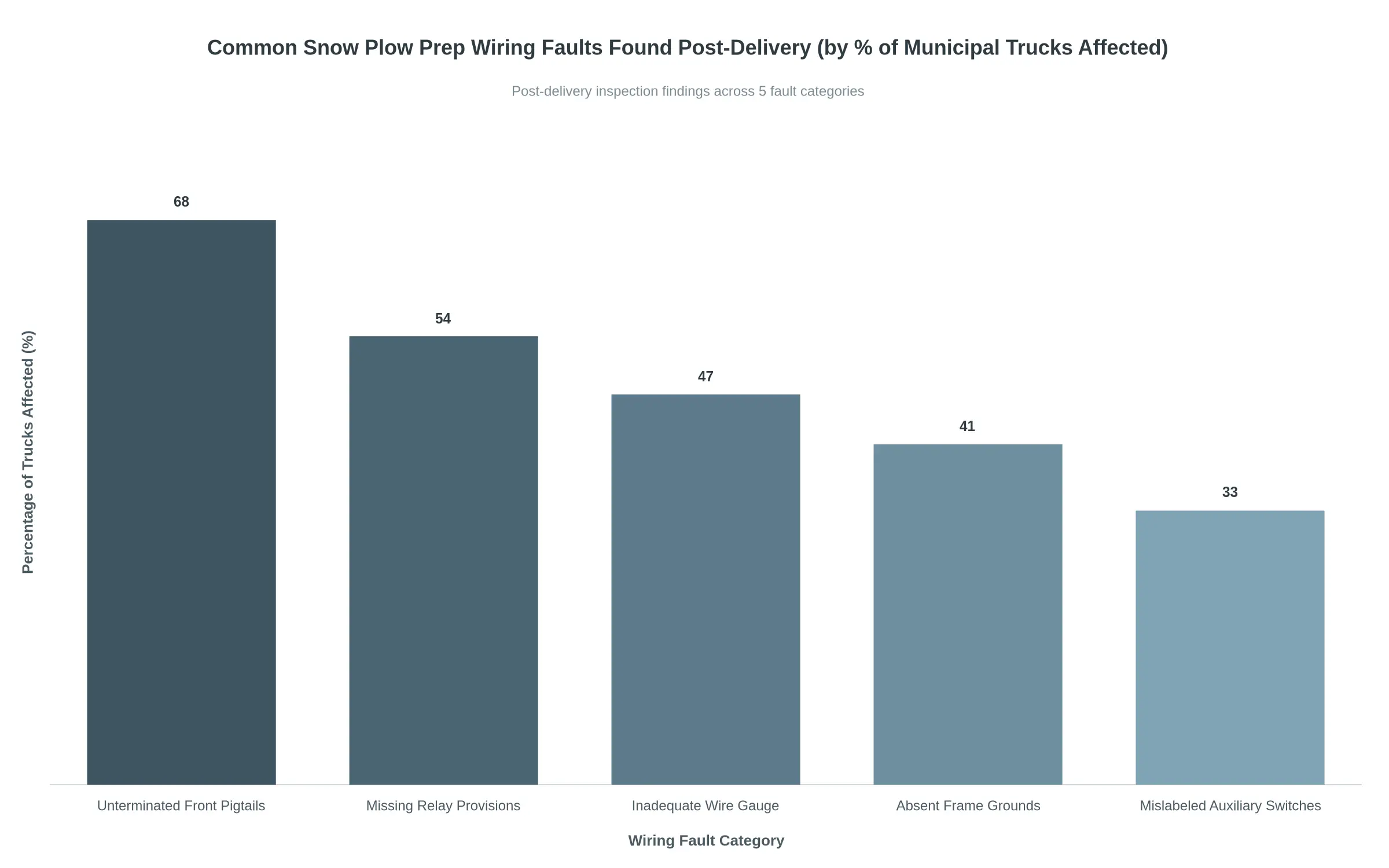
The faults that stop a plow on day one – dead leads and missing control hardware – are the ones upfitters report most often. If you are spec’ing new units, put these line items on the pre-acceptance list.
Pre-Delivery Snow Plow Prep Wiring Inspection Checklist
Post-delivery rework is where municipal snow budgets quietly bleed. When a truck arrives with incomplete or mis-terminated snow plow prep wiring, departments tend to find out after the first storm, when emergency upfit labor, overtime pay, and idle snow removal equipment all land at once. A pre-delivery inspection moves that discovery to the dealer lot, while the unit is still on the vendor’s dime and timeline and the warranty leverage is intact. The same checklist standardizes acceptance across units and vendors, so what procurement agreed to becomes a condition of delivery instead of an informal hope. Pair it with proven efficient snow removal technologies, and the fleet goes into winter plow-ready with documentation on hand for warranty claims.
Run this sequence on every unit before signing the acceptance form:
- Confirm the front pigtail termination at the grille harness is fully seated, weather-sealed, and pinned to the correct cavities for the plow control module.
- Validate that every snow plow prep relay and fuse is inserted in the power distribution center and matches the amperage specified for the plow package.
- Verify circuit labeling at the firewall, under-dash, and rear harnesses, confirming each conductor is tagged for plow lift, angle, lights, and control functions.
- Check frame ground continuity between the battery negative post, frame rail, and plow harness ground stud, measuring less than 0.5 ohms resistance on a calibrated multimeter.
- Confirm upfitter interface functionality by actuating the auxiliary switches and verifying ignition-sense, park/neutral, and speed signals report correctly through the upfitter module.
- Test the plow headlight and turn-signal integration harness to confirm it switches cleanly between truck and plow lighting modes without back-feeding.
- Inspect connector weather seals, dielectric grease application, and loom routing to confirm no chafing against the frame, brake lines, or body mounts.
- Verify the harness terminates at the correct locations for the specific plow brand (Western, Boss, Fisher) and matches the upfitter’s schematic.
- Confirm battery, alternator, and charging capacity meet the added electrical load of the snow removal equipment, including hydraulic pump draw at full lift.
- Document continuity and resistance readings, photograph the completed harness routing, and archive the records for warranty and audit purposes.
Operational Impact of Wiring Gaps on Fleet Uptime
A wiring gap becomes a schedule problem as soon as a truck moves from delivery to winter readiness. If the factory harness is missing circuits for plow controls, spreaders, or auxiliary lighting, the unit cannot be released, and the readiness window shrinks.
Winter readiness slips first. Every truck sent back for remediation consumes shop hours already committed to preventive maintenance, which pushes PM intervals into the plowing season and forces unplanned overtime.
Then the work moves to an outside upfitter, where the queue is not yours. A single harness correction can sit for days, and the department loses direct control of when the truck comes back.
Warranty disputes follow. The manufacturer blames the added circuits; the upfitter blames the factory provisions. While they argue, the truck sits, and a technical disagreement becomes lost availability.
Availability is the final cost. Every unit tied up in remediation shrinks the plow-route margin, so fewer trucks cover the same routes, response times stretch, and the trucks still running wear faster.
Most of this is avoidable if the harness architecture is verified before purchase. Options such as municipal snow plow trucks for sale in Massachusetts let procurement confirm prep completeness up front, before the first storm sets the deadline.
Tracing Snow Plow Prep Wiring Gaps: A Step-by-Step Diagnostic Workflow
When a truck shows up with an incomplete or dead snow plow prep circuit, upfitters and fleet technicians need a sequence they can repeat. The diagram below runs from circuit verification through relay and fuse checks to ground continuity testing – a quick reference to hand to any technician on the floor.
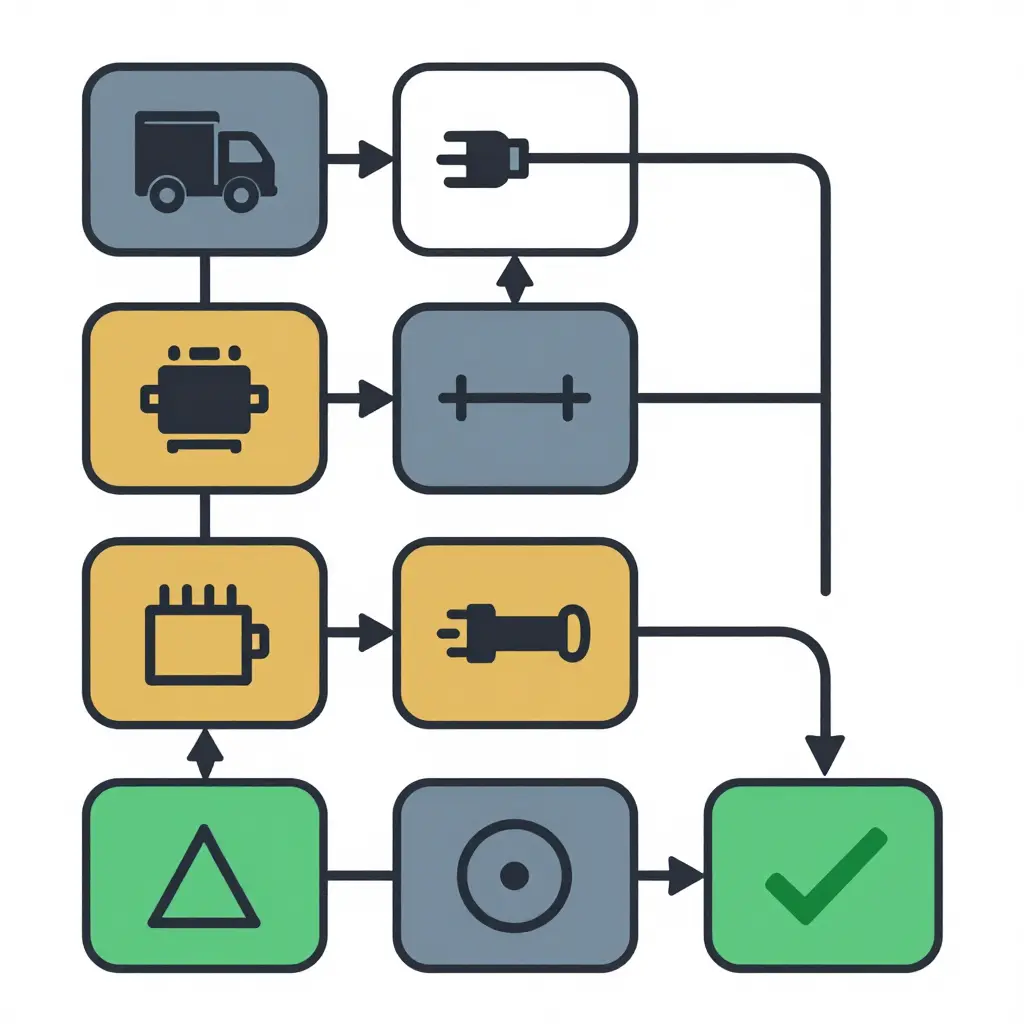
How to Read the Sequence
- Circuit verification first – Confirm the pre-wired battery feed and ignition-triggered circuit actually carry voltage before chasing downstream components. Many “gaps” are simply an unpopulated or mis-pinned harness.
- Harness and connector inspection – Trace the prep pigtail for missing terminals, reseated pins, or factory taped-off leads that were never terminated.
- Relay check – Load-test the plow prep relay and its socket; a weak coil or corroded seat will kill the control signal.
- Fuse check – Verify the correct cavity is populated and the amp rating matches the plow package spec.
- Ground continuity test – Resistance-test the chassis ground point, the most common source of intermittent plow control failures.
- Loop-back arrow – If any step fails after a fix, restart the sequence rather than assuming a single repair cleared the fault.
Quick Reference
| Step | What You’re Testing | Typical Fault Found |
|---|---|---|
| 1 | Battery / ignition circuit | Missing factory feed or unpopulated cavity |
| 2 | Harness connector | Loose or unterminated pins |
| 3 | Relay operation | Weak coil, corroded socket |
| 4 | Fuse continuity | Wrong amp rating, blown fuse |
| 5 | Ground continuity | High-resistance chassis ground |
Getting the truck and package spec right up front keeps most of these faults off the shop floor. For a complete snow-ready configuration, compare the specs behind today’s municipal snow removal equipment before you order.
Remediation and Upfitting Solutions for Snow Plow Prep Wiring Gaps
Incomplete snow plow prep wiring does not have to sideline a Ram municipal truck. A structured, warranty-conscious remediation plan closes the gaps and keeps the snow removal equipment working.
Start with the OEM dealer. Request the current body builder manual, confirm which factory circuits the truck was built to support, and have the dealer make warranty-approved harness corrections. Many gaps trace back to mismatched build codes or omitted pigtail connectors, and the dealer can supply correct replacement terminals, sealed connectors, and integration guidance.
Where factory provisions fall short, bring in an upfitter who works on municipal snow removal equipment. They can fabricate supplemental harnesses sized to plow loads, add weather-sealed connectors, and integrate controls without disturbing factory architecture. Familiarity with the right municipal truck bodies keeps the routing clean and predictable.
Specify aftermarket relay and fuse blocks rated for continuous high-amperage duty so the plow circuits stay isolated from critical vehicle systems. Pair them with an upgraded alternator and dual or high-capacity batteries that can sustain hydraulic pump and lighting loads through extended storm cycles. Verify charging capacity against total combined draw before commissioning.
Document every warranty-relevant change. Keep dealer work orders, upfitter schematics, part numbers, and load calculations, and note anything that could affect factory coverage. Those records matter for warranty claims, future repairs, and resale. Whether you run a new unit or a used municipal truck, the paperwork protects the asset.
Wiring-Related Downtime: The Winter Peaks Your Fleet Can’t Afford
In winter operations, a truck out of service is a public-safety problem, not an inconvenience. One wiring fault mid-storm can push routes back and stretch response times across the whole snowfighting plan. The chart below tracks monthly wiring-related downtime incidents across a five-month winter operating season, comparing trucks with properly executed snow plow prep wiring against trucks delivered with poorly executed aftermarket harness work.
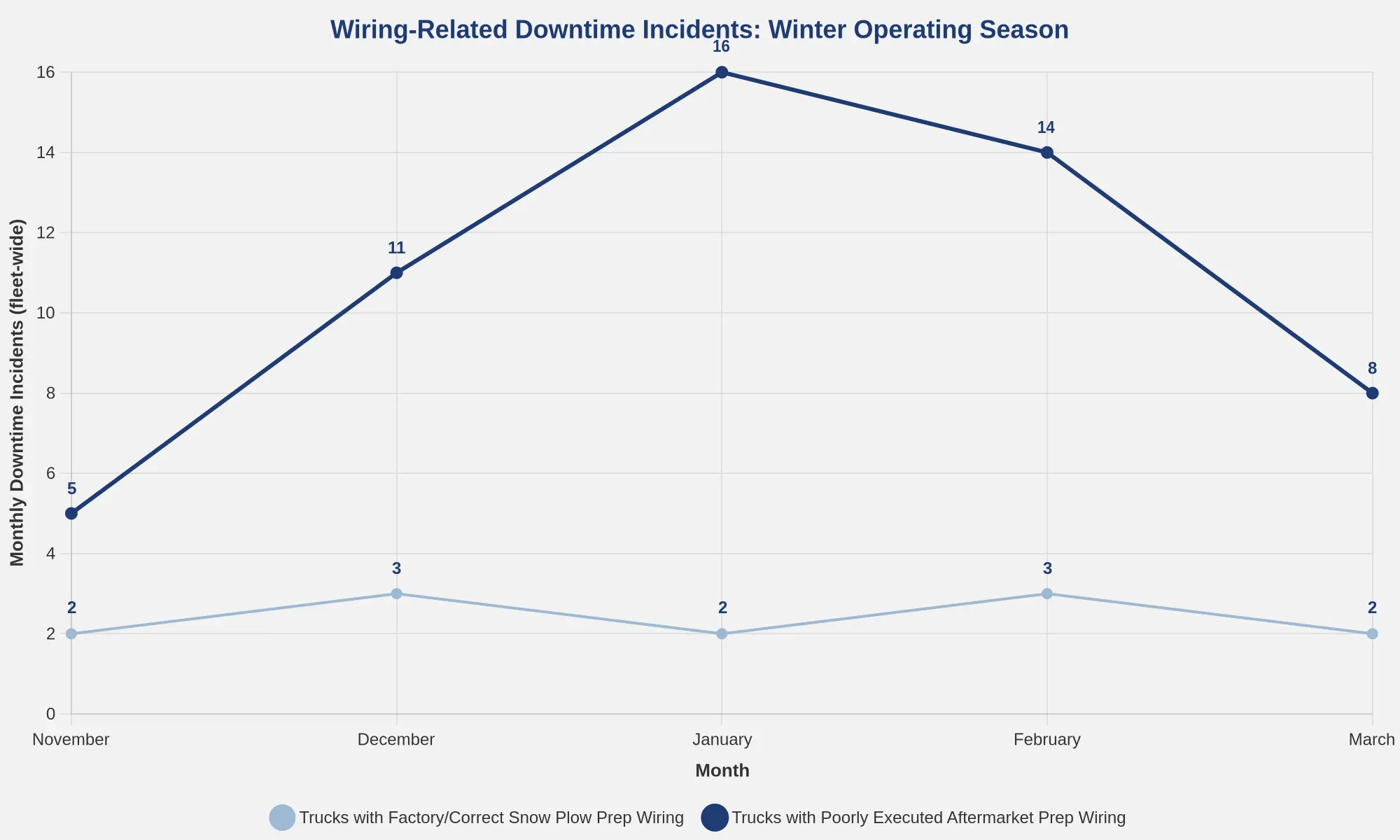
Trucks with correct, factory-spec prep wiring stay between two and three incidents a month – a rate a shop absorbs without touching the routes. The trucks with poor harness work climb steeply as temperatures fall, spiking through December, peaking in January, and tapering only after the harshest freeze window passes. That January peak is not coincidence. Marginal crimps, undersized grounds, and harnesses routed without strain relief fail exactly when load demand and thermal cycling are hardest on them.
Why the Peak Arrives in January
- Thermal contraction tightens every loose terminal, exposing cold solder joints and poor crimps.
- Peak controller load from simultaneous plow, spreader, and lighting draw overwhelms undersized conductors.
- Corrosion creep reaches critical resistance after weeks of wet, salted roads.
- Ground-path degradation causes intermittent faults that bench testing under warm, dry conditions never reveals.
Comparing the Two Cohorts at a Glance
| Month | Correct Prep Wiring (incidents) | Poorly Executed Wiring (incidents) |
|---|---|---|
| November | 2 | 5 |
| December | 3 | 11 |
| January | 2 | 16 |
| February | 3 | 14 |
| March | 2 | 8 |
By January, the gap between the two lines widens to roughly eight-to-one in favor of well-executed harnesses. For a fleet manager, that is the business case in one image: the wiring that comes with the truck largely determines whether the shop spends the winter thawing, diagnosing, and re-pinning connectors instead of pushing snow.
Treat prep wiring as a specification item, not an afterthought. Inspect harness routing, ground integrity, and connector sealing during acceptance, and document every fault for warranty leverage. Fleets that standardize the discipline end up on the low, boring baseline.
If you are evaluating equipment that gets the electrical architecture right out of the gate, start by understanding how the package is wired. Efficient snow removal technologies for municipal plow trucks shows how well-designed electrical architecture supports uninterrupted winter service.
Snow Plow Prep Wiring FAQ for Municipal Fleet Managers
What does the snow plow prep package actually include?
A factory snow plow prep package is often a “parts-only” provision: it supplies connection points and some hardware, not a completed circuit. On Ram trucks, the Snow Plow Prep Group has generally added the higher-output alternator and skid plates, with provision for plow wiring elsewhere in the build; exact content varies by model year and trim. Confirm ampacity, fuse coverage, and connector pinouts against the build sheet before assuming a truck is plow-ready.
Why do wiring gaps appear after delivery?
Chassis builders deliver an incomplete harness on purpose and expect upfitters to finalize the runs. OEMs stop wiring at the firewall or under-hood distribution box to keep warranty boundaries clean and build complexity down. When a municipality orders Ram municipal trucks for sale and assigns snow removal equipment without checking, technicians find missing grounds, unfused feeds, and undersized pigtails that never matched the plow’s true draw.
How do I identify inadequate harness gauge?
Measure voltage drop under load. A properly sized harness holds less than 0.5V drop at the plow’s full hydraulic load. Inspect the OEM blunt-cut leads – if 18 AWG is feeding a 60-amp snowplow module, the gauge is inadequate. Compare the manufacturer’s ampacity chart against the plow’s inrush spec and check connector ratings for heat discoloration.
Who is responsible for corrective upfitting?
Accountability usually sits with the upfitter who installed the snow removal equipment, but the underlying gap often traces back to procurement specs. Write harness continuity and gauge requirements directly into the bid. Many fleets resolve this by working with vetted suppliers; review your specifications against established Wisconsin municipal truck sourcing best practices to avoid repeat failures.
How do wiring gaps affect warranty?
Incomplete or improperly spliced snow plow prep wiring can jeopardize both chassis and plow warranties. Dealers may attribute electrical faults to aftermarket modification, shifting liability to the municipality. Document every upfit step, use OEM-approved connectors, and retain torque and continuity records to protect claims.
Conclusion and Procurement Recommendations
Gaps in factory snow plow prep wiring tend to surface only after delivery, when trucks are already committed to winter routes. For fleet managers evaluating Ram municipal trucks for sale, the remedy begins well before the purchase order is signed.
- Verify spec language before purchase. Confirm the order sheet explicitly names the required snow plow prep wiring circuits, amperage ratings, and connector types. Ambiguous option codes invite expensive corrections.
- Mandate pre-delivery wiring verification. Require the dealer or upfitter to test continuity, load capacity, and controller integration before acceptance.
- Budget for supplemental upfitting. Even well-specified trucks frequently need harness extensions, relays, or dedicated fuse blocks; reserve line-item funding for these additions.
- Enforce documentation. Demand as-built wiring diagrams and written warranty terms for every unit delivered.
Fleets that audit snow plow prep wiring at the specification stage avoid mid-season failures, cut unplanned downtime, and protect capital budgets. For related guidance, review proven snow removal technologies for municipal plow trucks.
Best practice, earned through hard winters: treat snow plow prep wiring as a verified deliverable, not a checkbox. Fleets that do put winter-ready trucks on the road on day one.