
The GVWR and PTO Spec Mismatch That Only Surfaces in Snow Season
A municipal dump truck can pass every check in the yard and still fail on the first storm route. Winter adds a plow, a spreader, and several tons of salt to a chassis that was bought for gravel and dry pavement. Two numbers decide whether it survives that change: GVWR and the PTO spec. They usually get read as separate line items at purchase time, which is where the trouble starts.
When you are searching for a municipal dump truck for sale, those two lines matter more than almost anything else on the listing. They are also the easiest to skim past.
GVWR (Gross Vehicle Weight Rating) is the most a truck is engineered to weigh safely, counting chassis, body, fuel, cargo, and every attachment bolted on. PTO (Power Take-Off) is what sends engine power to auxiliary equipment, such as the hydraulic pump behind a snow spreader or plow.
Each rating looks reasonable on its own. The mismatch shows up when they are evaluated separately and then combined with the real weight and hydraulic demand of winter equipment. A truck can sit inside its GVWR on paper while the added plow, spreader, salt load, and fluid push it past the axle and brake limits it was built for. A PTO that ran one function fine may not have the flow or torque to drive a plow and spreader at the same time in freezing conditions.
The sections below cover how the two specs interact once snow equipment is installed, the pitfalls that never surface during a warm-weather inspection, and the checks behind a defensible purchase. If your department depends on trucks that have to run on the worst days of the year, settle these specs before you sign. Practical guidance on the municipal dump truck for sale market is a reasonable place to start; the checks that follow are what to do with it.
What a PTO Really Does in Winter Service
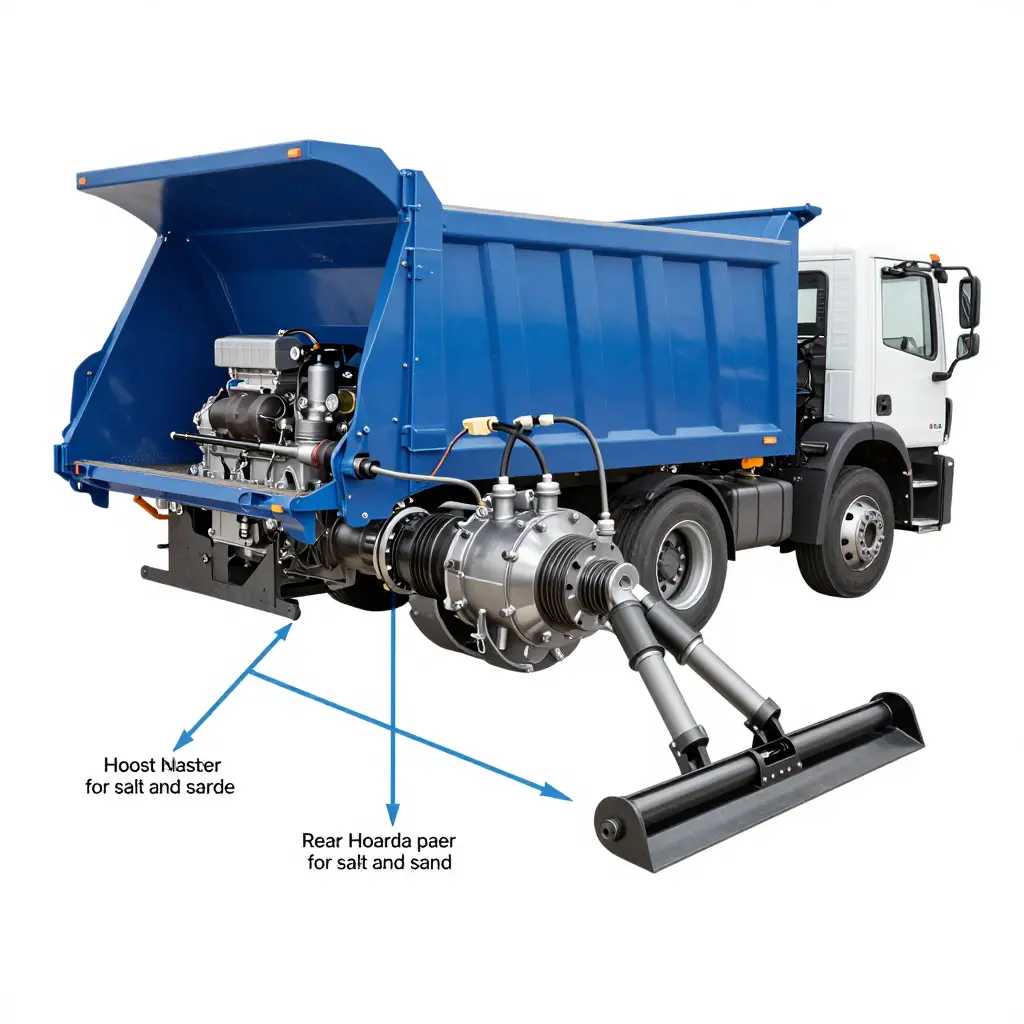
A Power Take-Off is the mechanical bridge between the engine and the hydraulics that do the work. On a municipal dump truck with a plow, the PTO taps rotational power from the drivetrain and redirects it to a hydraulic pump. From that one engagement point, a single pump can feed three circuits:
- Dump hoist – raises the bed to drop salt, sand, or aggregate at the stockpile.
- Hydraulic spreader – meters de-icing material onto the roadway through a rear conveyor or spinner.
- Plow functions – angle, lift, and float the moldboard as conditions change.
Intermittent vs. Continuous Duty
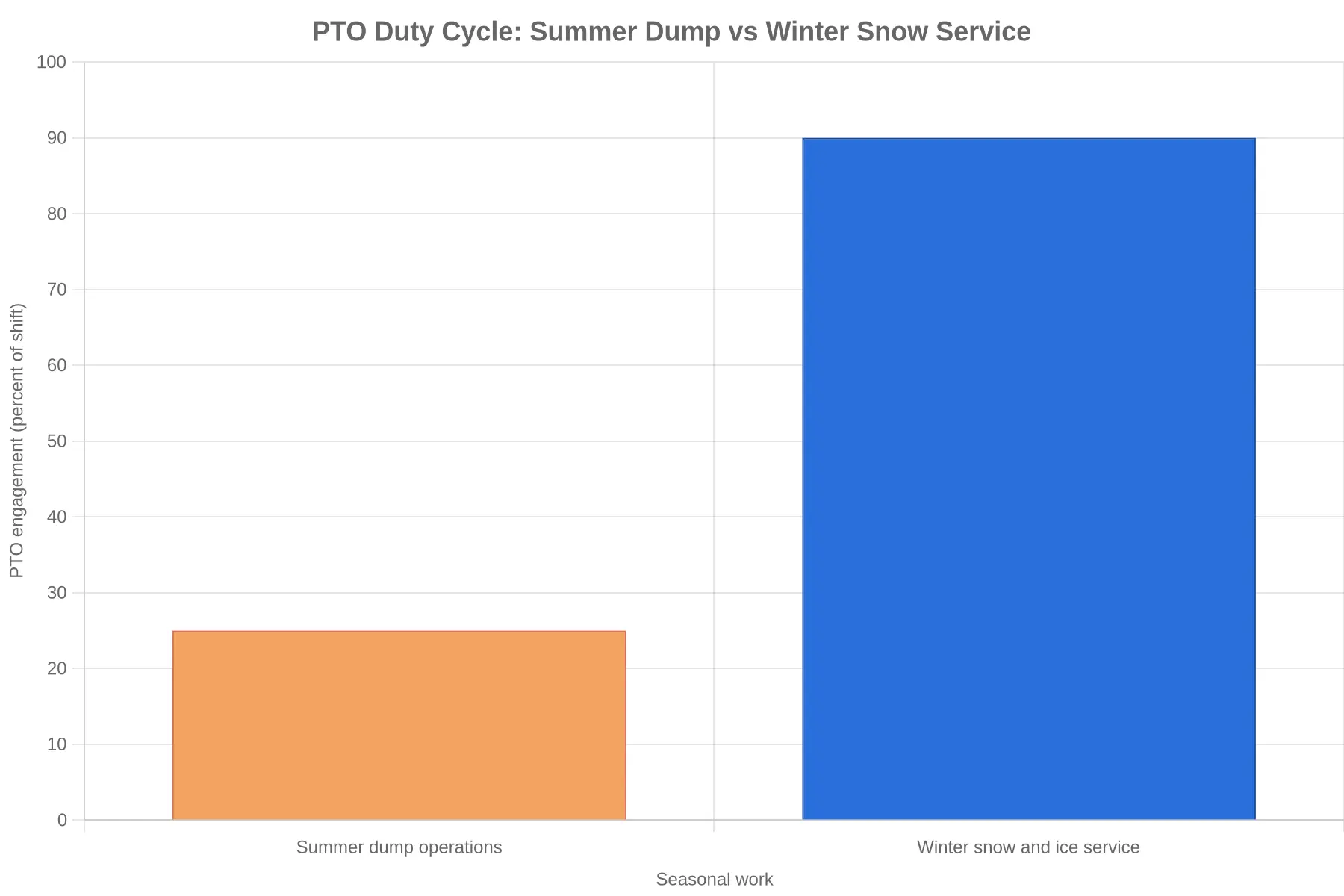
A summer dump cycle engages the PTO for seconds at a time: lift the bed, dump, lower, disengage. That is intermittent duty, and it gives the pump and the hydraulic fluid time to cool between events.
Snow and ice work runs the opposite way. The PTO stays engaged for hours, driving the spreader and plow at the same time while the truck moves along its route. A real PTO spec has to be sized for that near-continuous duty, because the hydraulic fluid never gets a chance to shed heat. Fluid temperatures climb, viscosity thins, and the pump, relief valves, and driveline all absorb the punishment.
PTO Types and How They Meet Torque and RPM
- Transmission-mounted (side-mount): Driven off the transmission gear. Torque and output RPM are tied to engine speed and gear selection, which is why it is common on a municipal dump truck with plow that also needs road speed.
- Engine-driven: Runs directly from the crankshaft or front engine accessory drive, delivering power independent of ground speed – useful when the spreader has to run at a standstill.
- Hot-shift: Pneumatic or electric shift-on-the-move, so the operator can engage or disengage without stopping – an advantage when moving between plowing and dumping.
- Live-drive: Independent of vehicle motion, keeping hydraulic flow steady whether or not the truck is moving.
Choosing efficient snow removal technologies for municipal plow trucks means matching the right PTO type to the torque curve and RPM window the pump actually needs. A PTO sized for occasional dumping will overheat and fail when it is asked to hold engagement all night in freezing conditions.
How Adding a Plow and Spreader Redistributes Weight Across the Axles
The schematic below shows a municipal dump truck from the side with both winter attachments mounted. It is a clean line-and-shape “principle diagram” rather than a photorealistic scene, so the load paths are easy to read: each weight source is a distinct block sitting over the frame, with force arrows dropping from every block to the axle that carries it.
Left to right, four loads act on one wheelbase:
- Plow load – a cantilevered block hanging ahead of the front axle, adding weight that lands almost entirely on the steering axle with very little leverage to the rear.
- Chassis load – the base vehicle, frame, and cab, centered low and spread along the frame rails.
- Dump body load – the hoist body and its payload, biased toward the rear of the frame and the rear axle group.
- Spreader material load – the salt or sand hopper and its contents, placed behind the rear axle, where it pulls weight off the front axle while adding to the rear.
[image]
That left-to-right grouping is the point of the diagram. A truck that leaves the factory comfortably under its GVWR can exceed it the moment those four blocks are stacked together, and the front axle often runs out of rated capacity first even though the rear carries the heaviest total. Keep this picture in mind when you compare candidate units. It shows why the gross vehicle weight rating and the power take-off spec both have to be matched to the winter equipment rather than to the bare chassis. For a longer walkthrough of matching truck and attachment specs, see our guide on municipal dump trucks configured with a plow.
Why the Mismatch Hides in the Sales Yard
A municipal dump truck for sale almost always looks correct on the lot. The GVWR plate and the PTO spec were chosen for one job – moving gravel, asphalt, or spoil on dry roads in mild weather. Winter changes the job, not the sticker.
How GVWR gets quietly exceeded. A truck spec’d for basic dumping carries its rated load against a curb weight that leaves only a few tons of usable capacity, which is plenty for fair-weather hauling. Then the winter hardware arrives after the fact:
- Front plow and mount: 1,200-2,000 lb
- Rear spreader, hopper, and spinner: 1,000-3,000 lb (more when loaded)
- Pre-wet tank or brine system: 500-1,500 lb
- Cab controls, wiring, and lighting: 150-300 lb
Now add the winter payload itself: salt and sand at roughly 1.2 tons per cubic yard. A single loaded spreader can push the truck several tons past its factory gross vehicle weight rating, before the plow ever touches snow. The axles, brakes, and springs are all working outside the number they were validated against.
The PTO stress. A PTO spec rated for light, intermittent dump duty – a few minutes of running per load – is suddenly asked to drive a hydraulic system continuously for hours. Plow angle cylinders, spreader augers, and spinner motors all draw flow at the same time. Duty cycle, not peak torque, is what kills it: heat builds, fluid shears, and the pump or PTO shaft fails mid-storm.
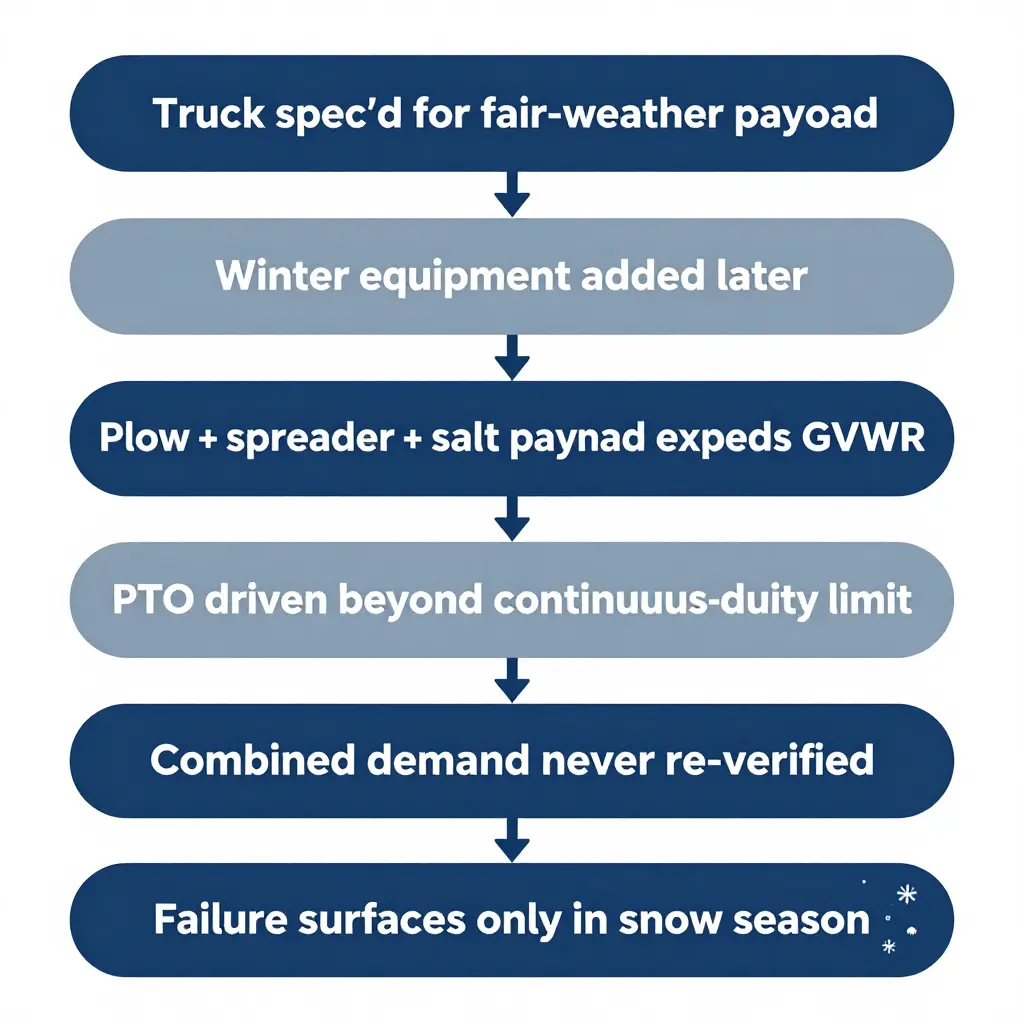
The chain runs like this:
- Truck is spec’d for fair-weather payload
- Winter equipment is bolted on later as an afterthought
- Hardware plus winter payload exceeds GVWR
- PTO is driven beyond its continuous-duty limit
- Combined demand is never re-verified against either rating
- The failure surfaces only under a winter load
Because the GVWR and the PTO spec were validated separately, in isolation, and in summer, the mismatch stays invisible in the sales yard. The buyer inherits a latent problem that only snow reveals.
Why Snow Season Exposes the Mismatch
A truck that runs flawlessly on a summer gravel route can turn into a liability in the first week of January – not because anything on it changed, but because its duty cycle did. Winter maintenance stacks load, resistance, and demand on top of each other, and every marginal specification gets tested at the exact same moment.
Here is what actually shifts when the snow starts:
- Sustained PTO engagement. Summer dumping cycles the power take-off for seconds at a time. Plowing and spreading keep it engaged for hours. Continuous operation drives hydraulic oil temperatures past the point where a marginal cooler and reservoir can cope, slowly cooking seals and wearing PTO clutch packs and pump drives far ahead of schedule.
- Cold hydraulic fluid viscosity. At subzero temperatures, hydraulic oil thickens and flow is restricted. Pumps cavitate, cylinders respond sluggishly, and the resulting heat buildup compounds the damage. A truck specced for fair-weather viscosity ends up fighting its own hydraulics all winter.
- Plow-induced front axle loading. A front-mounted plow hangs hundreds of pounds ahead of the bumper, shifting weight onto the front axle. When that axle is already near its rating, drivers start seeing front axle overload warnings the moment the blade drops.
- Spreader material payload. A full hopper of salt or sand can add several tons of moving weight – enough to push a truck past its dump truck GVWR even though the bed itself looks lightly loaded. Rear springs flatten, tires overheat, and braking margin disappears.
- Reduced traction. Ice and packed snow slash available grip just as braking load peaks, producing alarming braking distance loss on grades and curves.
| Seasonal trigger | Primary failure mode |
|---|---|
| Sustained PTO engagement | Hydraulic overheating, premature PTO wear |
| Cold fluid viscosity | Cavitation, sluggish response, seal failure |
| Plow front-axle loading | Axle overload warnings |
| Spreader material payload | GVWR overload, brake fade |
| Reduced traction | Braking distance loss |
Why fair-weather operation hides the problem
The insidious part is that none of this surfaces in the off-season. A municipal dump truck with plow equipment used only for occasional light hauling never runs the PTO long enough to cook the hydraulics, never carries a full salt load, and never fights for grip on ice. That lighter duty cycle flatters a spec that is quietly inadequate, so the mismatch stays invisible until the first heavy storm – when the consequences arrive all at once, on the road, in the dark. Public works teams in the Northeast can compare properly configured winter-ready municipal plow trucks in Massachusetts before the season starts, rather than discovering the gaps mid-storm.
The matrix below is a one-glance buying screen. It cross-references GVWR classes against PTO types so procurement officers can confirm a candidate chassis will hold up under plow and spreader duty. Before you commit, it also helps to review how a municipal dump truck with plow is typically spec’d, since the plow package drives much of the PTO and axle decision.
GVWR and PTO Compatibility Matrix for Winter Duty
| GVWR class | Typical chassis examples | Recommended PTO type | Continuous-duty suitability | Winter equipment caveats |
|---|---|---|---|---|
| Class 6 (19,501-26,000 lb) | Ford F-650, Freightliner M2 106, International MV | Transmission-mounted (6- or 8-bolt side PTO) | Moderate: fine for intermittent plow lift, spreader auger and spinner; avoid prolonged continuous use | Thin frame and axle reserve; single rear axle quickly runs out of rating with a full V-box plus wet salt. Verify front axle (FAW) load with plow raised and down, and add a PTO oil cooler for long storm cycles |
| Class 7 (26,001-33,000 lb) | Freightliner M2 106, International HV, Peterbilt 337 | Transmission-mounted or engine-driven (front crank or flywheel) | Good: engine-driven preferred when running high-flow hydraulics or tandem implements continuously | Weigh loaded spreader against rear axle and tire ratings before purchase. Engine-driven setups need bracket clearance for the plow pump and a dedicated cooler; confirm PTO port count if running plow plus spreader at once |
| Class 8 (33,001 lb +) | Peterbilt 567, Kenworth T880, Mack Granite, Volvo VHD | Hot-shift live-drive or engine-driven | Excellent: built for true continuous duty across multi-hour snow routes | Hot-shift live-drive demands reliable air supply and engagement while rolling, so audit the air system and PTO controls. Confirm PTO torque rating matches pump demand, and check cooling capacity when plow and spreader run together for hours |
How to read it: if the recommended PTO for your class is not the one stamped on the candidate truck, treat that as a red flag to re-cost the package before the snow flies, not after.
Pre-purchase verification checklist for a municipal dump truck
Before you commit budget to any municipal dump truck for sale, verify the specs that snow season will expose rather than the ones the sales sheet highlights. Run every line below against the actual build sheet and the intended winter attachments.
- Confirm the rated GVWR against the combined weight of dump body, plow, spreader, and payload.
- Confirm the PTO spec. supports continuous snow operation, not intermittent dump cycles.
- Confirm front and rear axle ratings accommodate the plow and spreader simultaneously.
- Confirm hydraulic cooling capacity for sustained engagement in stop-and-go plowing.
- Confirm the truck body and chassis are compatible with the intended winter attachments.
- Confirm the front axle rating covers plow weight plus the required front-axle loading.
- Confirm the alternator and battery capacity feed plow lights, spreader, and cab heat at idle.
- Confirm the transmission and PTO share compatible torque and duty ratings.
- Confirm brake and suspension ratings remain valid with the fully loaded winter configuration.
- Confirm the frame rail spacing and mounting points accept the spreader and plow mounts.
- Confirm axle and hub ratings allow for the lateral load a full plow pushes through a turn.
- Confirm the cooling package handles sustained low-speed, high-load hydraulic demand.
- Confirm the electrical system supports the spreader controller and any pre-wet pump.
Treat each unchecked box as a future failure, not a formality. Review municipal dump truck for sale options with these verifications in hand, and require documentation for every rating before purchase. A truck that fails one line on this checklist tends to fail it publicly, mid-storm, when the route cannot wait.
The Winter Failure Sequence: How a Fair-Weather Truck Ends Up Stranded
The diagram below maps the causal chain that quietly runs through thousands of municipal fleets. It begins with a dump truck realistically spec’d for fair-weather hauling – light loads, dry pavement, mild duty cycles – and ends with a breakdown that only surfaces once the first real storm hits.
The sequence is deceptively simple, yet every link matters. When a plow blade and a salt spreader are added to a truck that was never configured for them, the GVWR and PTO limits are exceeded in ways that paperwork often hides. From there, stress accumulates through the frame, driveline, and hydraulic system with every pass. None of it is visible in July. All of it surfaces in January.
The flow diagram illustrates this as a principle, not a specific truck: equipment added, limits exceeded, stress building, failure surfacing in winter. When reviewing candidate listings, resist the temptation to treat added attachments as pure value – they are a stress history you cannot see. For buyers who want to start from a unit whose original duty cycle actually matches winter service, exploring used municipal trucks with documented spec sheets is a far safer starting point than assuming a plow-ready look equals a plow-rated frame.
Spec’ing a Municipal Dump Truck That Survives Winter
Most municipal winter breakdowns aren’t mechanical mysteries – they’re arithmetic errors made months earlier on a spec sheet. When you’re evaluating a municipal dump truck for sale, the chassis, the plow, the spreader, and the hydraulics are often chosen by different people at different times. That’s how you end up with a truck that looks flawless in July and groans through its first January. The fix is to spec GVWR and PTO together, from the top down, instead of picking each part in isolation.
Start from the fully outfitted winter weight
Never size a truck from the bare chassis curb weight. Build your number from the top down: chassis, plus plow and mount, plus spreader, plus a full load of salt or sand, plus fuel, plus the operator, plus the wet snow and ice that clings to every surface in a storm. That aggregate figure – not the sticker on the lot – is what the truck must steer, brake, and hold together on black ice.
| Winter weight component | Typical added load |
|---|---|
| Front plow + mount | 1,200-2,000 lb |
| Empty V-box spreader and spinner | 1,000-3,000 lb |
| Salt or sand in a full hopper | 4,000-6,000 lb |
| Operator, fuel, tools | 500+ lb |
Your target GVWR must cover this fully outfitted figure with genuine headroom, not the dry weight you see parked indoors.
Size the PTO spec for continuous duty
A plow raises and lowers; a spreader spins for hours. That is the line between intermittent and continuous PTO duty, and it’s where the costliest PTO spec mistakes hide. A PTO sized for occasional dump use will overheat and shell out when it drives a conveyor and spinner for six straight hours. Spec the PTO for continuous engagement at the required flow and pressure, then confirm the hydraulic pump and reservoir are matched to that duty – not to the gentler dump cycle.
Match hydraulic cooling to sustained engagement
Hydraulic oil that never rests needs a cooler that never quits. Size the cooler for the worst case: sustained spreader operation at low ground speed, when there’s little airflow through the core. Undersized cooling is the classic hidden failure – the truck dumps perfectly all summer and cooks its oil every February.
Verify axle ratings for plow and spreader loads
Check the front axle rating against plow weight plus steering margin, and the rear axle rating against a fully loaded spreader. A chassis running near its axle limit empty will be over it with a salt load – and over-axle tandems warp, chew tires, and void warranties.
The real trade-off: margin versus apparent savings
A heavier chassis with margin costs more up front but survives a decade of winters. A lighter chassis looks like a bargain until you’re rebuilding PTOs, replacing stressed axles, or sidelining a route mid-storm while residents call about unplowed streets. The smarter play is often to invest in custom municipal trucks built around your winter duty cycle, which lets you align GVWR and PTO spec from day one instead of patching mismatches later. If you’re comparing platforms, Class 7 municipal dump trucks for sale offer a useful benchmark for how these ratings come together in practice.
Spec the weight, the drivetrain, and the hydraulics as one system – then the first snowstorm is a test the truck already passed.
FAQ: The GVWR and PTO Spec Mismatch That Only Shows Up in Snow Season
What exactly is a GVWR and PTO spec mismatch on a municipal dump truck?
A GVWR mismatch means the truck’s Gross Vehicle Weight Rating (the maximum legal loaded weight of chassis, body, payload, fuel, operators, and mounted equipment) is lower than the real-world weight of the truck once a plow and spreader are bolted on. A PTO spec mismatch is separate but related: the power take-off is sized and duty-rated for intermittent work, such as cycling a dump bed, yet it is being asked to run a hydraulic pump continuously to lift a plow, angle it, and spin a spreader auger for hours at a time. Either mismatch can void a warranty, exceed a bridge or axle rating, and leave a unit sidelined mid-storm.
Why does the mismatch only appear in snow season?
Snow equipment is the only duty that puts the truck at its true loaded limit. A bare municipal dump truck hauling gravel may sit comfortably inside its GVWR, so nothing looks wrong during routine summer work. Add a 1,200-2,000 lb front plow and mount and a spreader loaded with 4,000-6,000 lbs of treated salt, and the front axle and total gross weight jump dramatically. The same seasonal addition is what strains the PTO spec: an intermittent-rated PTO that shrugs off occasional dump cycles will overheat hydraulic fluid, shear shafts, or slip when it is asked for continuous, high-pressure flow in sub-freezing conditions.
How do I confirm a PTO is rated for continuous snow duty?
Check the manufacturer’s duty classification, not just the flow number. Look for an explicit continuous-duty rating and confirm the PTO’s torque rating (lb-ft) and maximum input speed match the pump it drives. Verify the hydraulic pump can sustain the plow and spreader circuits simultaneously at the required pressure, and confirm the chassis transmission has a compatible PTO opening and output. If the documentation only lists an intermittent duty cycle, treat it as unsuitable for snow service.
How much payload is lost when a plow and spreader are added?
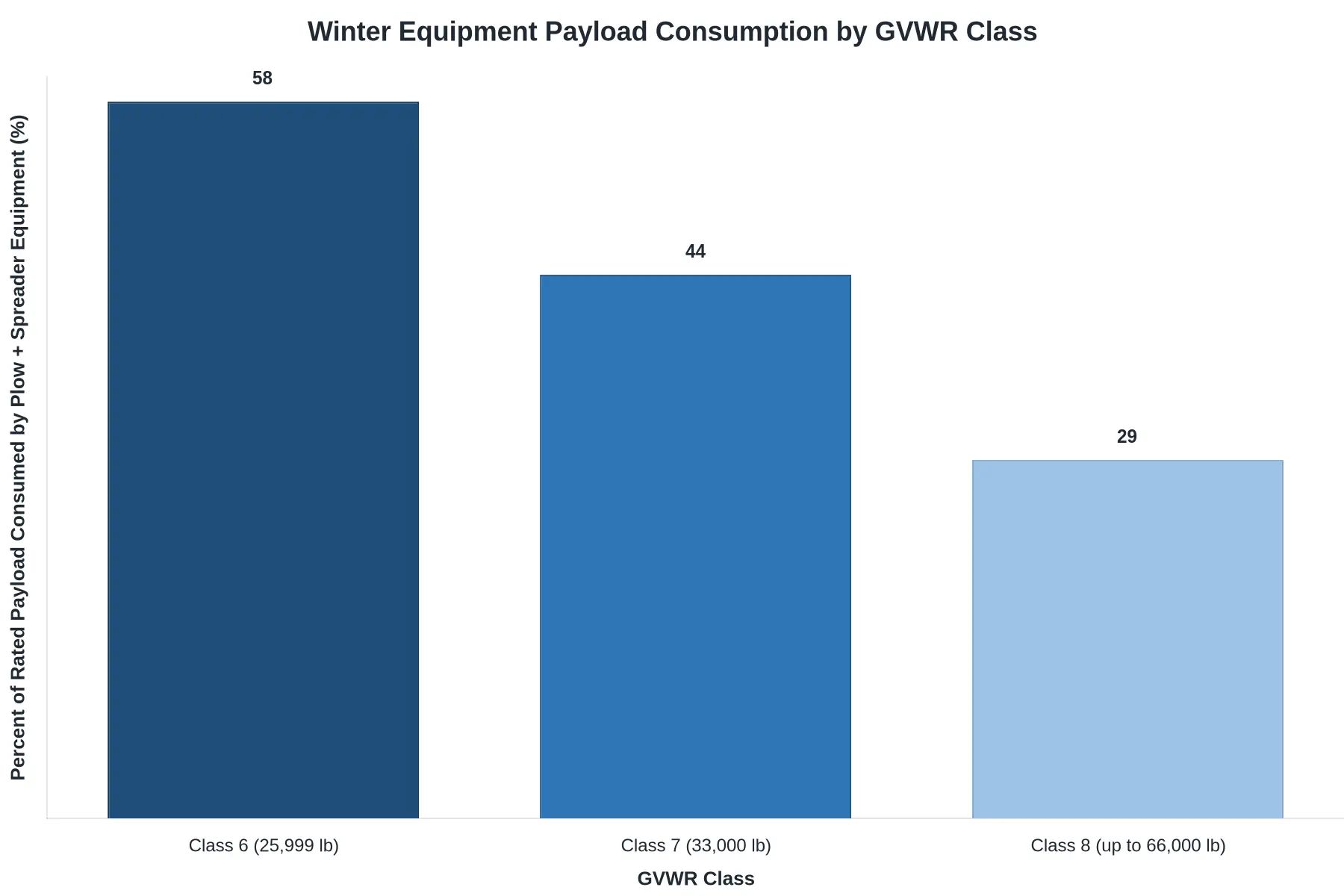
Budget conservatively. A typical setup removes roughly 5,000-7,500 lbs from usable payload once you account for the plow, mount, and spreader body. On a Class 7 chassis, that can cut legal payload by 25-40%. Subtract equipment weight from the GVWR first, then confirm the remaining capacity against your salt/sand target and axle limits.
Can an existing municipal dump truck be re-spec’d to fix the mismatch?
Sometimes, but only within the chassis’s limits. Options include upgrading to a heavier-duty or dual-output PTO and larger hydraulic cooling, adding a front-axle and spring upgrade to raise the front GAWR, or moving to a lighter plow and spreader package. What you usually cannot do is legally raise the published GVWR above the manufacturer’s rating. If the chassis is fundamentally undersized, replacing the unit is the safer, warrantied path. Before you commit to a municipal dump truck for sale, match the chassis rating to the full snow configuration, not the bare truck. For guidance on matching bodies and equipment to the right chassis, see our guide on finding the right municipal truck bodies.
Buying a Municipal Dump Truck With Eyes Open
The most expensive mistakes in municipal equipment procurement rarely come from choosing the wrong brand. They come from a configuration that was evaluated in July and delivered in January. Almost every spec mismatch described in this guide traces back to one habit: reading GVWR and PTO spec as two unrelated line items instead of a single, interdependent system – and reading both against a truck that is not yet fully outfitted.
A municipal dump truck for sale can look perfectly compliant on the spec sheet while sitting on the lot as a bare chassis with no plow frame, no spreader, and no hydraulic load. Add the real winter package – plow, hopper, salt, wet sand, and the operator – and the GVWR math collapses. The PTO spec must then be sized for genuine hydraulic demand: steering assist, plow lift, spreader augers, and conveyor running together as cold oil at low engine RPM. Confirm the fully outfitted winter weight first, then confirm the PTO spec against that load – before anyone signs.
Civictrucks operates as a B2B civic trucks dealer, partnering with leading factories to supply quality civic trucks, custom builds, and dependable after-sales support for global business buyers. Fleet managers can review our overview of civic trucks to align configuration choices with long-term service needs. For procurement officers, the takeaway is short: demand configuration-level documentation, validate GVWR and PTO spec against real winter duty, and make the award on verified numbers rather than fair-weather ones.