
Pump Cavitation Is a Symptom, Not the Root Cause
When a municipal water truck starts growling, surging, or losing pressure on a dust-control route, the pump gets blamed first. That diagnosis is usually wrong. Cavitation is a symptom: the noise and the damaged hardware are real, but the cause sits upstream in the tank. On graded and unpaved routes, the trigger crews overlook is the tank baffle inspection they keep putting off until seals fail. What follows is why slosh physics starves a pump, how to catch baffle failure before it eats an impeller, and the checks a shop can run in under an hour.
What This Article Covers
This covers municipal water trucks used for dust control and road-grading support: the 2,000- to 4,000-gallon platforms with PTO-driven centrifugal pumps that wet haul roads, suppress dust, and stabilize shoulders all day. They run on washboard surfaces, tight turnarounds, and long grades, the conditions that punish a poorly baffled tank hardest. For a broader rundown of platform types first, see this overview of municipal water truck configurations.
The failure chain is mechanical and predictable:
- Loaded water sloshes hard on every grade change and pothole.
- Loose, cracked, or rusted-out baffles let that mass slam the tank ends.
- The slosh exposes the pump suction pickup to air instead of water.
- The pump pulls vapor, collapses it against the impeller, and cavitates.
- Seals, impellers, and bearings fail long before their service interval.
The repair rarely starts at the pump; it starts at the tank. Fix the baffles and the cavitation stops. Skip them and you will be replacing the same pump next season. The slosh mechanics come next, then the diagnostic sequence and the inspection routine that keeps these trucks working.
What Pump Cavitation Actually Is in a Municipal Water Truck System
On a graded route, a water truck has one job: move water from the tank to the spray bar at a steady, controllable rate. When the pump starts screaming and the spray stutters, a lot of crews reach for the parts catalog and order a pump. More often than not, what they are hearing is cavitation, which is a pressure problem rather than a wear problem.
The vapor-pressure mechanism, in plain terms
Every liquid has a vapor pressure: the pressure at which it boils at a given temperature. Lower the pressure around water far enough and it boils even when it is cold. That is what drives cavitation.
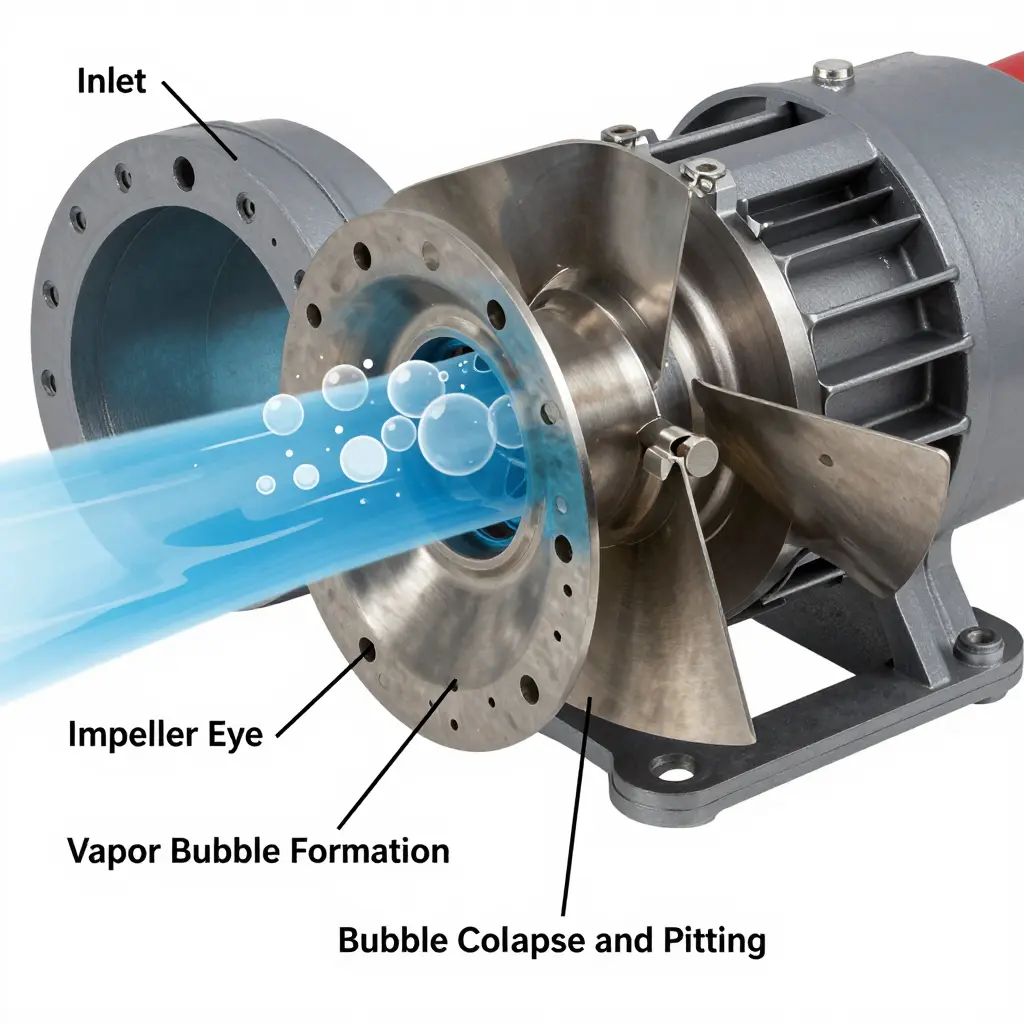
Inside the pump, the impeller spins fast and pulls water through the inlet. If the inlet is starved by a clogged screen, a partly closed valve, a low tank, or a kinked suction hose, or if the flow turns aerated and agitated, the pressure at the impeller eye can drop below the water’s vapor pressure. The water flashes into vapor bubbles. Those bubbles do not stay put. They ride into the higher-pressure side of the impeller and collapse against the metal, thousands of times a second. The result is the rattle that sounds like gravel, the pitting that bites tiny craters out of the surface, and a measurable loss of flow.
Cavitation is not wear-out, and it is not air entrainment
These three get lumped together constantly, and each one needs a different fix:
- Cavitation is a pressure/vapor event. It chews up metal over time but can appear suddenly on an otherwise healthy pump.
- Air entrainment is gas being sucked in – a loose fitting or a vortex in the tank pulling atmospheric air into the suction line. The pump moves froth instead of water. There is no vapor collapse, so less pitting, but plenty of flow loss.
- Wear-out is gradual mechanical decline: clearances open up, the impeller erodes, and performance sags over months. It is the slow baseline, not an abrupt event.
Pump cavitation symptoms
Watch for these appearing together on a water truck:
- Surging or spitting spray instead of a smooth fan
- Pressure dropping off at the spray bar even with the tank full
- A rattling, gravelly noise coming off the pump
- Pump temperature climbing as energy turns into heat instead of flow
Together they point to starvation or aeration on the suction side, often the same skipped tank-baffle inspection that lets slosh and vortexing starve the inlet. If you want the full picture on municipal water trucks and how the plumbing is laid out, that overview is a good place to start.
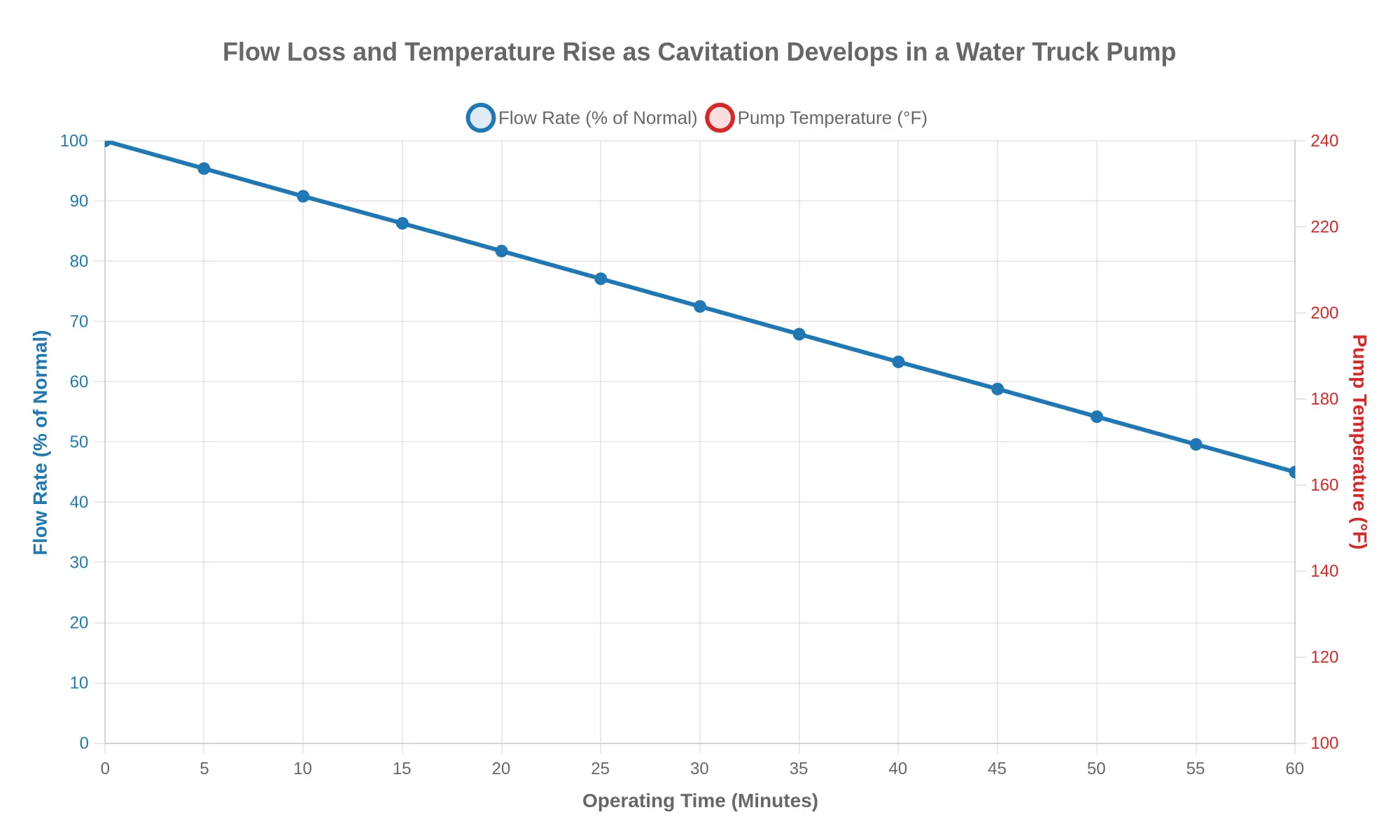
The chart shows the pattern: as cavitation sets in, flow fades while temperature climbs. That is a pump fighting vapor instead of moving water, not a pump that has simply given up.
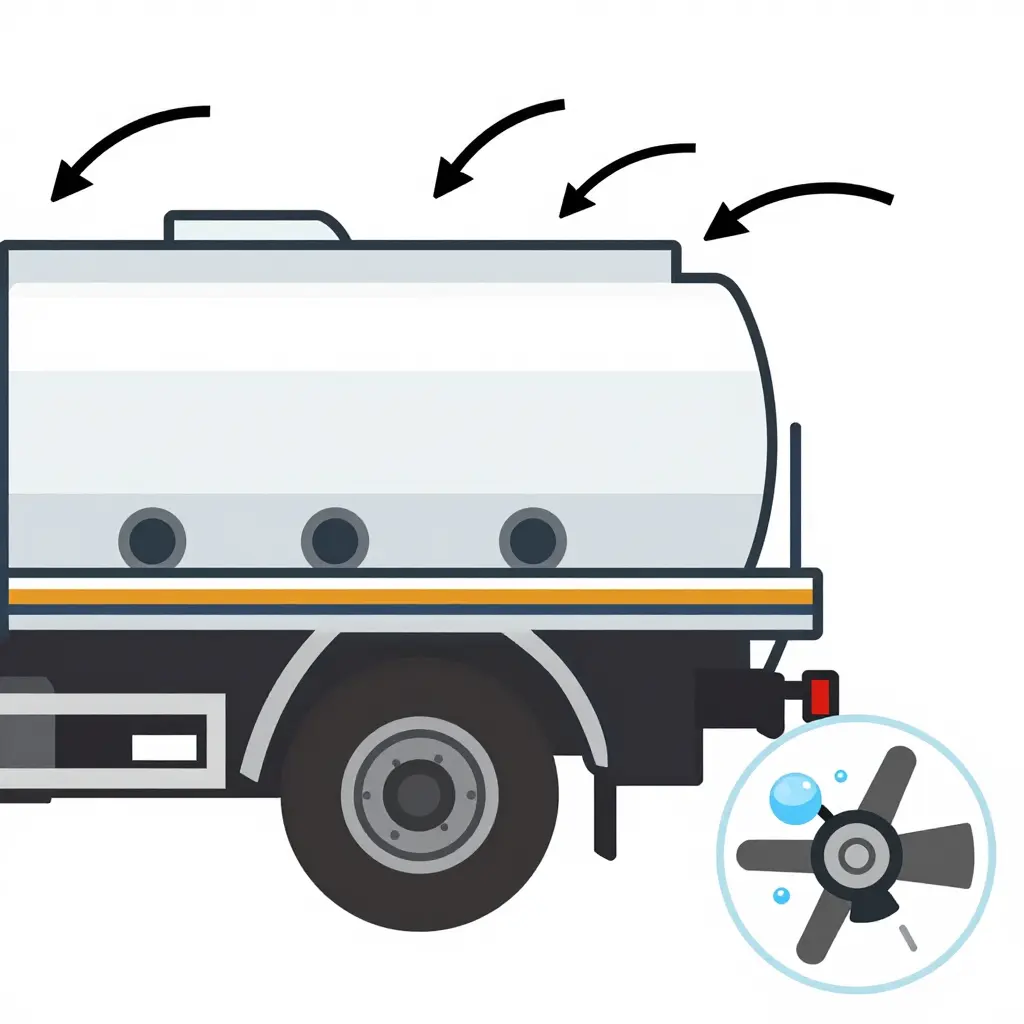
The schematic traces how a partly loaded tank behaves on a graded route. When the truck brakes, accelerates, or corners, water rushes through the open baffle gaps and sloshes along the length of the shell. If baffle spacing is too wide, or a baffle opening is oversized or damaged, the surge reaches the rear pump inlet as a broken, air-entrained slug instead of a steady column of liquid. That instability starves the impeller eye, drops local pressure below the water’s vapor pressure, and produces the vapor bubbles shown in the inset. Those bubbles collapse against the blade surfaces, which is what causes the pitting, noise, and premature seal failure crews mistake for a worn pump.
What Tank Baffles Actually Do
A water truck tank looks simple from the outside, but inside it holds an engineered set of vertical partitions called tank baffles. The plates split the tank into compartments and leave only small openings or cutouts near the bottom so water can still move between sections.
Their job is easy to describe:
- Limiting liquid surge. As a truck brakes, accelerates, or corners, the water wants to keep moving. Baffles break that momentum into smaller, manageable volumes so a full tank does not become one sloshing wave.
- Reducing dynamic load. Less surge means less force hammering the tank shell, the mounting hardware, and the chassis frame. Every gallon that slams forward is stress the structure has to absorb.
- Keeping the pump inlet submerged. A baffled tank holds water calm and distributed around the pickup, so the pump draws steady liquid instead of air.
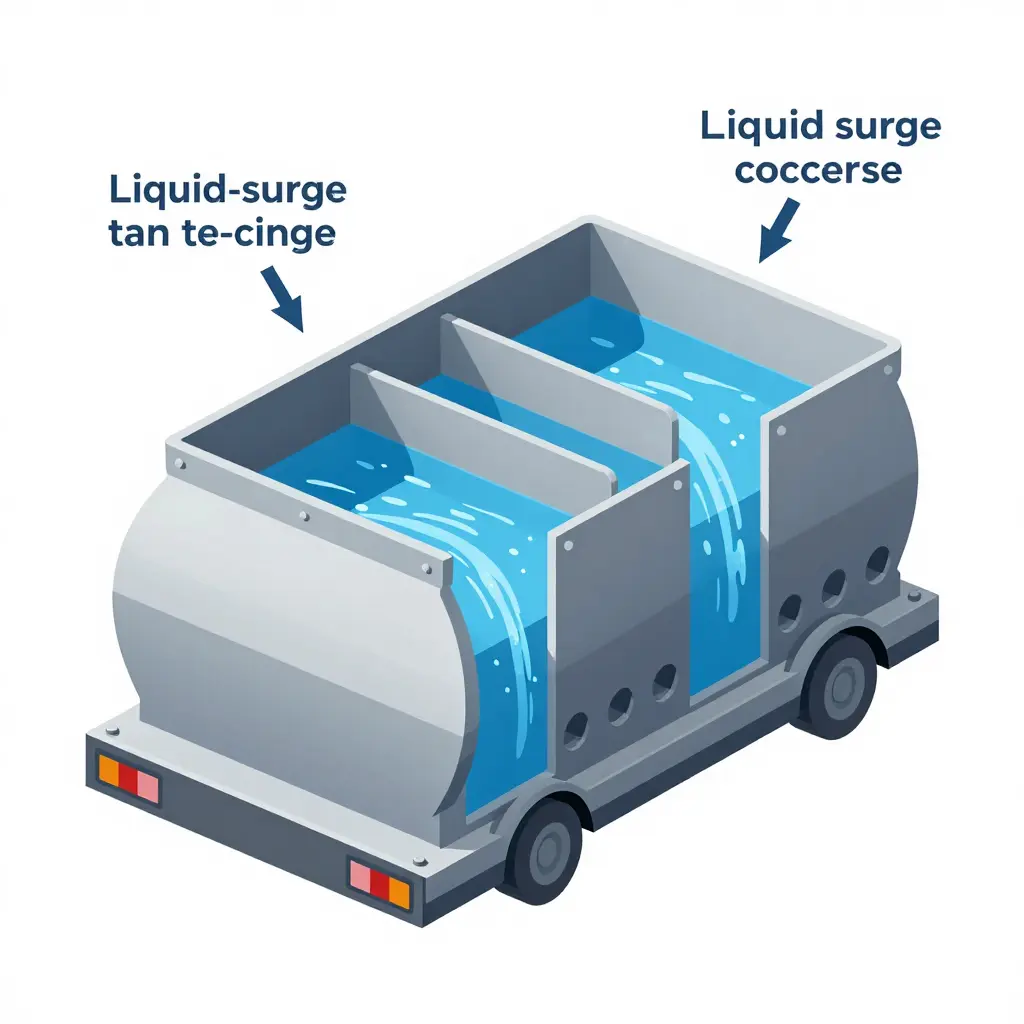
Why Graded and Unpaved Routes Stress Baffles
Dust-control duty is hard on baffles because these trucks rarely run full. Partial fills are the norm on long graded stretches, and the empty headspace lets liquid surge build far more energy than a topped-off tank would. Graded roads add constant motion: braking, turning, and crown or off-camber sections throw the water against the baffles again and again. Over thousands of cycles, that load works at the welds and fasteners until a plate cracks loose.
When a Baffle Fails
A cracked, loose, or missing tank baffle stops doing its job. Bulk liquid moves freely, alternately starving the pump inlet on one movement and overwhelming it on the next. That cycle is exactly what drives pump cavitation, seal damage, and the failures crews chase long after the real cause has been missed. For a closer look at how these trucks are specified for daily service, see our guide to municipal water trucks.
Why Crews Skip the Tank Baffle Inspection
No fleet manager plans to neglect a tank, yet in municipal water truck programs the tank baffle inspection is the step that most reliably falls through the cracks. The reason is structural, not attitudinal.
Baffles Are Invisible by Design
A baffle lives inside a sealed tank. Without a borescope or a full tank entry, there is nothing to look at during a walkaround. What you cannot see rarely makes it onto a PM sheet.
There Is No Gauge or Warning Light
Tank pressure, level, and pump readings all have instruments. Baffle condition has none. A cracked weld or a detached baffle sends no signal until it starts sloshing load and starving the pump. See how these trucks are built in our overview of municipal water truck fleets.
Pre-Trip Inspections Look Outward
Pre-trip checks are built around what a driver can see and touch: tires, lights, leaks, mirrors, and fluid levels. The tank baffle inspection targets a component that never appears on that list, so it stays off the radar.
Hoses and Nozzles Crowd Out Internal Checks
Spray patterns, nozzles, valves, and suction hoses are the visible failure points, and crews check them hard. The diligence is real, but it uses up the inspection window and pushes internal tank checks to the bottom of the sheet.
Graded-Route-Ready Pressure
Downtime costs money. Pulling a truck for an internal inspection takes a working asset off a graded route for something that has not failed yet. When every truck is needed on the road, the invisible step is the easiest one to defer.
A Structural Gap, Not Laziness
The skipped tank baffle inspection is not a discipline problem. It is a design gap in most PM programs: no access, no sensor, no trigger. Closing it means writing the step into the schedule, funding the borescope, and setting a real tank-entry interval instead of waiting for seals to fail.
The schedule below pairs each tank and pump action with a defensible interval and the field consequence that follows when crews defer it on graded routes.
| Maintenance Action | Recommended Interval | What It Detects | Consequence If Skipped |
|---|---|---|---|
| External tank and baffle weld visual check | Weekly / pre-trip | Weld cracking, corroded seams, weeping joints, baffle fatigue | Weld failure, tank rupture, abrupt load shift |
| Internal baffle inspection (borescope or tank entry) | Annually or every 500 hours | Dislodged or broken baffles, internal corrosion, trapped debris | Uncontrolled water surge, pump cavitation, structural failure |
| Pump inlet strainer cleaning | Monthly or every 100-250 hours | Sediment, scale, and debris blockages at the inlet | Starved pump, restricted flow, accelerating cavitation damage |
| Pump seal and bearing inspection | Every 500 hours or annually | Seal weeping, bearing play, shaft wear, air ingress | Seal blowout, bearing seizure, full pump rebuild |
| Spray bar and nozzle flow test | Monthly | Uneven spray pattern, clogged nozzles, hidden pressure drop | Patchy dust control, wasted water, uneven graded routes |
| Tank mounting hardware torque check | Every 6 months or after rough-road cycles | Loose U-bolts, stretched fasteners, cracked frame mounts | Tank shifting, mount failure, detachment risk |
The internal baffle inspection anchors this schedule. It is the check crews skip most often, and its failure most reliably cascades into pump cavitation and premature seal failure.
The Cause-and-Effect Chain: From a Skipped Baffle to a Failed Seal
A baffle inspection takes a few minutes. Skipping it can carry a municipal water truck from a small internal defect to a dead pump and a failed seal. The chain follows a predictable order.
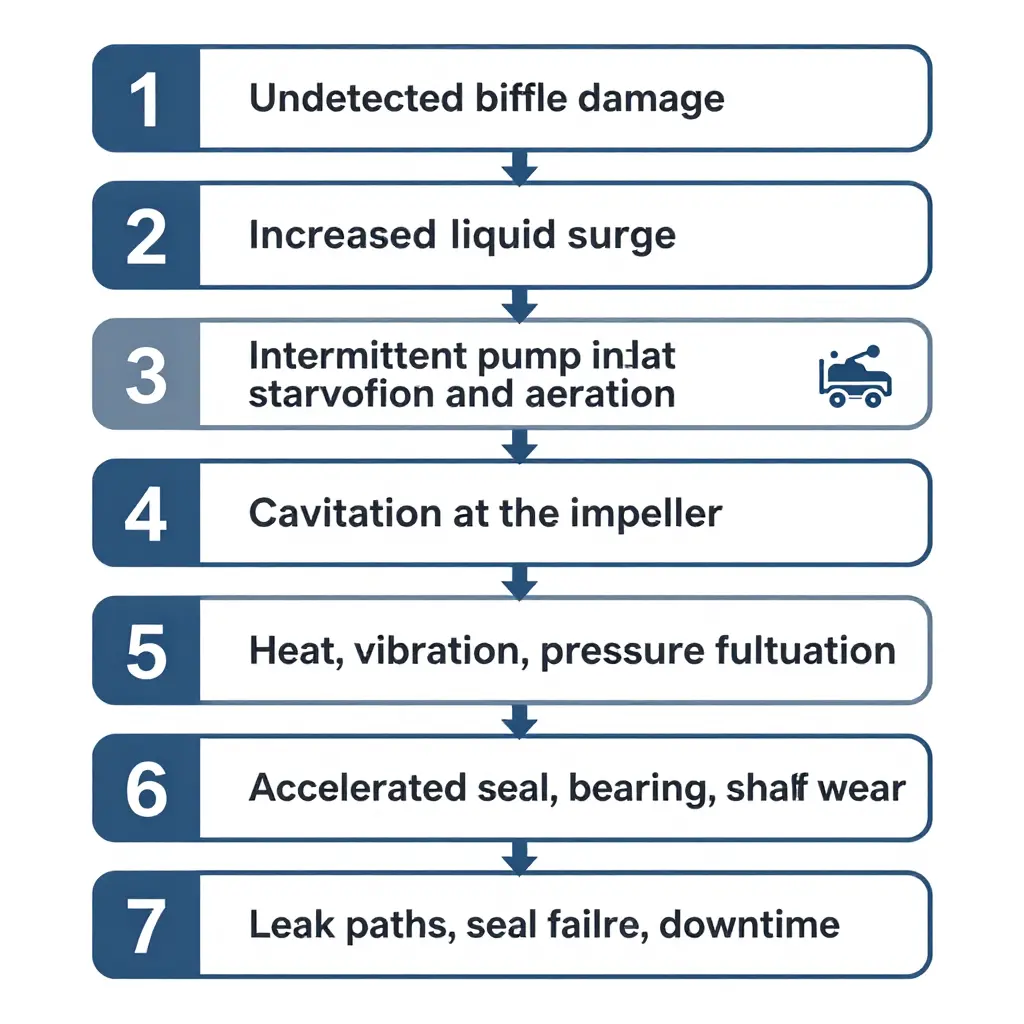
1. Undetected baffle damage. A cracked, bent, or missing baffle stops controlling where the water sits inside the tank. Because the damage is internal, no one sees it during a walk-around, so it goes unrepaired.
2. Increased liquid surge. Without baffles to divide the tank, the full water load sloshes front-to-back on every grade change, brake application, and washboard bump. The surge is heavier than the tank and mounts were ever designed to contain.
3. Intermittent pump inlet starvation and aeration. As the water heaves away from the pump inlet, the pump briefly pulls air instead of a solid column of water. Suction breaks, recovers, and breaks again each time the load shifts.
4. Aeration produces pump cavitation. When air and vapor reach the impeller, the bubbles collapse against the vanes. This is classic pump cavitation: it erodes metal and pounds the rotor with every collapse. The noise starts as a rattle drivers often mistake for a loose bracket.
5. Heat, vibration, and pressure fluctuation. Collapsing bubbles release localized heat, shake the pump housing, and send discharge pressure spiking and dropping. Gauges flutter, hoses pulse, and the whole pump assembly works against itself.
6. Accelerated mechanical wear. Seal faces, bearings, and the shaft absorb the punishment. Seal faces overheat and lose their flat contact, bearings take impact loads they were never meant to carry, and shaft runout grows.
7. Leak paths and seal failure. Worn faces and grooved shafts open paths for water and lubricating oil to escape. The result is a hard seal failure, followed by bearing play, shaft damage, and a truck parked when it should be grading roads.
How the Failure Escalates in the Field
Crews can read the escalation if they know the pattern. It moves in three stages.
- Early stage: a faint rattle at the pump, plus pressure-gauge flutter and a pulsing discharge hose.
- Middle stage: loss of spray performance, uneven water throw, and the pump struggling to hold pressure on climbs.
- Late stage: seal weeping, visible drips under the pump, and noticeable bearing play when the shaft is hand-checked.
Each step feeds the next, so the leak is never just a seal problem. Replacing the worn seal without restoring the baffle guarantees the chain repeats. On a properly maintained municipal water truck, catching baffle damage early breaks the chain at step one, long before pump cavitation and seal failure reach the shop.
How the Gap Widens
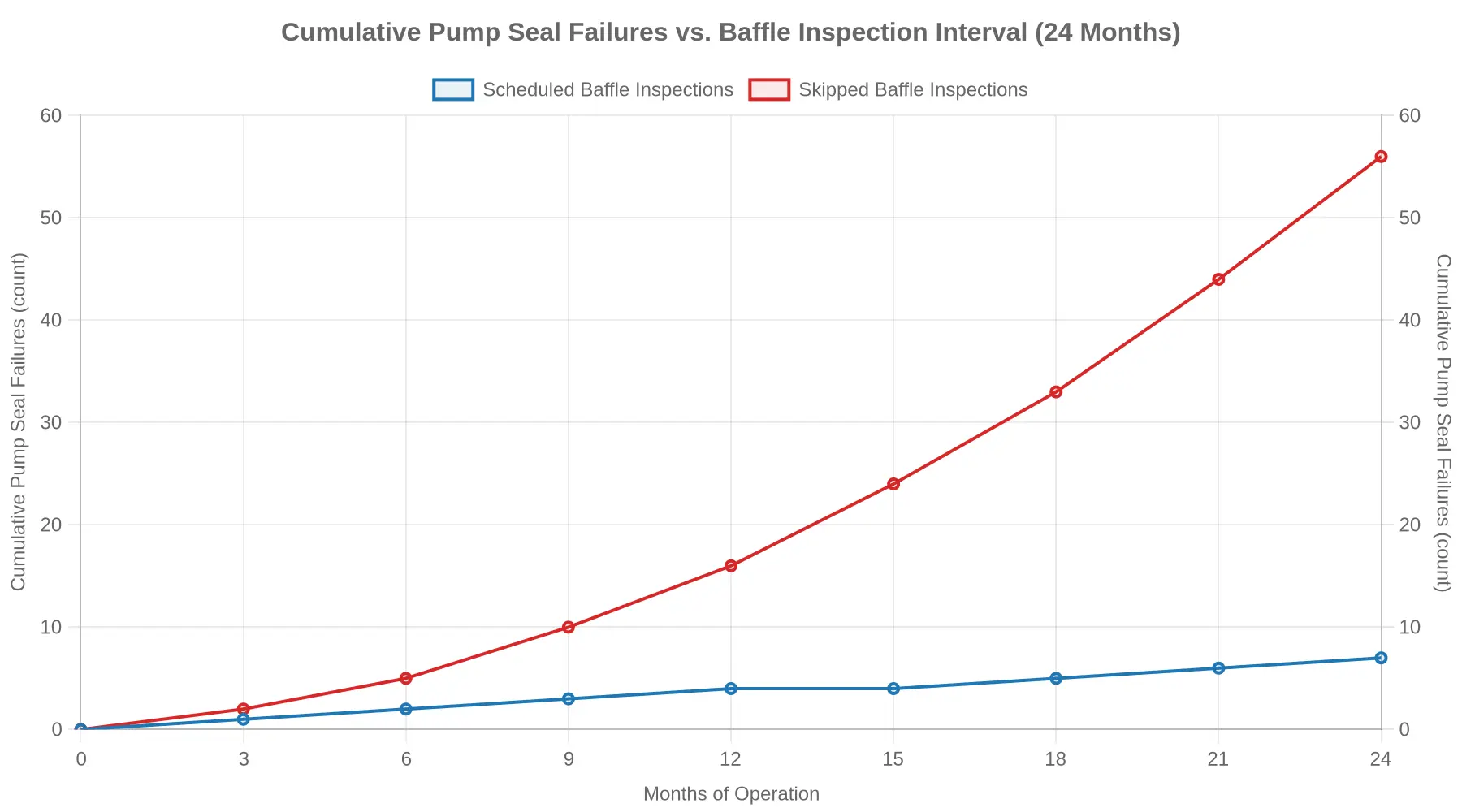
The two lines show a maintenance shortcut compounding over a 24-month operating window. The fleet that kept its internal municipal water trucks on a scheduled baffle inspection cadence recorded 7 cumulative pump seal failures. The fleet that deferred those checks reached 56. The lines separate slowly in the first quarter and then diverge sharply after about month 12, once loosened baffles, sloshing surge, and repeated low-pressure cavitation have had time to work the same seal faces across graded routes.
The fleet that skipped its baffle inspections finished the two-year period with eight times the seal failures of the fleet that stayed on schedule, and the gap was still widening when the chart period ended.
Field Diagnostic Checklist: Catch Cavitation and Baffle Problems Before Seal Failure
Before your next graded route, run this field diagnostic checklist on your municipal water trucks and spray systems. Each check takes only seconds, but together they catch the cavitation and baffle problems that destroy pump seals:
- Listen for pump rattle at idle and under load – a gravelly knock that tracks engine RPM usually means vapor bubbles are collapsing in the impeller, the earliest sign of cavitation.
- Watch spray bar pressure for flutter – a needle that twitches or dips in rhythm with the pump points to air entrainment, not a lazy nozzle.
- Check for intermittent flow loss at partial tank fill – if spray weakens when the tank is half empty, suspect a baffle that no longer keeps the inlet flooded.
- Inspect the pump inlet strainer for debris – pull it, clear leaves, scale, and grit, then log the condition so repeat clogging gets escalated.
- Verify tank fill level during route operation – confirm the operating level keeps the suction port submerged through grades and crown transitions.
- Borescope the internal baffles at every PM interval – look for cracked welds, bent panels, and missing gussets that let water slosh and starve the pump.
- Check the pump seal for weeping – a few drops after shutdown is normal, but a steady drip or wet weeper means cavitation is already hammering the seal.
- Check bearing play and temperature – feel the shaft for radial play and hit the housing with an IR gun; hot or loose bearings amplify cavitation damage fast.
Field-Ready Prevention and Specification Recommendations
The PM standards you set and the procurement language you approve decide whether your trucks cavitate early or run for years. Pump cavitation rarely announces itself. It works through impellers, seals, and bearings until a repair bill lands on your desk. These recommendations are field-tested and spec-driven.
Put Internal Baffle Inspection on the PM Schedule
Baffles get skipped because they sit out of sight, but a partly filled municipal water truck on a graded route slams water into those plates every time it turns or brakes. A cracked weld or fatigued baffle lets the load surge, starves the pump inlet, and starts the cavitation cycle.
Set a defined interval: 500 hours or once a year as the baseline, tightened to 250 operating hours or 90 days, whichever comes first, for units that run graded, unpaved routes daily. Log the results so trends stay visible.
Specify Borescope Access Ports
You should not have to drain a tank or pull the body to look inside. Require factory or retrofit borescope access ports so a technician can feed a camera to each baffle in under thirty minutes. Place ports at the front, middle, and rear chambers.
Demand Baffle Design and Weld Quality
When specifying new or replacement tanks, write the details into the bid. Call for gusseted baffles, correct spacing, and full-penetration welds rather than stitch welds that crack under surge. Reject any tank that cannot provide a baffle drawing.
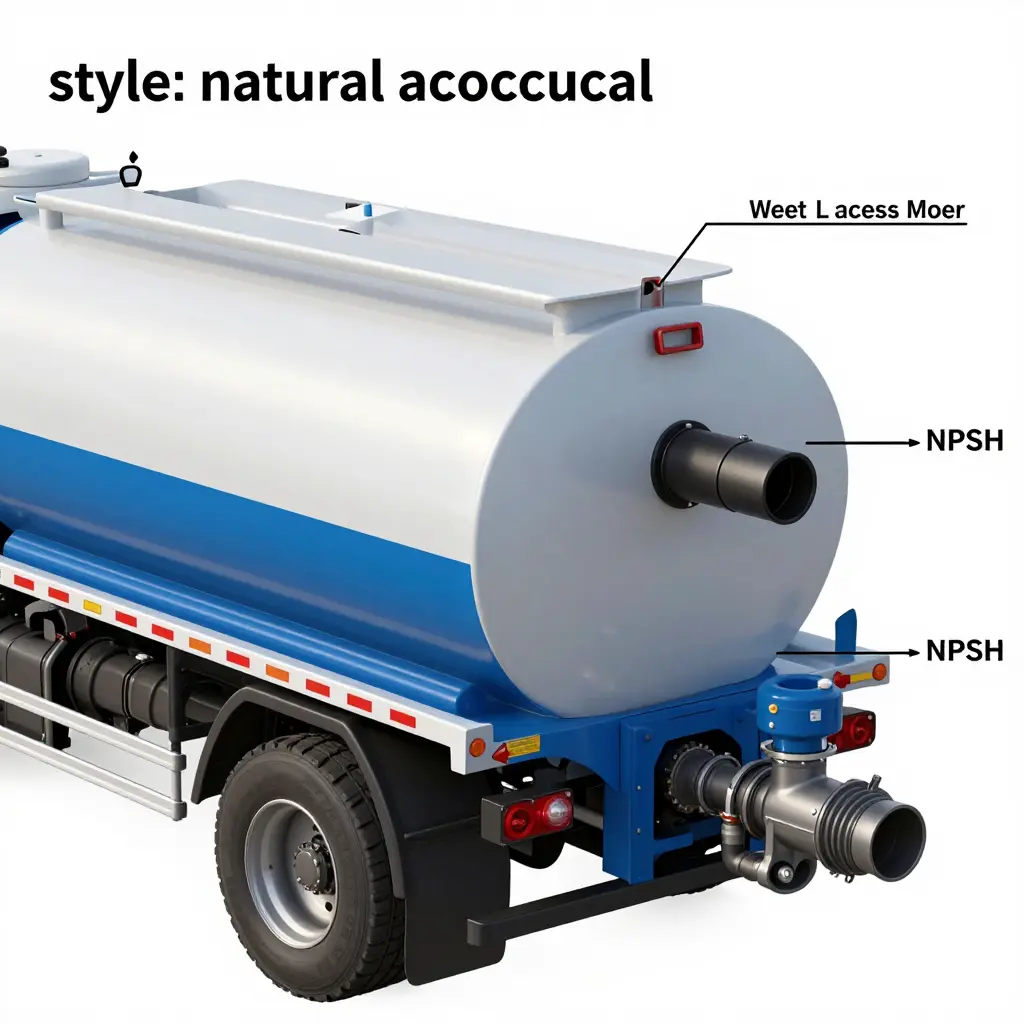
Size Pumps and Inlet Plumbing for NPSH
A cavitating pump is usually a plumbing problem, not a pump problem. Size the pump to the flow you actually need, then upsize the suction line one step. Keep suction runs short, eliminate sharp elbows, and never neck down right at the inlet.
Coach Operator Habits That Reduce Surge
Operators control half the problem. Smooth acceleration and braking, avoiding half-loads at highway speed, and matching fill level to the job all cut surge loads. Add a short refresher to annual driver training.
Buy Tanks and Pumps with Documented Baffle Configurations
Documentation is leverage. When suppliers provide baffle drawings and weld specs, you can verify condition, plan PM, and compare replacement options. This matters most when evaluating used tank and pump condition before you commit budget.
| Component | PM Interval | Spec / Target |
|---|---|---|
| Internal baffles | 250 hrs or 90 days (graded routes) | Gusseted, full-penetration welds |
| Borescope access | Each seasonal service | Front, middle, rear ports |
| Pump suction line | Annual inspection | One size larger, short, few fittings |
| NPSH margin | At commissioning | Positive margin at max flow |
| Operator training | Annual refresher | Smooth start/stop, correct fill level |