
Why the Wisconsin Road-Salt Environment Accelerates Corrosion
Winter Writes the Corrosion Recipe
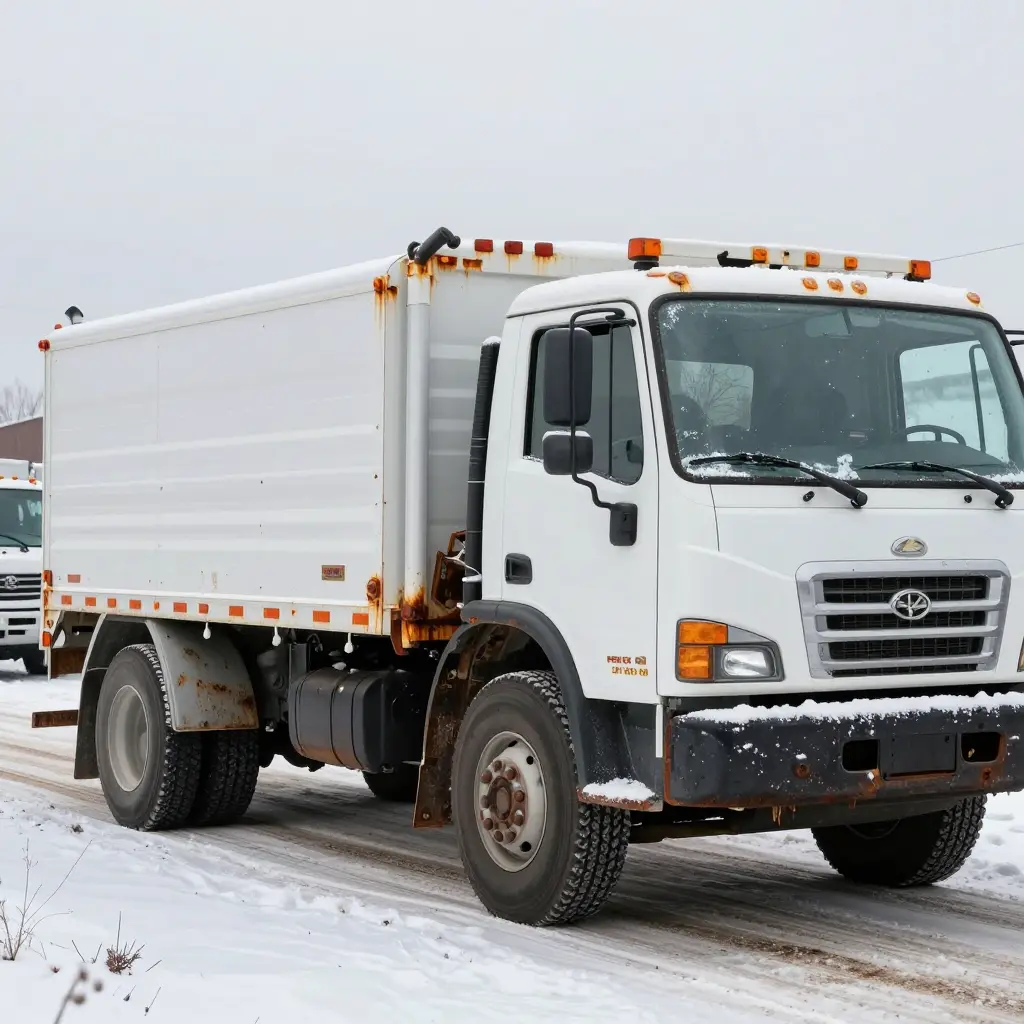
Wisconsin winters are not only cold. They are chemically hostile to steel. The state’s winter maintenance cycle exposes municipal trucks to far more chloride than a quiet cold climate ever would, and the damage lands on the frame rather than the paint. The result is road salt frame rust that starts out of sight and shows up as structural failure long after the warranty conversation ended.
For fleet managers, that reframes the problem. Rust here comes from exposure, not age, and the exposure repeats: a Wisconsin plow or salt-spreader truck meets the same set of conditions every season.
Chemistry, Retention, and Time
Salt and brine volumes
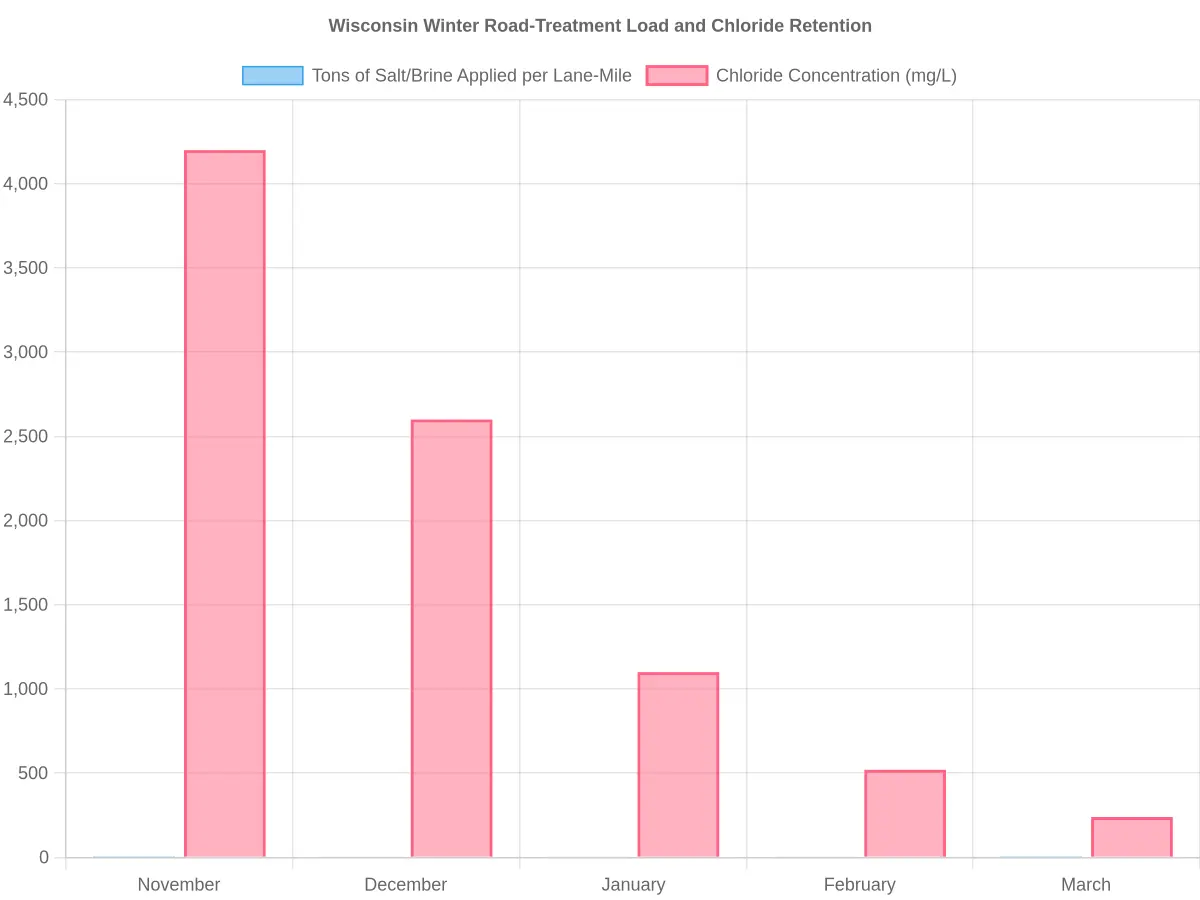
Modern winter operations use both rock salt and liquid brine, and application climbs sharply at the peak of the season. In a typical year, salt and brine use per lane-mile roughly doubles between November and January, then tapers off in March. Almost none of it stays where it lands. It ends up under the body, inside the rails, and in every cavity the spray can reach.
Chloride stays behind
Chloride is the corrosive agent, and it lingers. After a brine application, chloride retained on the road surface stays high for days and remains measurable for weeks between events, falling from more than 4,000 mg/L on day one to still-significant levels three weeks later. Trucks are not splashed once; they sit in a chloride bath.
Freeze-thaw cycling
Wisconsin’s winters cross the freezing point again and again. Every thaw lets chloride-laden water into seams and joints; every refreeze expands it. The cycle pushes brine deeper into the structure, and the electrochemical reaction behind snowplow truck frame corrosion speeds up with it.
Long exposure windows
Plow and spreader duty cycles are punishing in a way most fleet work is not. These trucks run the longest shifts on the calendar, often 12-hour rotations through storms in the wettest, coldest, most salt-saturated conditions. Their exposure is measured in months, not minutes.
How brine reaches the frame
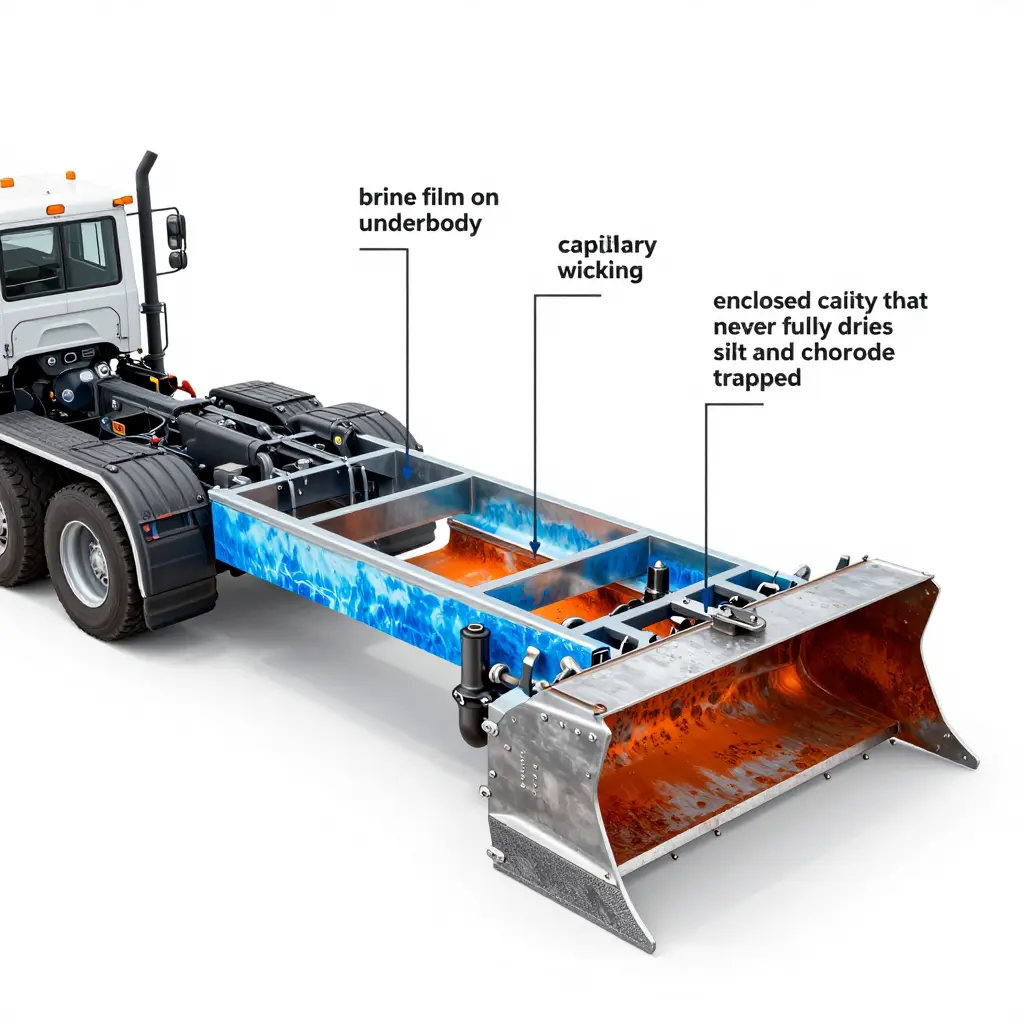
Liquid brine clings to underbody surfaces, then wicks upward by capillary action into enclosed, boxed frame cavities. Moisture, chlorides, and road silt collect there, and the cavities never fully dry. Corrosion starts on the inside while the exterior still looks clean.
The Implication for Fleet Operators
For municipal fleet maintenance, the lesson is that Wisconsin compresses the corrosion timeline. Failures arrive ahead of schedule. Rinsing, cavity flushing, and inspection intervals have to be built around how aggressive the environment is, not around the calendar. Operators of heavy equipment already manage corrosion rinse intervals to slow the same pattern, and the same discipline applies here. The trucks that last a full Wisconsin career are the ones inspected inside the rails, not just under the cab.
The Inspection Gap: Why Road Salt Frame Rust Goes Undetected Until It’s Structural
The Gap Is Systemic, Not Careless
It would be easier to blame a missed frame crack on a distracted technician or a skipped checklist line. The more uncomfortable answer is that inspection gaps in municipal fleet maintenance are built into how inspections are designed, scheduled, and funded. They are not a matter of technician competence.
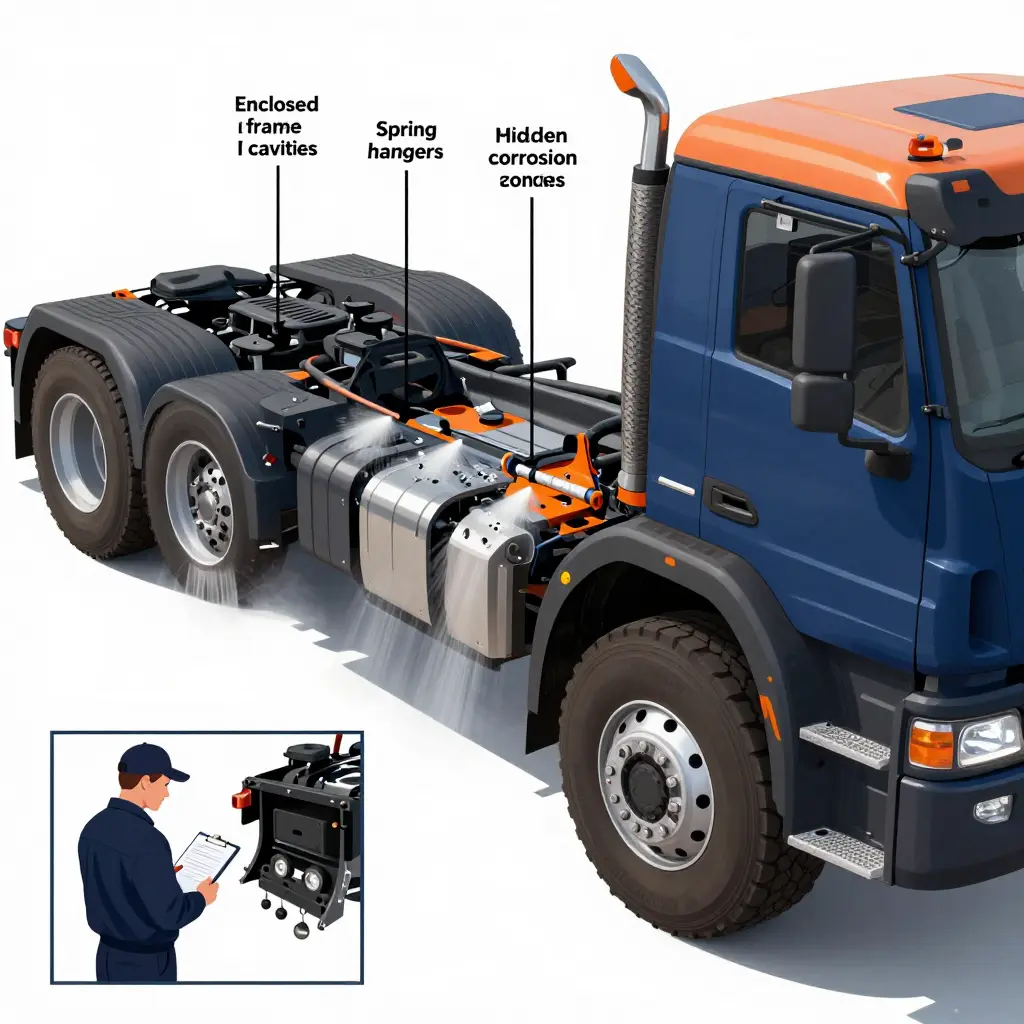
A pre-trip walkaround and a preventive maintenance (PM) service are built to answer one narrow question: can this truck safely leave the yard today? They check brakes that stop, lights that illuminate, tires that hold air, and hydraulics that lift. All of it is fast, visual, and reachable from outside. The enclosed frame cavities, spring hangers, and crossmember junctions where road salt frame rust actually begins – the spots most exposed to brine spray and least exposed to daylight – are none of those things. By design, the inspection system looks everywhere the corrosion is not.
What Standard Inspections Cover, and What They Miss
| Inspection layer | Primary focus | Access method | Frame cavities / spring hangers / crossmembers |
|---|---|---|---|
| Pre-trip walkaround | Brakes, lights, tires, mirrors, leaks | Visual, external | Not accessed |
| Preventive maintenance (PM) service | Fluids, filters, brake wear, hydraulic lines | Visual and hands-on at serviceable points | Rarely tapped or probed |
| Annual safety inspection | Steering, suspension, brake balance | Visual and load test | Partially visible at best |
The final column repeats across all three rows: the chassis parts most vulnerable to chloride are the ones no standard interval is designed to reach. For a closer look at how corrosion-service intervals are set, see this guidance on landfill truck bed corrosion and rinse intervals.
Why Visual-Only Inspections Miss Structural Damage
Three forces reinforce one another:
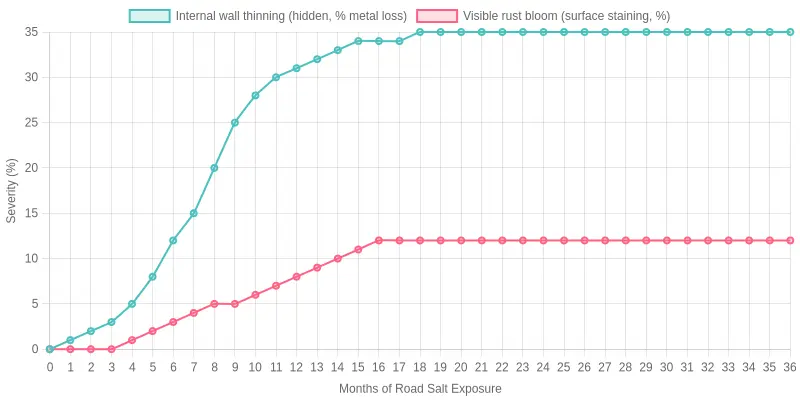
- Paint hides wall-thinning. A frame rail can lose a third of its steel thickness from the inside while the factory coating still reads “intact” from the curb. Corrosion begins on interior walls, between stacked C-channels, and behind riveted gussets, where moisture and salt pool and dry over and over.
- Salt residue obscures the early bloom. The white-grey crust a worker wipes away is a symptom, not harmless film. Read it as cosmetic winter grime, and the first visible rust bloom stays underneath it.
- Downtime pressure discourages deep teardown. Pull a plow truck from service in January and a route goes unplowed. Dropping crossmembers, splitting frame rails, tapping with a pick hammer: all of it gets deferred precisely when salt exposure peaks.
The chart below tracks the gap between hidden internal wall loss and the surface bloom crews actually see.
Hidden Corrosion Crosses the Threshold First
Timing defines this failure mode. Internal wall-thinning climbs steadily from the first winter of chloride exposure, while the rust bloom that would trigger action lags by months, often years. By the time pitting or flaking shows on an accessible surface, corrosion has already crossed structural thresholds inside the rail, the hanger, or the crossmember junction. The inspection did not fail because someone was careless; it failed because it was never pointed at the right place.
Wisconsin’s heavy road-salt and brine program does its damage long before visible rust tells the story. The table below maps where salt-driven corrosion takes hold, what failure hides behind it, and what inspection rhythm to build into the winter-readiness schedule. Adjust the intervals to your own operating hours, wash-down frequency, and corrosion rinse cadence.
| Component | Corrosion Vulnerability | Typical Hidden Failure Mode | Recommended Inspection Method | Suggested Inspection Interval |
|---|---|---|---|---|
| Frame rails | High – brine pools on the top flange and inside the C-channel | Internal wall thinning plus cracked web near the rear axle | Tap test with a hammer, ultrasonic thickness gauge, borescope inside the rail | Twice yearly (post-winter and pre-winter) |
| Crossmembers | High – traps road spray and debris at riveted joints | Loosened rivets and concealed section loss at attachment points | Hammer tap for rust-jacking, visual scan, ultrasonic spot checks | Annually, before pre-winter service |
| Spring hangers | Very high – direct salt spray with no drainage path | Fatigue cracking at the hanger-to-frame weld | Dye-penetrant or magnetic-particle test plus close visual for cracking | Every six months |
| Body mounting brackets | Medium-high – crevice corrosion at bolt interfaces | Bolt stretch and hidden bracket thinning | Torque check with brackets partially loosened, then visual | Annually |
| Brake lines and fittings | Very high – exposed to direct salt and continuous spray | Internal pitting escalating to sudden line burst | Full-run visual, pressure test, replace at first sign of pitting | Every six months (before each winter) |
| Fuel tank straps | High – moisture and salt trapped between strap and tank | Strap section loss causing tank shift or drop | Visual and tap test, verify strap tension | Annually |
| Underbody wiring harnesses | Medium – connector and conduit corrosion | Intermittent electrical faults and hidden chafing | Visual for cracked conduit, test connectors for corrosion | Every six months |
Early Warning Signs of Hidden Road Salt Frame Rust
Wisconsin’s brine-and-salt winters attack a truck frame from the inside out, so the earliest clues rarely look like much. Have your crew flag these conditions during every post-storm walkaround:
- Flaking or bubbling paint along the frame rails, especially behind the cab where salt spray collects.
- Orange staining on spring hangers and shackle brackets that returns within days of a wash.
- Rust-colored weep marks trailing from crossmember-to-frame seams and rivet heads.
- Soft spots or a spongy “give” when probing the web and flange with a dull awl.
- Sagging body mounts, uneven cab-to-bed gaps, or compressed and crushed shims.
- Recurring brake-line corrosion at retaining clips, elbows, and the master-cylinder run.
- Pitting and scaling on fuel-tank straps, battery-box mounts, and underbody support brackets.
- Hairline cracks radiating from bolt holes and weld toes, often masked by rust scale.
- Crumbling or missing undercoating that exposes raw metal on lower frame sections.
- White or grey salt residue packed into boxed-frame cavities that never fully rinse out.
How to Read These Signs
Read the list as a severity ladder, not a pass-or-fail checklist. Surface bloom on a spring hanger is a maintenance reminder. A spongy awl probe that punches through a rail is a structural emergency. The distinction matters most on trucks that ride low to the roadbed all winter: ongoing snowplow truck frame corrosion usually starts at joints and mounts before it ever reaches a flat, visible section of steel. Two or more signs clustered in one zone means the damage is already deeper than the paint suggests.
Escalating from Visual Check to Deep Inspection
A thorough visual pass is only the first step. When warning signs appear, escalate in order. Clean the area with a wire brush or needle scaler, then tap-test with a ball-peen hammer and listen for the dead sound of thin metal. Follow with ultrasonic thickness gauging at reference points recorded during the truck’s first service year. A borescope will show boxed rails where salt-laden slurry settles and hides, and magnetic particle or dye-penetrant testing confirms cracks that rust has camouflaged.
Document every finding with photos, measurements, and dates. That history is what lets a maintenance supervisor justify a repair, a rotation, or a replacement before a rail fails mid-route.
Turning Signs into Decisions
Strong municipal fleet maintenance programs turn these observations into scheduled work: warm-water rinsing after storms, targeted cavity flushing, and shorter inspection intervals for plow-dedicated units. Consistent corrosion rinse intervals usually slow the decay more cheaply than any repair. When gauging shows metal loss beyond safe limits, the hard call is repair versus retirement. Either way, catching the signs early keeps a snowplow on the road and off the tow truck.
Why the Numbers Don’t Match Your Inspection Sheet
Road salt does not attack a truck frame in a straight line, and that is why so many municipal fleets get caught out. The chart below plots two corrosion curves for salt-exposed trucks running through Wisconsin winters. Watch how far apart they drift after the six- or seven-year mark.
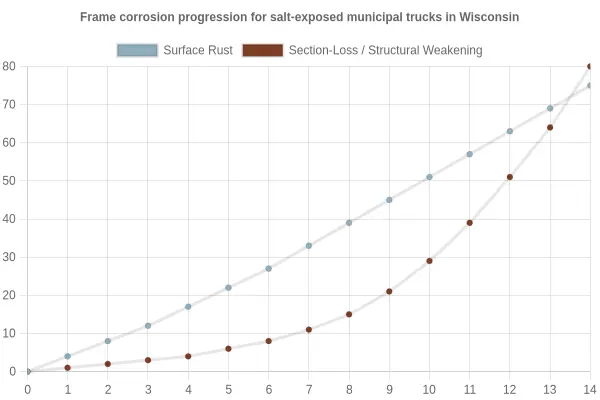
Figure 1: Surface rust advances in a steady crawl. Structural section-loss stays flat for years, then bends sharply upward as wall thickness erodes past its safety margin.
Reading the Two Curves
The Surface Rust line creeps upward at a near-constant rate. It is visible, it is ugly, and it is what every mechanic photographs during a walkaround. It is also the least dangerous signal on the truck.
The Section-Loss / Structural Weakening line tells the real story. It hugs zero for the first few winters, because a thick steel frame can absorb a lot of surface oxidation before load-bearing capacity drops. Then, somewhere between year 5 and year 8, the curve elbows upward. Thinning wall sections lose stiffness faster than they lose thickness, a nonlinear relationship that creeps up on anyone inspecting only visually.
| Years in Service | Surface Rust (index) | Section-Loss (index) | Real-World Consequence |
|---|---|---|---|
| 0-2 | 0-8 | 0-2 | Cosmetic only; no action needed |
| 3-5 | 12-22 | 3-6 | Coatings fail; schedule rinsing |
| 6-8 | 27-39 | 8-15 | Hidden pitting; begin ultrasonic testing |
| 9-11 | 45-57 | 21-39 | Wall-thinning accelerates; load limits in review |
| 12-14 | 63-75 | 51-80 | Sudden fracture risk; structural repair or retirement |
What This Means for Your Fleet
The inspection gaps fleets find too late come from trusting a visual check to answer a structural question, not from lazy crews. Surface rust can look steady while the frame rail underneath crosses the threshold where a potholed plow route or a fully loaded dump bed turns into a failure event instead of a warning.
The pattern worth remembering: corrosion that presents itself suddenly almost never developed suddenly. The data has been bending toward trouble for years. It only looks like a surprise because nobody was measuring the right variable.
If you are deciding whether a high-hour truck is worth keeping in the rotation, compare its corrosion curve against what the used market actually offers before you commit to repairs. Learn more about the municipal trucks for sale in Wisconsin and how to vet frame condition before purchase.
Lifecycle Cost and Total Cost of Ownership: The High Price of Deferred Frame-Rust Attention
A Wisconsin public works director weighing a modest underbody rinse program against the other line items in the budget will usually treat the rinse as the discretionary one. That instinct is the most expensive habit in municipal fleet maintenance. Frame rust does not announce itself. It accumulates quietly under salt-soaked trucks, working a corrosion timeline that only surfaces at the worst possible moment.
Deferred Maintenance Is the Most Expensive Option
Postponing frame-rust work does not remove the cost. It converts a small, predictable operating expense into a large, unpredictable capital and service expense. With road salt frame rust, the savings from waiting are an illusion backed by an escalating liability. The money protected this fiscal year comes back as emergency welding, borrowed equipment, and replacement cycles arriving years early.
The Asymmetry of Cost Categories
The two sides are not close. Prevention costs are annual, incremental, and plannable. Failure costs are lumpy, concentrated, and they land during peak demand.
| Cost category | Proactive (annual, per truck) | Deferred (event-driven, per truck) |
|---|---|---|
| Underbody rinse program | $400 – $700 | – |
| Cavity wax / coating (amortized) | $150 – $300 | – |
| Targeted frame inspections | $300 – $500 | – |
| Frame repair and welding | – | $6,000 – $20,000 |
| Unplanned downtime | – | $500 – $1,500 per day |
| Peak-season emergency rental | – | $15,000 – $40,000 per season |
| Accelerated / premature replacement | – | $80,000 – $150,000 |
A full prevention program runs roughly $850 to $1,500 per truck per year. A single structural frame failure can consume that investment many times over, without warning. The chart below shows the imbalance.
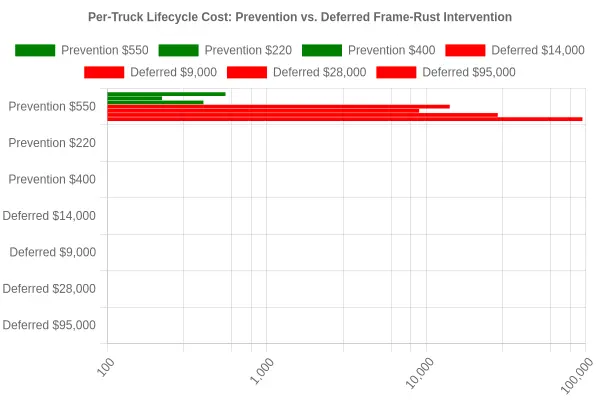
The Peak-Season Failure Multiplier
Timing turns an expensive repair into a crisis. A salt truck that fails in July is an inconvenience with a scheduled fix. The same truck failing in January, mid-freeze-thaw cycle with routes already running long, is a public safety and service-delivery emergency. The fleet then rents replacements at premium winter rates, chases emergency procurement for a truck that is not available, or pulls units off other routes. Each choice compounds the original repair bill.
Proactive Programs Pay Back
Rinsing, cavity coatings, and targeted inspections are not overhead. They are the cheapest insurance a municipal fleet can buy: they keep trucks in service, preserve structural integrity, and protect the asset value that decides what a unit is worth when it leaves the fleet. If you are weighing whether to repair, retire, or replace a corroding truck, understanding how replacement timing and condition affect used municipal truck resale and valuation will sharpen the math. The cheapest strategy is the one that spends a little early, every year, before the salt gets the final word.
Mitigation and Best Practices: Controlling Road Salt Frame Rust in Municipal Fleets
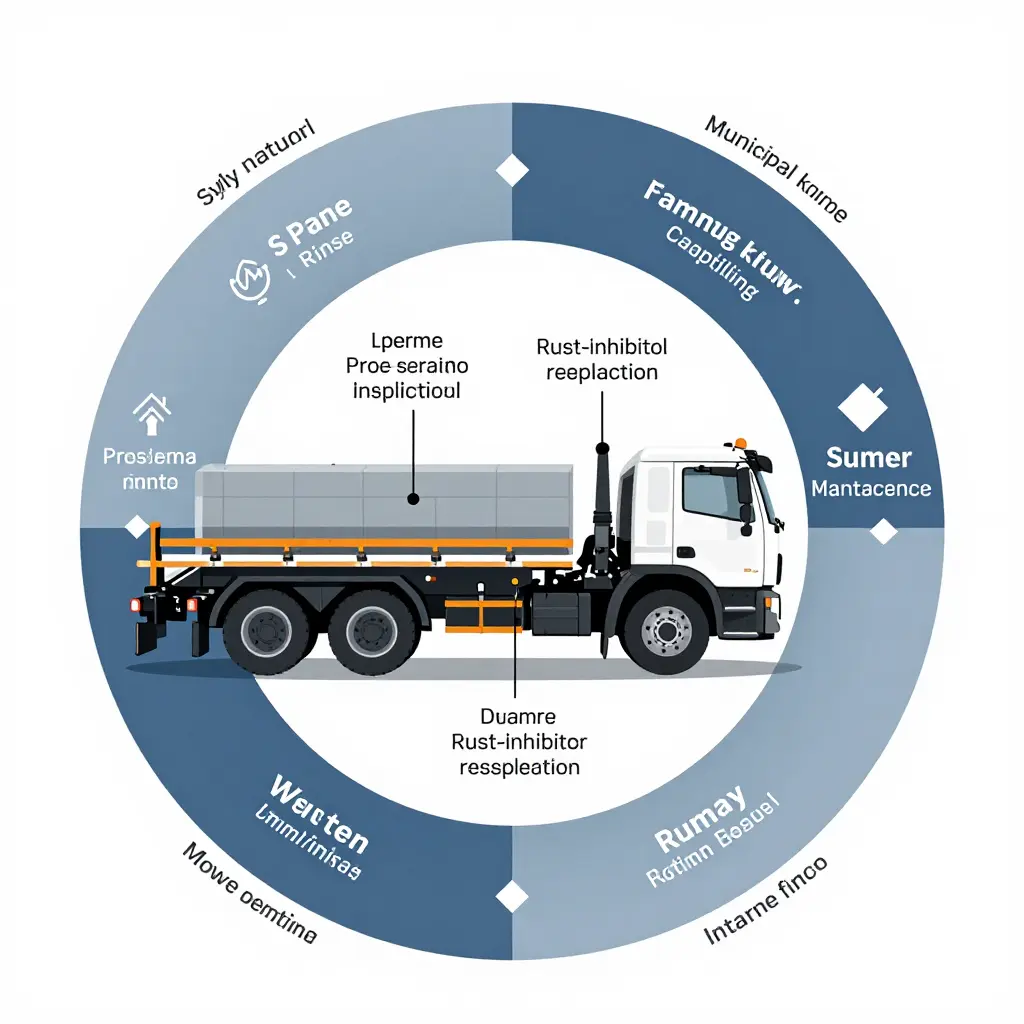
The gaps that surface too late on Wisconsin plow trucks are rarely one failure. They are the accumulated result of skipped steps, season after season. The practices below give municipal fleets a defensible, repeatable defense against road salt frame rust.
- Run a scheduled underbody rinsing and cavity flushing program. Daily fresh-water rinsing during the salt season removes chloride film before it binds to steel. Periodic high-pressure cavity flushing clears trapped brine from the enclosed box sections where corrosion accelerates.
- Specify corrosion-resistant structures at procurement. Written specifications should require galvanized or factory-coated frames, sealed cavity design, and drain passages that let brine escape instead of pooling.
- Apply sacrificial anodes or rust-inhibiting coatings. Zinc anodes and creep-capable inhibitors add a replaceable layer of protection that corrodes before the frame does, extending service life on units that cannot be rinsed daily.
- Schedule spring and autumn deep-inspection cycles. Spring inspections catch winter damage before it spreads; autumn inspections confirm every plow truck is road-ready before the first storm.
- Document every inspection finding for trend tracking. Standardized records reveal whether failure rates are climbing on specific makes, model years, or routes, turning anecdote into evidence.
- Institute a clear operator reporting protocol. Drivers who see bubbling paint, flaking scale, or new flex in a frame rail must have a simple, low-friction way to flag it the same day.
Prioritization: where to start when budgets are tight
Not every action carries equal weight, so rank by risk and cost. Rinsing and cavity flushing give the most protection per dollar because they interrupt the corrosion cycle all season. Corrosion-resistant specifications pay off over the ownership life, but only on new purchases, so they belong in long-range planning. Anodes and inhibitors sit in the middle, best reserved for high-use plow units facing severe exposure.
Integrating these practices into municipal fleet maintenance
These steps work best folded into routines you already run rather than as a separate program. Put cavity flushing on existing PM intervals, attach the autumn inspection to pre-season plow-truck servicing, and route operator reports straight into the work-order system so nothing is lost.
Over time, trend data sharpens municipal fleet maintenance decisions about when to repair, rotate, or retire a unit. Catching snowplow truck frame corrosion in spring costs far less than finding a compromised frame at first snowfall. For related guidance, see our notes on setting a practical rinse interval. Road salt is beaten by consistency, not by intensity.
Where the Money Actually Goes: Prevention vs. Reactive Repair
A Wisconsin municipality’s truck-corrosion budget rarely tells the whole story through its line items. The chart below maps how a typical snowplow and road-salt-exposed fleet allocates corrosion spend, and the picture is uncomfortable: most of the money goes to fixing damage after it happens, not to stopping it.
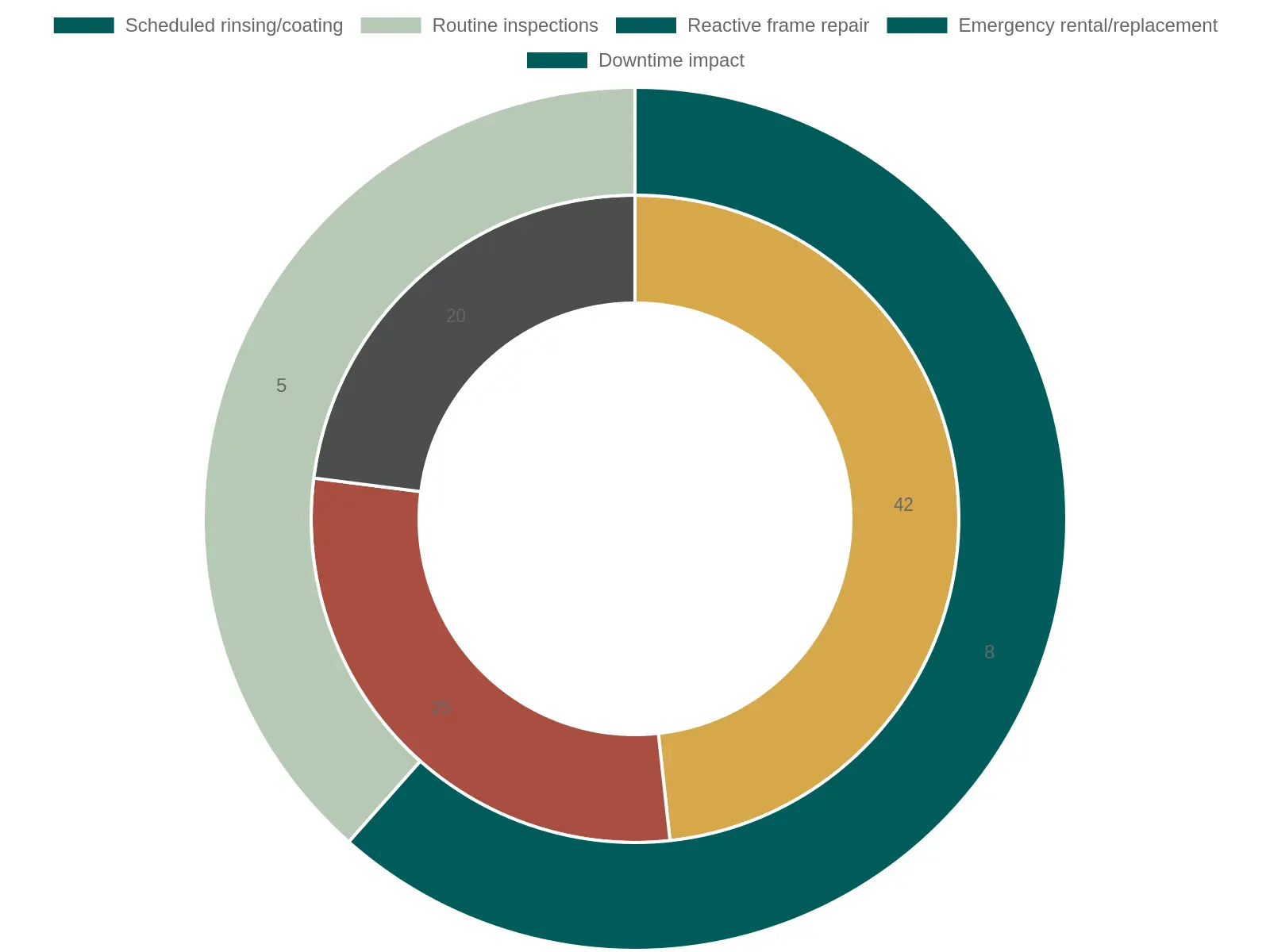
The ring breaks down like this:
| Budget Category | Share of Spend | Group |
|---|---|---|
| Scheduled rinsing/coating | 8% | Prevention |
| Routine inspections | 5% | Prevention |
| Reactive frame repair | 42% | Reactive |
| Emergency rental/replacement | 25% | Reactive |
| Downtime impact | 20% | Reactive |
| Prevention subtotal | 13% | — |
| Reactive subtotal | 87% | — |
Why the Small Slice Is the Big Lever
The two prevention segments, scheduled rinsing/coating and routine inspections, add up to roughly 13% of the budget. The three reactive segments – frame repair, emergency rental or replacement, and downtime impact – absorb the other 87%.
That imbalance is the argument for shifting spend upstream:
- Undercarriage rinsing and protective coatings interrupt the chloride chemistry that turns road-salt brine into structural rot. A modest line item here prevents corrosion that would otherwise surface years later as cracked frame rails and failed crossmembers.
- Routine inspections with an enforced interval catch surface rust and flaking at the stage where a wire brush and a fresh coat still work. Once pitting reaches the load-bearing steel, the cheap fix is gone.
- Downtime impact, at a fifth of the budget, is the hidden tax. A truck in the shop during a February freeze-up is a repair bill plus a plow route running behind, with overtime absorbing the gap.
Reading the Chart as a Decision Tool
If your fleet’s ring is more skewed than this, with prevention stuck in the low single digits, the math is working against you. Reactive categories do not shrink on their own; they compound as the fleet ages and salt exposure accumulates season after season. Moving even a few points from “reactive frame repair” into “scheduled rinsing/coating” and “routine inspections” attacks the largest segments indirectly, by starving them of the corrosion that feeds them.
A practical first step is to tie rinse frequency to actual exposure instead of the calendar alone. For a closer look at interval-based rinsing in demanding waste and heavy-haul environments, see this guide to corrosion rinse intervals on landfill truck beds, where the same salt-and-brine logic applies to municipal frames.
The cheapest corrosion program is the one you fund before the frame starts talking back.
Procurement and Specification: Engineering Corrosion Out of the Contract
By the time a plow truck shows bubbling paint on the doors or a frame rail you can flex with a thumb, the damage was locked in at the specification stage, not the maintenance bay. For fleet and risk managers, corrosion resistance is a procurement decision, and road salt frame rust is the symptom that surfaces years after the warranty conversation ended. The framework below helps bake corrosion performance into the contract, verify it at delivery, and hold suppliers accountable over the full service life.
Write Spec Language That Survives the Salt Belt
Vague phrases like “corrosion-protected frame” are unenforceable. Reference standards, materials, and measurable minimums instead:
- Galvanized frames: “Frame rails and crossmembers shall be hot-dip galvanized after fabrication to ASTM A123, minimum coating weight of 2.0 oz/ft2 (3.4 mil). All cut edges and drilled holes shall be coated with a zinc-rich repair compound.”
- Cavity wax: “All enclosed frame sections, boxed members, and cab rockers shall receive factory-applied corrosion-inhibiting wax injection, minimum 40 microns dry film thickness, before body mounting.”
- Sealed electrical connectors: “All chassis, body, and lighting connectors shall be rated IP67 or better, with sealed splice joints and dielectric grease at all field connections.”
- Corrosion-resistant fasteners: “All exposed body, fender, and undercarriage fasteners shall be 300-series stainless steel or zinc-nickel coated; standard zinc-plated hardware is not acceptable.”
| Component | Example spec language | Field benefit |
|---|---|---|
| Frame | Hot-dip galvanized per ASTM A123, 3.4 mil min | Delays structural rust-through |
| Cavities | Factory wax injection, 40 micron DFT | Protects hidden box sections |
| Electrical | IP67 sealed connectors, greased splices | Prevents brine-driven short circuits |
| Fasteners | 300-series stainless or zinc-nickel | Stops seized, corroded hardware |
Inspection Requirements at Delivery
A truck that meets the spec on paper can still arrive compromised. Insist on a witnessed inspection before final payment:
- Spot-check galvanizing with a magnetic coating-thickness gauge on three frame locations per unit.
- Watch for inspection gaps: unpainted cut edges, missing cavity plugs, unsealed splice connections, and body-mounted wiring resting against bare steel.
- Document everything with dated photos and a signed punch list, then withhold final retention until defects are corrected.
Warranty Language Around Corrosion
Push past a generic “perforation” clause. Require a stated term (five to seven years is realistic for galvanized frames), define “perforation” as measurable rust-through rather than visible staining, and insist that cosmetic and fastener corrosion are covered separately. Clear remedies – repair, replace, or credit – matter as much as the duration.
Vet the Supplier’s Track Record
Ask for fleet references in similarly salty climates, then call them and ask one question: how did these trucks look at year five? Review prior warranty claims and service bulletins, and check whether the builder’s corrosion process is documented in a controlled standard. Working with qualified suppliers of specialized municipal units gives you a documented baseline to compare bids against, rather than trusting marketing claims.
Weigh Upfront Cost Against Lifecycle Performance
The corrosion-resistant build usually carries a real premium, often $12,000 to $20,000 per unit. The premium hides the economics: a standard build bleeds money through frame repairs, electrical gremlins, and a shortened resale life, and those costs compound every winter. The premium typically pays back between years six and eight.
When budgeting, model total cost of ownership over ten years rather than purchase price. Then factor in the regional reality: for fleets buying municipal trucks in Wisconsin, where brine and road salt are applied for months at a time, corrosion resistance is closer to a structural requirement than a luxury. The cheapest bid is rarely the cheapest truck.
FAQs: Road Salt Frame Rust and Inspection Gaps in Wisconsin Municipal Fleets
Wisconsin winters are hard on more than schedules. They take truck frames apart from the inside out. Here are the questions public works directors and fleet managers ask most.
Q: How quickly does road salt cause frame rust on municipal trucks in Wisconsin?
A: In Wisconsin’s salt-heavy winters, unprotected steel frames can show surface oxidation within one season and meaningful pitting within two to three years. The state applies hundreds of thousands of tons of salt a year, and chlorides stay active whenever temperatures hover near freezing. Plow and brine-spreader trucks face the highest exposure, because spray reaches frame rails, crossmembers, and hidden cavities. Without disciplined rinsing, road salt frame rust moves from flash rust to structural loss faster than most fleet schedules anticipate.
Q: Can surface-only inspections catch structural frame corrosion?
A: Rarely. Visual walkarounds confirm only what you can see, and road salt frame rust typically begins inside boxed frame rails, between layered steel, and around rivets where moisture and chlorides collect. By the time corrosion blisters through the outer surface, cross-section loss is often already significant. A truck can pass a superficial check while hiding unsafe thinning. Effective programs use tap testing, ultrasonic thickness gauges, and borescopes to read internal condition, not just surface appearance.
Q: How often should underbody cavity inspections occur?
A: For Wisconsin plow and salt-spreader trucks, inspect enclosed frame cavities at least twice each winter and again during spring decommissioning. High-exposure units running brine or continuous storm duty may need monthly checks. Cavity inspections reach what rinsing alone cannot: inside boxed rails, behind fuel tanks, and around body mounts. Documenting findings each cycle turns municipal fleet maintenance from reactive repair into a predictive schedule, catching thinning before it becomes a roadside failure.
Q: Which components fail first from salt exposure?
A: Frame rails and crossmembers usually lead, followed by brake lines, fuel and air tank straps, spring hangers, and cab mounts. Electrical grounds, battery trays, and hydraulic fittings corrode nearly as fast. Salt-laden spray settles in low points, so rear frame sections behind spreaders go first. Because these parts are structural or safety-critical, road salt frame rust on any of them needs prompt attention. Focus inspections on these known weak points for the most risk reduction per inspection hour.
Q: What seasonal timing works best for rinse and inspection programs?
A: Rinse aggressively during and immediately after each salting event. Chlorides need moisture to corrode, and dry residue reactivates with the next thaw. Schedule deep underbody cleaning and full cavity inspections in late spring, once roads are clear, and again in early fall before the first storm. Mid-winter thaw windows are a bonus. You can review established corrosion rinse intervals to benchmark your own cadence. Aligning cleaning with freeze-thaw cycles keeps salt from sitting on bare steel for weeks.
Q: Is replacing a corroded truck ever cheaper than repairing it?
A: Sometimes. When corrosion has compromised frame rails, crossmembers, or multiple safety-critical mounts, welding repairs can exceed the truck’s remaining value and still leave hidden thinning elsewhere. A repair that restores one section while adjacent steel keeps failing becomes a recurring cost. Compare total repair estimates plus projected downtime against replacement cost and remaining service life. If structural loss is widespread, replacing the unit is often cheaper and safer than chasing road salt frame rust piece by piece.
Q: How do inspection gaps affect municipal fleet maintenance budgets?
A: Undetected corrosion drives surprise failures, emergency repairs, and unplanned downtime that disrupt snow response. Because inspection gaps hide deterioration until it turns structural, managers pay premium rates for rushed fixes or premature replacements. Conservative worst-case budgeting and documented inspection histories help, but prevention is cheaper. Strengthening municipal fleet maintenance with regular cavity checks and disciplined rinsing protects the budget and the public trust the trucks carry every storm.
The Bottom Line for Wisconsin Fleet Decision-Makers
One conclusion runs through all of this: road salt frame rust does not announce itself. It advances from the inside out, hidden behind undercoating, brackets, and crossmembers. The corrosion that ultimately cracks a frame is often years in the making before anyone in the shop sees it. For municipal trucks in Wisconsin, the corrosion you can see is rarely the corrosion that matters.
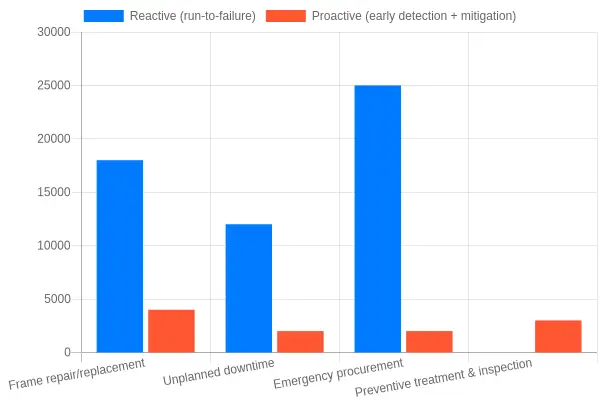
The inspection gap compounds it. Standard service intervals focus on brakes, fluids, and drivelines; frame integrity gets a visual check, infrequently or not at all. The failures then surface during pre-trip checks in January, in the middle of a snow event, or on the road. By then the decision has been made for you, and it is always the expensive one.
Early detection and mitigation programs change the economics of ownership, as the chart below shows.
Priorities to Act On Now
| Priority | Action | Why It Matters |
|---|---|---|
| 1. Baseline every frame | Photograph and gauge critical frame sections this season | Establishes a reference point so change, not appearance, drives decisions |
| 2. Build a wash cadence | Schedule undercarriage rinsing after every salt cycle | Removes the chloride load that fuels hidden rust |
| 3. Formalize frame inspection | Add scale-and-gauge checks to PM intervals | Closes the gap that lets failures surface too late |
| 4. Fund treatment | Budget for annual anti-corrosion treatment and sealant repair | Converts unpredictable repairs into a known line item |
| 5. Track lifecycle cost | Log corrosion spend per unit, per year | Turns maintenance from anecdote into evidence |
None of these steps is speculative. Operators who treat corrosion as a managed program rather than an inevitability see lower repair frequency, fewer roadside breakdowns, and longer service life from each unit. A disciplined approach to undercarriage corrosion control through scheduled rinse intervals is among the most cost-effective moves a municipal fleet maintenance operation has.
Why Proactive Corrosion Management Protects Your Budget and Your Winter
The case for action is straightforward. Proactive corrosion management protects winter readiness: a truck with a sound frame answers the call when the first storm hits, while a truck pulled for emergency repairs does not. It protects budget stability by replacing the high-cost spikes of run-to-failure repairs with planned, forecastable spending that holds up in a council review. For directors and procurement leads accountable for both uptime and the bottom line, that combination is the whole argument. Inspect early, treat consistently, and document everything. The cheapest frame repair is the one you prevented.