
Why the Standard Rinse Interval Fails Landfill Fleets
Landfill truck bed corrosion is the rusting and metal loss that happens when leachate, the liquid that drains from decomposing waste, contacts bare steel on truck beds and hoppers. Leachate carries chlorides and, while the waste is still young, is acidic. Every load throws splash onto bed walls, frame rails, and seams, where it dries, concentrates, and keeps attacking the metal long after the truck leaves the tipping face.
Most fleets set their rinse interval around housekeeping convenience, often once a shift or once a day, rather than around how the liquid behaves on steel. That mismatch is the problem. Leachate starts working on unprotected steel as soon as it wets the surface, and liquid caught in seams keeps working after a quick wash. A daily cycle leaves hours of active attack between rinses, and the damage accumulates load after load.
Below is the corrosion timeline of leachate on truck beds, the chemistry behind chloride and pH effects, and a rinse interval and method that match the real exposure cycle. Fleet managers specifying new units should evaluate municipal solid waste landfill trucks against this exposure profile.
Leachate Chemistry and Corrosion Mechanics
Landfill leachate is more than dirty water. It forms as rainwater and waste moisture percolate through decomposing refuse and dissolve organic acids, salts, and metals along the way. Its makeup shifts with the age of the fill: young, acid-forming waste produces acidic leachate with high organic acid content, while older waste gives leachate that moves toward neutral but stays heavy with chlorides and ammonia. Either way, it clings to whatever it splashes on, including the steel bed of a landfill truck.
The main offenders driving corrosion include:
- Organic acids (humic and fatty acids) that lower pH and strip protective oxide layers
- Chlorides that break down passive films and spark pitting
- Dissolved sulfates that feed microbial and electrochemical reactions
- Abrasive grit and suspended solids that scratch coatings and expose bare steel
- Persistent moisture that sustains the electrolyte needed for ion flow
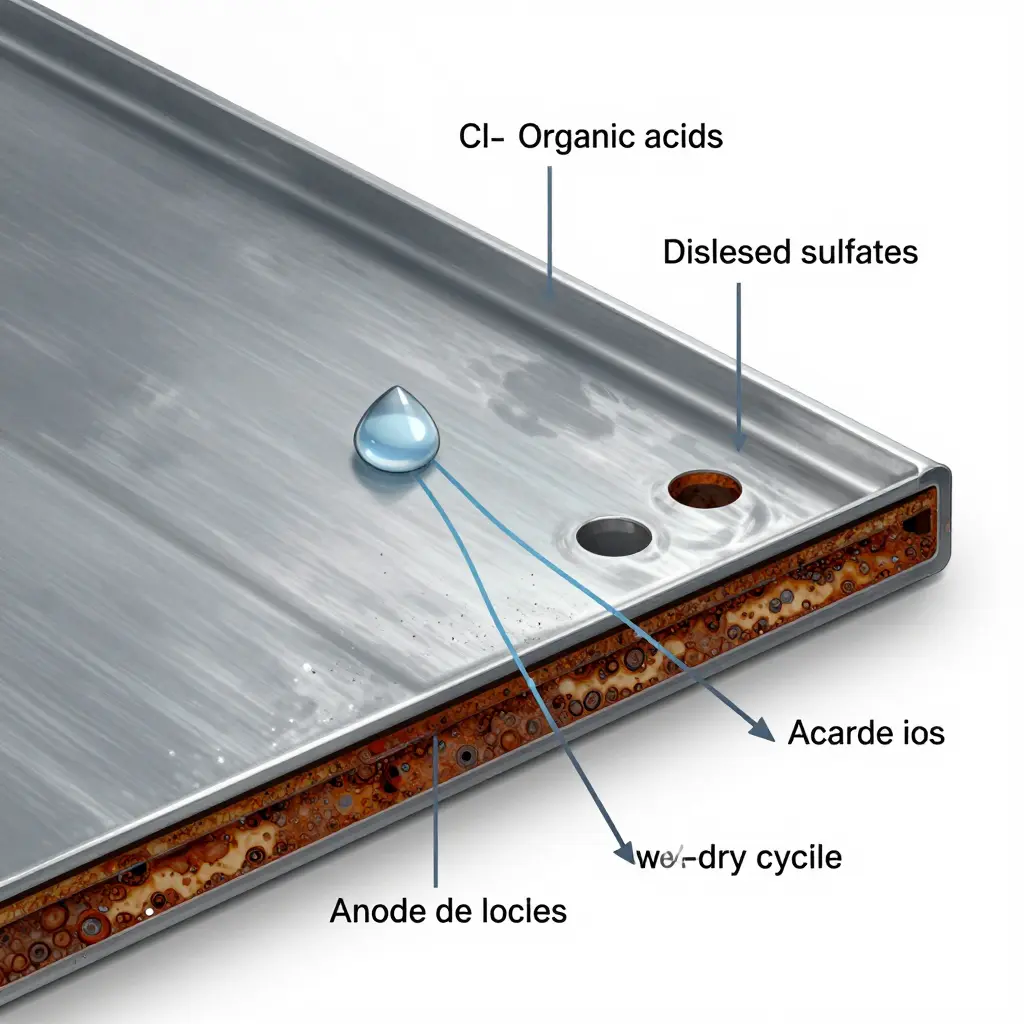
Corrosion here is electrochemical. Chlorides and acids attack the mill scale and paint on bed steel, opening tiny anodes and cathodes. Once the electrolyte bridges them, iron dissolves at the anode while oxygen reduces at the cathode, and rust creeps beneath the edges of intact coating. Wet-dry cycling makes it worse: each splash wets the surface, then evaporation concentrates chlorides and oxygen against the metal and reactivates the corrosion cell. Grit scours fresh metal, and the cycle restarts, eating bed steel long before visible rot appears.
What This Chart Shows
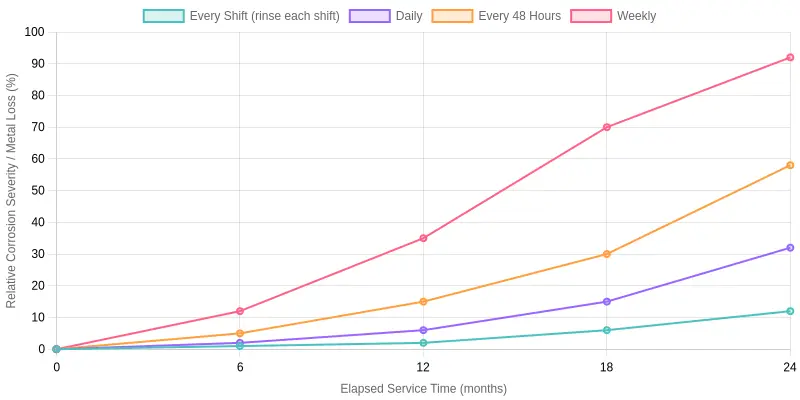
The chart is a modeled illustration rather than a field measurement. It plots relative corrosion severity, metal loss as a percentage, against service time in months for four rinse intervals. All four curves start at zero, then diverge as the months pass: rinsing every shift gives the flattest curve, weekly rinsing the steepest. The useful signal is the shape, not the exact values. Damage does not grow steadily with the length of the rinse gap. It compounds.
Chart Specification
| Element | Detail |
|---|---|
| Chart type | Line chart (four series) |
| Title | Landfill Truck Bed Corrosion Progression by Rinse Interval |
| X-axis | Elapsed Service Time (months), 0 to 24 |
| Y-axis | Relative Corrosion Severity / Metal Loss (%), 0 to 100 |
| Series 1 | Every Shift (rinse each shift) – flattest curve, ~12% at month 24 |
| Series 2 | Daily – moderate curve, ~32% at month 24 |
| Series 3 | Every 48 Hours – steep curve, ~58% at month 24 |
| Series 4 | Weekly – steepest curve, ~92% at month 24 |
| Legend | Color-coded, corner placement |
The Takeaway
The gap between a daily rinse and a weekly rinse is not a small scheduling preference. In this model it is the difference between a bed that lasts a full service life and one that is structurally compromised within two years. For fleets weighing replacement budgets, that curve is a cost line as much as a corrosion line, and belongs next to the economics of adding landfill-rated trucks to the lineup.
Caption: This line chart tracks corrosion severity over 24 months for four rinse intervals, showing that longer gaps between rinses produce progressively steeper metal-loss curves. Values are illustrative, not measured fleet data.
Rinse Interval vs. Corrosion Risk: A Quick Reference for Waste Fleets
How long leachate splash is allowed to sit before it is rinsed away is easy to overlook in landfill truck bed longevity. The table below maps common rinse schedules against the corrosion symptoms crews actually see in the yard. The timeframes and life impacts are typical estimates, not guarantees.
Rinse Interval and Corrosion Risk Comparison Table
| Rinse Interval | Typical Splash Exposure | Corrosion Risk Level | Recommended Action | Expected Component Life Impact |
|---|---|---|---|---|
| After every load | Minimal; leachate never dries on surfaces | Low | Maintain current practice; inspect drains and seals weekly | Bed and hoist can reach full 12-15 year service life |
| End of shift | Light to moderate; residual film sits a few hours | Low to Moderate | Rinse beds, hoist rails, and tailgates before parking | Minimal pitting; full design life largely preserved |
| Every 24 hours | Moderate; acidic film begins bonding overnight | Moderate | Rinse thoroughly; flush under-bed channels and hinges | Early surface rust manageable with annual touch-ups |
| Every 48 hours | Heavy; dried leachate salts activate on wetting | High | Deep clean, neutralize with alkaline wash, inspect seams | Pitting and seam corrosion likely within 3-5 years |
| Weekly | Severe; continuous salt and acid attack | Very High | Steam-clean and pressure-wash; schedule weld inspections | Structural thinning and premature bed replacement likely |
| Monthly | Extreme; corrosion fully established | Critical | Emergency remediation; assess bed for perforation | Component failure and costly replacement almost certain |
Once a fleet drifts past the 24-hour mark, each extra day of delay compounds the damage rather than adding to it in a straight line. That is why short, routine rinses matter more than occasional deep cleaning.
Corrosion Inspection Checklist for Landfill Truck Beds
Routine inspection is the first line of defense: the sooner staining, blistering, or pitted welds turn up, the cheaper the fix. Inspection only helps if the rinse interval is right, because no walk-around can undo leachate that sat on steel overnight. Here is what to check on every landfill truck bed.
- Inspect all welded seams along the bed sides for dark streaks, rust bleeding, or hairline cracks where leachate pools.
- Check hinge points at the tailgate and side gates for stiffness, exposed metal, and dried residue.
- Examine tailgate edges and top rails for chipped coating and gouges that trap acidic splash.
- Walk the full bed floor, especially behind the cab, for pitting, soft spots, and thinning plate.
- Examine the hoist frame and mounting brackets for corrosion where leachate runs and collects.
- Look for paint blistering or lifting on vertical panels, an early sign of subsurface corrosion.
- Confirm drainage channels and weep holes are clear and flowing, not clogged with debris.
- Check fasteners, U-bolts, and crossmembers for rust jacking and loosened hardware.
How Leachate Splashes Across the Truck Bed
[Figure: 2D side-view technical diagram – Leachate splash path across a landfill truck bed]
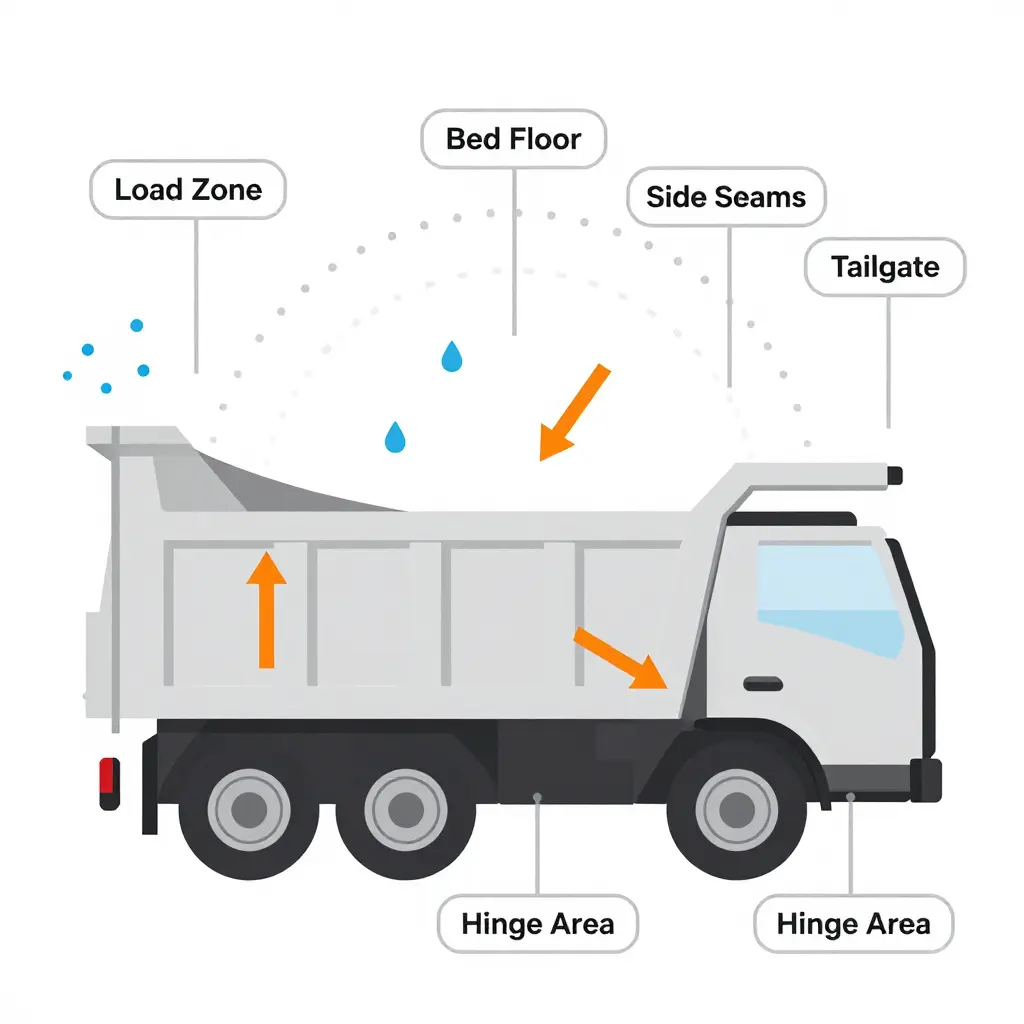
Image specification: A clean, flat-vector 2D side-view cross-section of a landfill dump truck bed. Simple geometric shapes (rectangles, arcs, circles) depict the bed, load mass, and truck body. Dotted blue splash arcs emanate from the load at the tipping area and travel backward and outward along the bed floor. Bold orange arrows indicate splash direction toward the tailgate and side seams. Short callout boxes label five zones: Load Zone, Bed Floor, Side Seams, Tailgate, and Hinge Area. Minimal palette (light gray bed, blue droplets, orange arrows, white background); no photographic textures and no baked-in captions.
Figure caption: Leachate flung from the load migrates along the bed floor and concentrates at the tailgate, side seams, and hinge area, which is where splash-zone corrosion takes hold. Reviewing how these trucks are built can help fleets plan inspection points for municipal solid waste landfill trucks.
The Real Price of Ignoring Leachate Corrosion
Leachate is acidic while the waste is young and chloride-heavy throughout. Every splash against a landfill truck bed starts or feeds a corrosion cell, and the repair bill arrives long before the truck is due for replacement.
The bed takes the first hit. Pitted floors and thinning sidewalls force replacement well before the truck reaches its expected service life. Once corrosion reaches the frame, the budget line becomes structural repair rather than routine upkeep.
The damage does not stay in the bed. Leachate migrates into hoist pivots, hydraulic rams, and seal surfaces, causing binding, leaks, and seized components. For a closer look at how heat and contaminants shorten seal life, see this breakdown of refuse truck compaction hydraulics and seal failure.
Downtime is where the cost lands hardest. A truck parked for hydraulic work is a route uncovered, a crew idle, and a substitute pulled from reserve. Across a fleet, corrosion becomes a scheduling problem as much as a repair bill.
Leaking beds and compromised hoists can also drip contaminated liquid onto public roads, which invites citations, spill reporting, and regulator attention.
Set against all that, the rinse interval is not a maintenance chore. It is one of the few levers that moves cost, uptime, and liability at the same time.
Why Rinse Schedules Slip Behind Leachate Exposure
Corrosion is expensive and easy to miss in refuse equipment, and the guidance for washing truck bodies asks more than most fleets deliver.
The gap is between written guidance and the schedule on the shop floor. Washing bodies after collection routes is the usual recommendation, but operational pressure stretches it to weekly or biweekly in many yards. Per-shift rinsing is the baseline the waste-body industry points to for corrosion control. That gap is where landfill truck bodies lose service life.
Where leachate splash lands, damage is aggressive and localized. Acidic, chloride-rich liquid accelerates rust along seams, hoppers, and underbody sections faster than road salt alone. Splash zones are small and often hidden, so corrosion runs unnoticed until the repair is structural.
Deferred washing shows up later in lifecycle cost: earlier steel loss, more repairs, lower resale value. Treating the rinse interval as a daily standard rather than an occasional chore is the cheapest corrosion defense a waste fleet has.
Repair Costs by Corroded Component
Not all corrosion damage is equal. When leachate splash eats into a landfill truck, the money concentrates in a few predictable places rather than spreading evenly across the vehicle. The chart below compares the relative average repair or replacement cost of the six most commonly affected components, with the bed floor indexed at 100. The figures are relative estimates, not quotes.
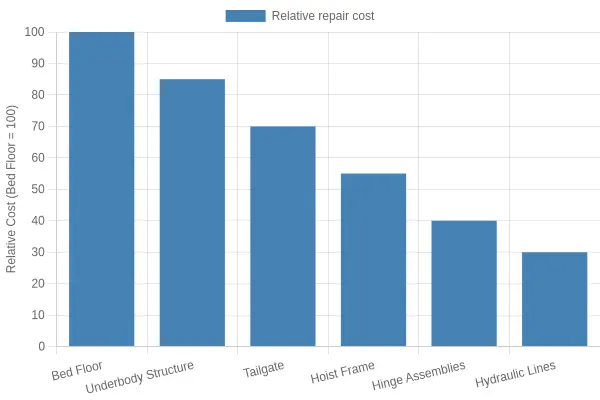
Chart specification
- Chart type: Bar chart
- Title: Relative Repair/Replacement Cost of Corroded Components on a Landfill Truck
- X-axis: Corroded Component (Bed Floor, Underbody Structure, Tailgate, Hoist Frame, Hinge Assemblies, Hydraulic Lines)
- Y-axis: Relative Cost (Bed Floor = 100), starting at zero
- Legend: Relative repair cost (single series)
- Data:
| Corroded Component | Relative Cost (Bed Floor = 100) |
|---|---|
| Bed Floor | 100 |
| Underbody Structure | 85 |
| Tailgate | 70 |
| Hoist Frame | 55 |
| Hinge Assemblies | 40 |
| Hydraulic Lines | 30 |
Caption: Bed floor and underbody structure account for the largest share of corrosion-related repair spending on landfill trucks, which makes them the components where a tighter leachate rinse interval pays for itself fastest.
Coatings and Material Mitigation: Building Beds That Survive Leachate
No rinse schedule can outwork a poorly protected bed. Corrosion protection starts at specification, where coating systems, galvanizing, and geometry decide how much maintenance a fleet actually carries. A high-build epoxy truck bed coating resists the acidic splash that eats seams and floor pans, while hot-dip galvanizing shields structural steel where coatings get scuffed off by heavy debris.
Design details matter as much as chemistry. Sealed seams keep leachate from wicking into joints that rinsing never reaches, and a rolled drip edge channels runoff away from the chassis instead of letting it pool along the frame. Proper floor drainage lets moisture exit the bed instead of lingering in corners.
Those choices reset the rinse interval you can live with. A galvanized, seam-sealed, drip-edged bed with full drainage can hold up on a weekly rinse, while bare or poorly drained bodies need attention after every wet load.
Specify these measures from day one:
- High-build epoxy or polyurethane bed liners
- Hot-dip galvanized structural steel and fasteners
- Continuously sealed seams with flexible sealant
- Rolled drip-edges and sloped floors
- Positive floor drains and wash-down ports
Sourcing well-specified bodies upfront is the cheapest corrosion strategy available. See how to find the right municipal truck bodies before you sign a fleet order.
Frequently Asked Questions About Landfill Truck Bed Corrosion
How often should a landfill truck bed be rinsed?
Rinse at the end of every shift, or at minimum once every 24 hours of active hauling. The right interval depends on how much leachate the loads produce and how long wet waste sits against the steel. When loads are unusually wet, rinse after every tip and treat daily rinsing as the baseline, not an upgrade.
Is plain water sufficient to remove leachate splash?
Plain water removes most solids and dilutes residual leachate, so it works fine for routine rinsing. It will not neutralize the acidic, chloride-rich film that drives pitting. Adding a mild alkaline detergent once a week noticeably improves results on any landfill truck.
Does cold winter weather change the rinse interval?
Yes. Road salt and frozen-on leachate combine to accelerate corrosion during freeze-thaw cycles. Rinse more often in winter, and never let residue stay frozen on the bed overnight. You can review municipal solid waste landfill trucks built for cold-weather duty cycles.
How can I tell if corrosion is already advancing?
Look for rust staining near seams, thin blistering paint, and pitting along the floor and side panels. Check weld lines and drain channels where moisture lingers after washing. A coating that feels soft or bubbles when pressed points to active corrosion underneath.
Do protective coatings eliminate the need to rinse?
No. Coatings slow penetration but do not stop leachate from sitting on the surface. Liners extend a bed’s life only when paired with regular rinsing. Skip rinsing and even a premium coating fails early, so keep the wash schedule intact.
A Rinse Protocol That Matches the Exposure
Leachate splash is the quiet threat in a waste management fleet. Every load leaves a film of moisture, salts, and organic acids clinging to the bed, and wherever that film lingers, corrosion begins. The cost is not cosmetic: pitting and rusted floor panels shorten service life, raise repair budgets, and pull replacement forward. The mistake most fleets make is the rinse interval itself, waiting days or waiting for a visible mess instead of cleaning after each shift.
To protect your equipment, build a repeatable routine:
- Rinse the bed immediately after every landfill shift, while residue is still wet and loose.
- Use a targeted, high-pressure wash focused on corners, seams, and the tailgate where splash collects.
- Inspect the floor and side panels for early pitting or blistering before returning the unit to service.
- Apply a corrosion-inhibiting coating or neutralizer to the cleaned bed at defined intervals.
- Document each wash and flag recurring rust zones for scheduled repair.
A disciplined protocol pays off long after today’s loads. Consistent rinsing extends equipment longevity, stabilizes maintenance costs, and keeps trucks productive for years, delaying the point at which you need to explore municipal trucks for sale.
Where Leachate Actually Lands: A Zone-by-Zone Breakdown
Not every square inch of a landfill truck bed gets hit equally. Leachate does not spray in an even pattern. It throws, drips, and pools depending on where the load shifts and where the truck flexes under it. That uneven distribution is what should set the rinse interval, not a general sense of having been thorough.
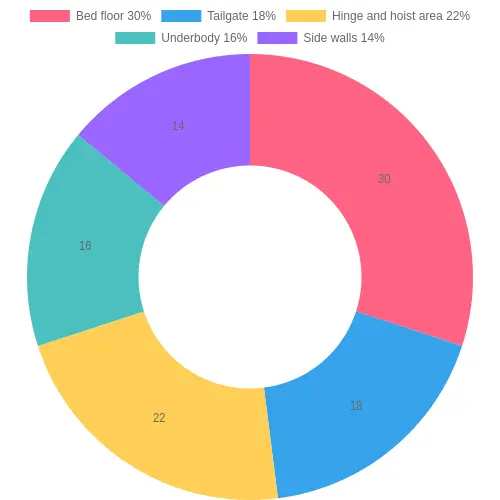
This doughnut chart shows the estimated share of total leachate splash contact by zone across a landfill truck: bed floor (30%), hinge and hoist area (22%), tailgate (18%), underbody (16%), and side walls (14%) – with the hinge/hoist and underbody zones collectively absorbing roughly 38% of all splash contact despite occupying only a fraction of the exposed surface area.
Why the Small Zones Carry the Big Risk
The numbers run against first instinct. The bed floor takes the largest single share at 30%, which makes sense, since it is a broad, flat surface that catches everything the load throws off. Then the hinge and hoist area pulls in 22%, and the underbody another 16%. Together, those two tight, hard-to-reach zones account for well over a third of all splash contact.
That is the trap fleets fall into. A washer walks around the truck, blasts the bed floor and the tailgate because those are the surfaces within sight and reach, and then calls it a day. Meanwhile the hinge, the hoist pivot, and the underbody, tucked underneath and behind, stay wet with acidic leachate long after the rinse is “done.”
Why Exposure Concentration Matters More Than Surface Area
Splash contact is not the same as corrosion. What corrodes a truck is leachate that lingers in crevices, joints, and enclosed spaces where moisture cannot drain or evaporate. That is exactly what the hinge/hoist and underbody zones provide:
- Trapped moisture: Pivot points and enclosed underbody cavities hold water far longer than an open bed floor.
- Salt and acid concentration: Repeated wetting and slow drying concentrate corrosive compounds in seams.
- Mechanically critical parts: A rusted bed floor is annoying; a seized hinge or corroded hoist mount can sideline the truck.
So when you are setting rinse intervals, weighting every zone equally is a mistake. The hinge and underbody deserve disproportionate attention. They take a heavy share of the splash and they are the least likely to dry out between loads.
A Smarter Way to Set Rinse Intervals
Instead of rinsing on a fixed calendar that treats the whole truck the same, build your interval around the zones that concentrate exposure:
- Prioritizing the hinge/hoist area and underbody in every wash cycle, not just the visible surfaces.
- Shortening intervals for trucks hauling high-moisture or high-organic loads that produce more aggressive leachate.
- Inspecting the underbody and pivot points between washes, since corrosion there is often invisible until it is structural.
For a closer look at how these exposures show up across different waste-hauling configurations, it helps to review our overview of municipal solid waste landfill trucks and how their bodies are built to handle the job.
What to Do With This
A rinse interval that only chases the biggest visible surface is built around the wrong metric. Track exposure by zone, give the hinge and underbody the weight they have earned, and your interval will protect the parts that actually keep the truck on the road.